
Session Information
Date: Tuesday, June 21, 2016
Session Title: Hyperkinetic Movement Disorders, RLS, Sleep
Session Time: 12:30pm-2:00pm
Objective: To explore the role of CTC in the pathophysiology of ET and DT by assessing cerebellar brain inhibition (CBI).
Background: The mechanism of tremor in essential tremor (ET) and dystonic tremor (DT) is still unclear. The cerebellothalamocortical (CTC) pathway has been suggested to be involved in tremor genesis in ET but unknown in DT.
Methods: 11 ET and 11 DT patients were studied. Patients with DT were subdivided into 7 patients with pure DT (pDT; tremor and dystonia in the same limb) and 4 patients with tremor associated with dystonia (TAWD; isolated tremor with dystonia elsewhere). CBI was obtained by ipsilateral cerebellar stimulation to the more affected side of tremor followed by the contralateral M1 stimulation at the interstimulus interval of 5 ms both at rest and tonic activation. CBI was performed at the unaffected hemisphere as well as the affected hemisphere only in patients with pDT. CBI was compared between patients groups and healthy controls. We correlated CBI at rest with tremor severity score (TETRAS score).
Results: CBI was not significantly different between ET, DT and controls both at rest and tonic activation. However, subgroup analysis showed significant higher CBI at rest in pDT but not TAWD and ET comparing to controls. (p=0.04) 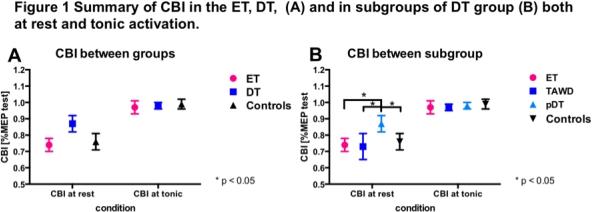 CBI in unaffected side was not different from the affected side in patients with pDT. For all patients, CBI negatively correlated with TETRAS ADL, TETRAS performance and TETRAS total score. (r=-0.44, p=0.04, r=-0.6, p<0.01, r=-0.57, p=0.01, respectively)
 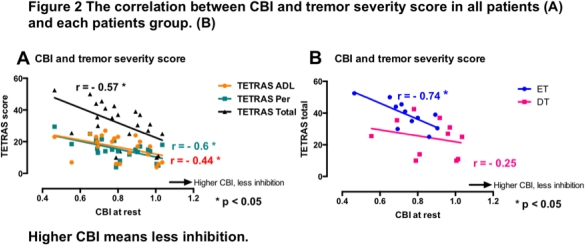 Considering the patient groups separately, there was a negative correlation between CBI at rest and TETRAS total score only in the patients with ET but not DT.
Conclusions: Our study suggests that there was less cerebellar brain inhibition in patients with DT especially pDT in both affected and unaffected sides than ET and controls. This could be due to an impaired efferent pathway of CTC or less cerebellar involvement in pDT but not in TAWD and ET. Physiology in TAWD is likely more similar to ET. The correlation between CBI and tremor severity score might support the impact of cerebellum in tremor generation only in ET but not DT.
To cite this abstract in AMA style:
P. Panyakaew, H.J. Cho, P. Srivanitchapoom, M. Hallett. Involvement of cerebellothalamocortical pathway in essential tremor and dystonic tremor [abstract]. Mov Disord. 2016; 31 (suppl 2). https://www.mdsabstracts.org/abstract/involvement-of-cerebellothalamocortical-pathway-in-essential-tremor-and-dystonic-tremor/. Accessed October 18, 2026.« Back to 2016 International Congress
MDS Abstracts - https://www.mdsabstracts.org/abstract/involvement-of-cerebellothalamocortical-pathway-in-essential-tremor-and-dystonic-tremor/