
Session Information
Date: Tuesday, June 6, 2017
Session Title: Huntington's Disease
Session Time: 1:45pm-3:15pm
Location: Exhibit Hall C
Objective: To examine central processing speed as an early marker of Huntington’s disease (HD) onset using the Computerized Test of Information Processing (CTiP).
Background: The CTiP, administered on a laptop, is a relatively simple and useful tool for evaluating the extent to which neurological conditions affect cognitive processing speed. It consists of three computerized reaction time (RT) subtests that progressively increase in task complexity – Simple RT (SRT); Choice RT (CRT), with an added decisional component; and Semantic Search RT (SSRT) with an added conceptual component.
Methods: Gene carriers (n=77) were categorized using the UHDRS Total Functional Capacity and Penny Burden of Pathology score as early pre-manifest, transitional (i.e. individuals close to disease onset or with very mild HD), or moderate HD. Subjects were administered the CTiP in addition to traditional cognitive assessments commonly used in HD. Central processing speed was measured using motor-corrected CRT and SSRT values. A one-way ANCOVA adjusting for age was used to compare group performance on the RT subtests.
Results: Moderate HD subjects showed significantly slower reaction times in all conditions (p<0.001), as compared to NC. Importantly, even transitional subjects showed significantly slower reaction times on the CRT (p<0.01) and SSRT (p<0.01), and in central cognitive processing, compared to NC. [table1] [table2]
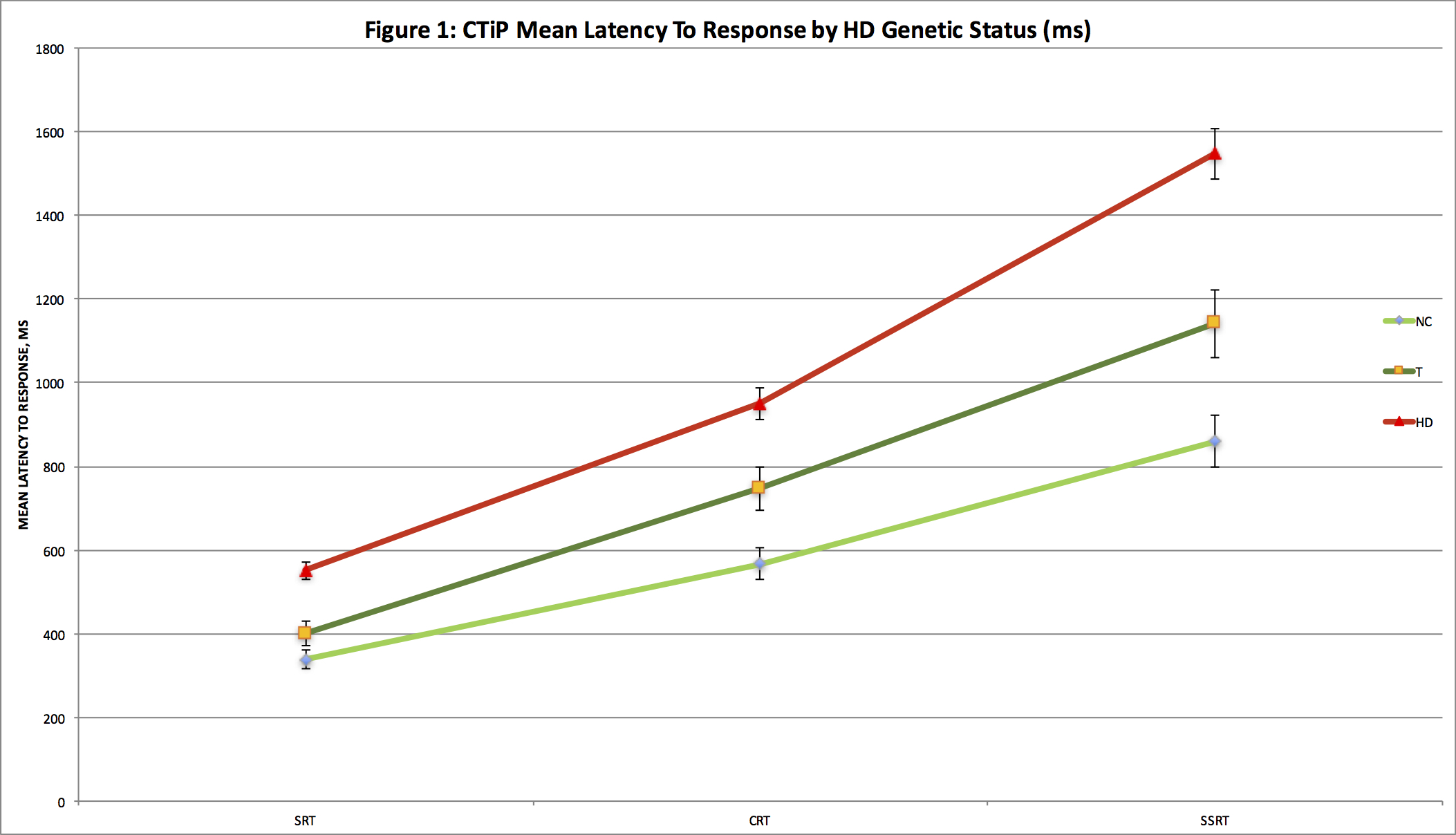
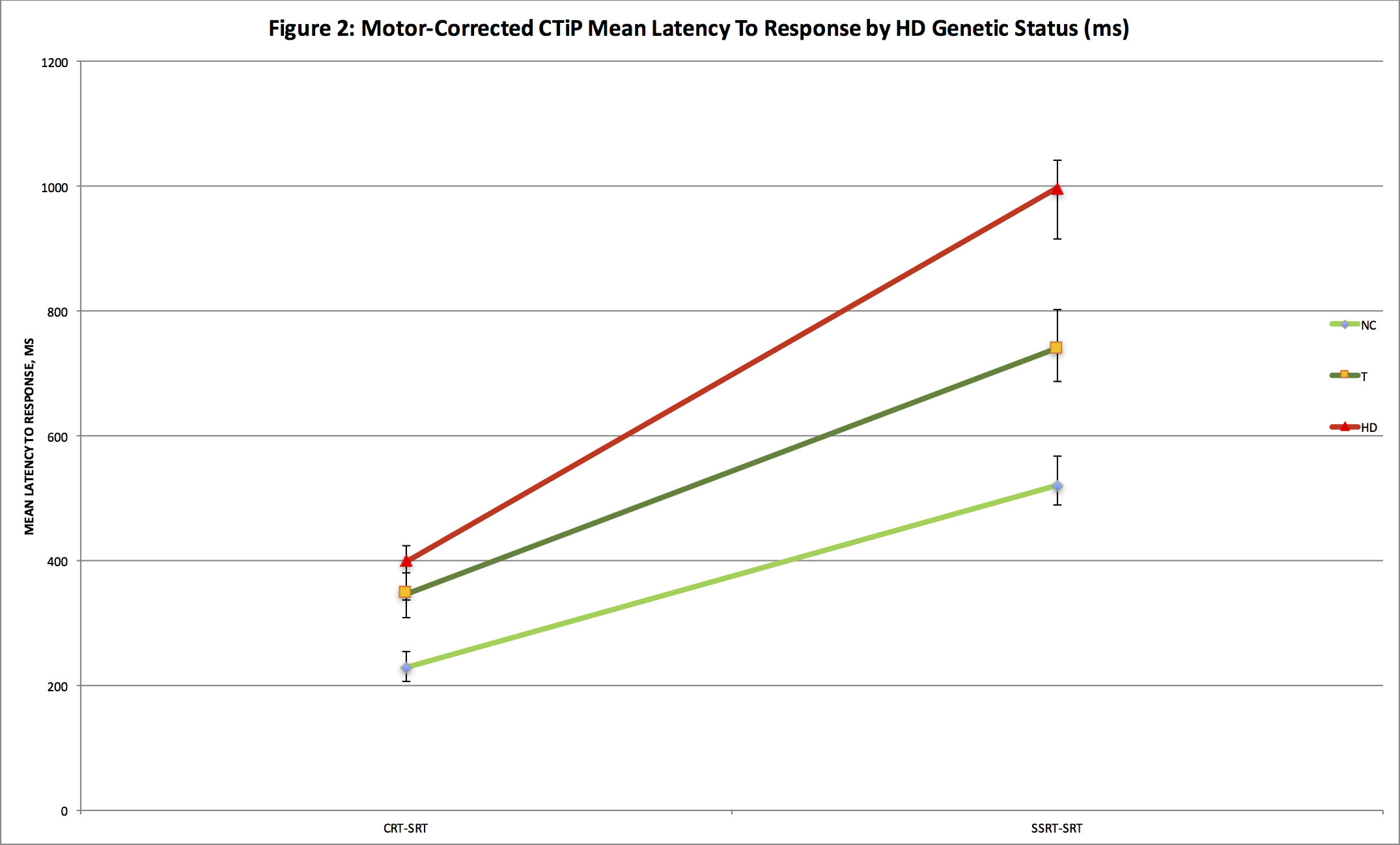
Conclusions: Our results suggest that the CTiP may be a useful and early marker of deficits in central cognitive processing in individuals with, and transitioning to, HD.
To cite this abstract in AMA style:
A. Nathan, S. Park, P. Gilbert, J. Corey-Bloom. Examining central cognitive processing speed as an early marker of Huntington’s disease (HD) onset [abstract]. Mov Disord. 2017; 32 (suppl 2). https://www.mdsabstracts.org/abstract/examining-central-cognitive-processing-speed-as-an-early-marker-of-huntingtons-disease-hd-onset/. Accessed October 3, 2026.« Back to 2017 International Congress
MDS Abstracts - https://www.mdsabstracts.org/abstract/examining-central-cognitive-processing-speed-as-an-early-marker-of-huntingtons-disease-hd-onset/