
Session Information
Date: Thursday, June 8, 2017
Session Title: Dystonia
Session Time: 1:15pm-2:45pm
Location: Exhibit Hall C
Objective: Evaluate the impact of injection interval on patient satisfaction with abobotulinumtoxinA (AboBoNT-A; Dysport®) over 1 injection cycle in patients with cervical dystonia (CD).
Background: The clinical benefits of botulinum neurotoxin type A (BoNT-A) typically peak within the first 2-3 weeks, and then gradually wear-off over the following months. While patient satisfaction is expected to match this time-course, patient expectations and management experience may also influence treatment satisfaction.
Methods: This analysis of the MetaCD database includes data from 2 of the 3 component observational studies (INTEREST IN CD2 & ANCHOR-CD), which both evaluated patient satisfaction with BoNT-A treatment. Subjects received 1 injection cycle and rated their highest level of satisfaction (i.e. at peak effect) during the treatment cycle. This analysis compared levels of satisfaction of AboBoNT-A-treated subjects categorized by injection interval.
Results: Of 124 AboBoNT-A-treated subjects new to BoNT, 94 (75.8%) were treated with an injection interval of 12-16 weeks, 18 (14.5%) with >16-week interval and 6 (4.8%) with <12-week interval; data were missing for 6 subjects. A further 719 AboBoNT-A-treated subjects had been previously treated with a BoNT. Of these, 487 (67.7%) were treated with an injection interval of 12-16 weeks, 200 (27.8%) with >16-week interval and 20 (2.8%) with <12-week interval; data were missing for 12 subjects. Patient satisfaction was very high across all injection intervals, regardless of previous BoNT treatment [Table 1].
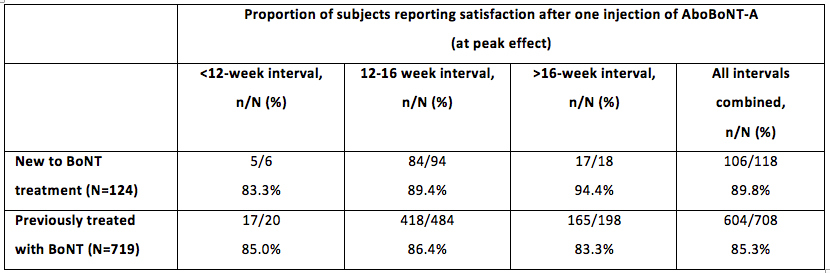
Conclusions: These observations indicate that satisfaction with AboBoNT-A treatment is consistently high. The majority of subjects treated with AboBoNT-A had injection intervals ≥12 weeks, with 27.8% of previously treated subjects having an interval >16 weeks. The lack of subjects with an interval <12 weeks precludes any robust conclusions for this short interval. Factors other than direct AboBoNT-A effect, including patient expectations, may also play a role in the reported satisfaction rates.
To cite this abstract in AMA style:
R. Trosch, V. Misra, P. Maisonobe, S. Om. Impact of injection interval on patient satisfaction in the routine treatment of cervical dystonia with abobotulinumtoxinA [abstract]. Mov Disord. 2017; 32 (suppl 2). https://www.mdsabstracts.org/abstract/impact-of-injection-interval-on-patient-satisfaction-in-the-routine-treatment-of-cervical-dystonia-with-abobotulinumtoxina/. Accessed November 9, 2026.« Back to 2017 International Congress
MDS Abstracts - https://www.mdsabstracts.org/abstract/impact-of-injection-interval-on-patient-satisfaction-in-the-routine-treatment-of-cervical-dystonia-with-abobotulinumtoxina/