
Session Information
Date: Thursday, June 8, 2017
Session Title: Dystonia
Session Time: 1:15pm-2:45pm
Location: Exhibit Hall C
Objective: To explore the mechanism of action of a sensory trick by comparing cerebral oscillations at network level, with a sensory trick and administration of botulinum toxin, using MEG in a patient with cervical dystonia.
Background: Up to 83% of cervical dystonia patients note partial to complete benefit with a sensory trick. Parietal cortex, a region associated with multimodal sensory integration, has been reported to be hyperactive during execution of the sensory trick.
Methods:
MEG data was collected on a patient with cervical dystonia with a definite and effective sensory trick, in the form of a yawn. Patient was scheduled for a MEG scan, pre and post Botulinum toxin injection and pre and post yawn.
For each cortical model site, coherence is defined as the oscillations of neural activity and their synchronization with all other active network sources, and further averaged over frequencies. Coherence imaging was performed to quantify default mode network connectivity of subjects.
Results:
Pre and post Yawn, pre and post injection
Beta levels decreased and gamma increased after yawn. Left cerebellar activity is seen pre yawn followed by activity in the Right cerebellar region post yawn.
Differences with yawn, pre injection
Maximal changes were see in the following locations for pre yawn: Left Medial Occipital Gyrus, lingual and cerebellar regions. Post yawn changes were seen in the Left lingual, parahippocampus regions.
Differences with yawn, post injection
Maximal changes were see in the following locations for pre yawn: Left Cerebellum and middle occipital areas. Post yawn changes were seen in the Left Superior Marginal and angular gyri.
Pre and Post injection, no sensory trick
Beta levels increased and gamma levels stayed the same after injection. Left cerebellar activity stays unchanged post injection but activity in the Right cerebellar region increases.
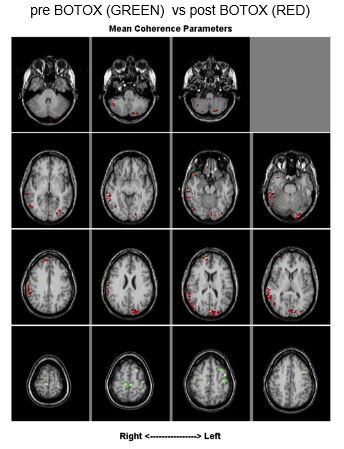
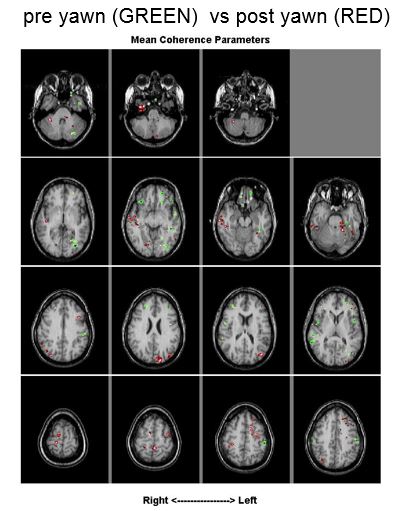
Conclusions: Prior hypothesis suggests that sensory tricks act via faulty proprioception by enhancing pathways between the occipital and parietal lobes. Our study shows hyper excitability in the parietal cortex with sensory trick. An increase in gamma levels perhaps indicate increasing GABAergic activity. Moreover, we note an increase in activity in the Right cerebellar region post sensory trick and post injection, perhaps even indicating a common sensory pathway for neuronal activation.
References: 1. Patel N, Hanfelt J, Marsh L, Jankovic J. Alleviating manoeuvres (sensory tricks) in cervical dystonia. Journal of neurology, neurosurgery, and psychiatry. 2014;85(8):882-884. doi:10.1136/jnnp-2013-307316. 2. Elisevich K, Shukla N, Moran J, et al. An Assessment of MEG Coherence Imaging in the Study of Temporal Lobe Epilepsy. Epilepsia. 2011;52(6):1110-1119. doi:10.1111/j.1528-1167.2011.02990.x.
To cite this abstract in AMA style:
A. Mahajan, A. Zillgitt, S. Bowyer, C. Sidiropoulos. Sensory trick in a dystonic patient: insights from Magnetoencephalogram [abstract]. Mov Disord. 2017; 32 (suppl 2). https://www.mdsabstracts.org/abstract/sensory-trick-in-a-dystonic-patient-insights-from-magnetoencephalogram/. Accessed October 18, 2026.« Back to 2017 International Congress
MDS Abstracts - https://www.mdsabstracts.org/abstract/sensory-trick-in-a-dystonic-patient-insights-from-magnetoencephalogram/