
Session Information
Date: Monday, September 23, 2019
Session Title: Rare Genetic and Metabolic Diseases
Session Time: 1:45pm-3:15pm
Location: Les Muses Terrace, Level 3
Objective: To highlight a less recognised but characteristic manifestation of ATP1A3-related disease.
Background: ATP1A3 mutations cause a wide clinical spectrum, and are one of the “commoner rare diseases”.
Method: Case series of four patients with ATP1A3 mutations.
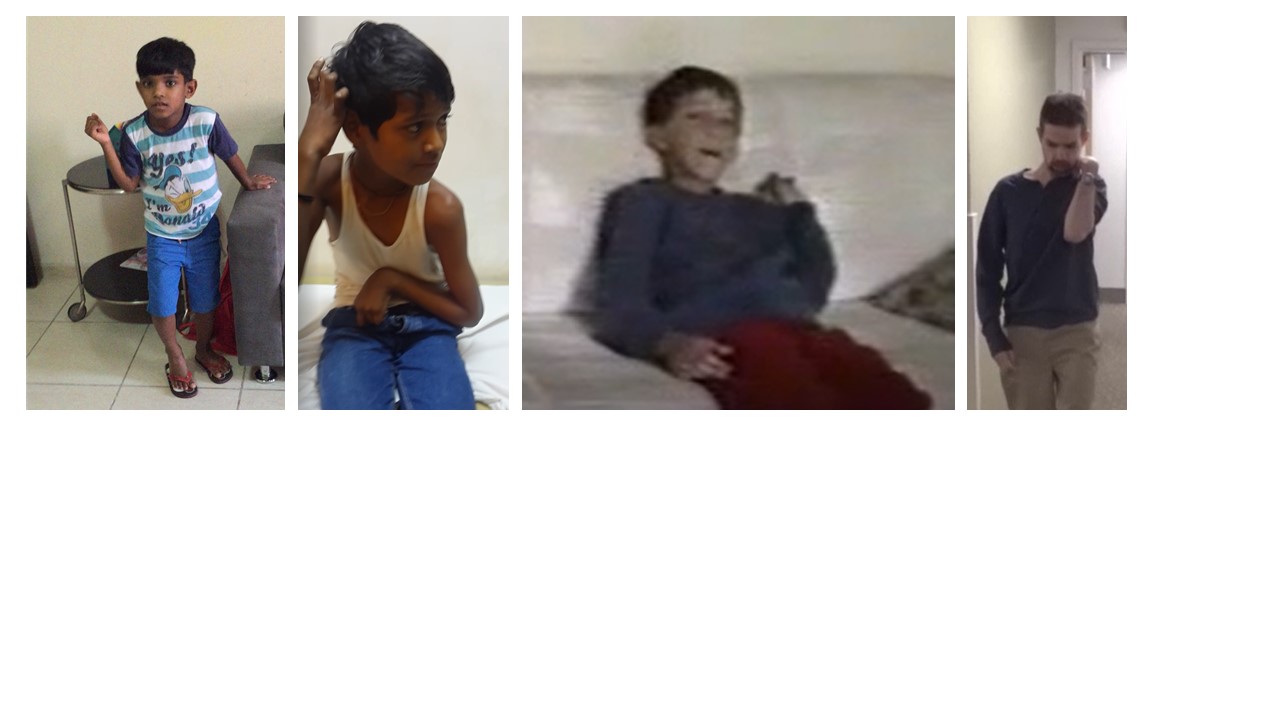
Results: The patients displayed characteristic episodes of dystonic arm posturing, involving a dystonic, flexed arm held in front of the body, or held close to the body but with the hand raised upwards (see figure). Other attacks manifest with arm extension, either beside the body or reaching upwards. Dystonic posturing occurred paroxysmally, with no neurological signs between attacks, or combined with other signs like chorea, ataxia and hypotonia.
Conclusion: While previous diagnostic criteria have not included paroxysmal or episodic dystonia, recent expert consensus has proposed to include alternating or paroxysmal dystonia as major feature calling for ATP1A3 genetic testing. Attacks of marked arm flexion posturing, either paroxysmal or as episodic exacerbation of mild pre-existent dystonia, are a characteristic clue to ATP1A3-related disease.
To cite this abstract in AMA style:
B. Balint, C. Stephen, V. Udani, C. Sankhla, N. Barad, A. Lang, K. Bhatia. Paroxysmal asymmetric dystonic arm posturing – a less recognised but characteristic manifestation of ATP1A3-related disease [abstract]. Mov Disord. 2019; 34 (suppl 2). https://www.mdsabstracts.org/abstract/paroxysmal-asymmetric-dystonic-arm-posturing-a-less-recognised-but-characteristic-manifestation-of-atp1a3-related-disease/. Accessed October 23, 2026.« Back to 2019 International Congress
MDS Abstracts - https://www.mdsabstracts.org/abstract/paroxysmal-asymmetric-dystonic-arm-posturing-a-less-recognised-but-characteristic-manifestation-of-atp1a3-related-disease/