
Category: Tremor
Objective: Essential tremor (ET) is one of the most prevalent neurological disorders and has increasingly been linked to cognitive dysfunction. However, most existing data regarding cognitive impairment in ET are derived from cross-sectional studies, focusing mainly on prevalence. Longitudinal data addressing the natural course, progression, and clinical outcomes particularly conversion from mild cognitive impairment (MCI) to dementia remain limited.
Background:
To determine the rate of progression from mild cognitive impairment (MCI) to dementia among elderly patients with essential tremor during an 18-month follow-up period.
Method:
This prospective longitudinal study included 233 elderly patients with essential tremor recruited from the Movement Disorders Units of Al-Azhar University Hospitals and Cairo Fatemic Hospital. The study was conducted over an 18-month period, from January 2023 to June 2024. All participants underwent a comprehensive neuropsychological assessment at baseline (T1), at 9 months (T2), and at 18 months (T3). Based on clinical and cognitive evaluations, patients were classified as having normal cognition (ET-NC), mild cognitive impairment (ET-MCI), or dementia (ET-D).
Results: At baseline, 48 of 233 patients (20.6%) were diagnosed with ET-MCI and were eligible for longitudinal follow-up. At the 9-month assessment (T2), 6 of 48 patients (12.5%) had converted from ET-MCI to ET-dementia. Among the remaining 42 ET-MCI patients, follow-up at 18 months (T3) revealed that 11 patients (26.2%) had progressed to dementia.
The calculated average annual conversion rate from ET-MCI to ET-dementia was approximately 12–13%.
Conclusion: Cognitive impairment in essential tremor remains an emerging area of research with limited longitudinal evidence. In this Egyptian cohort, the annual conversion rate from ET-MCI to dementia was notably higher than rates previously reported in historical control populations (2.6–6.3%). These findings provide clinically relevant longitudinal data that may help guide prognosis, patient counseling, and future research in essential tremor–related cognitive decline.
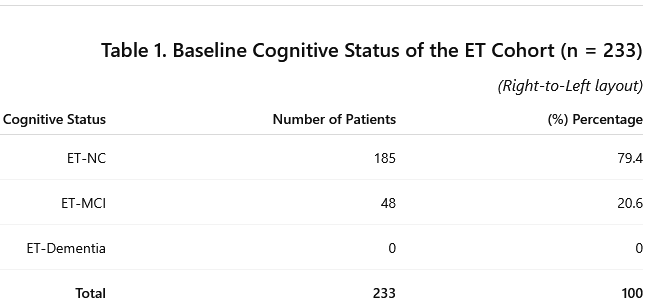
Table 1
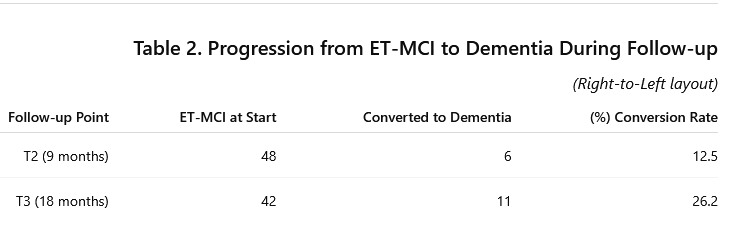
Table
To cite this abstract in AMA style:
E. Abed. Cognitive Progression in Elderly Essential Tremor Patients: Evidence from an 18-Month Prospective Cohort [abstract]. Mov Disord. 2026; 41 (suppl 1). https://www.mdsabstracts.org/abstract/cognitive-progression-in-elderly-essential-tremor-patients-evidence-from-an-18-month-prospective-cohort/. Accessed October 1, 2026.« Back to 2026 International Congress
MDS Abstracts - https://www.mdsabstracts.org/abstract/cognitive-progression-in-elderly-essential-tremor-patients-evidence-from-an-18-month-prospective-cohort/