
Category: Parkinsonism (Other)
Objective: To describe the course of a patient with an inherited IRF2BPL variant presenting as adult-onset indolent ataxia and tremor with no prior developmental abnormalities, expanding the phenotypic understanding of this rare condition.
Background: IRF2BPL-related disorders have only recently been identified, exhibiting a wide range of symptoms, including developmental regression, intellectual disability, seizures, abnormal MRI findings, and movement disorders such as ataxia, chorea, tremor, dystonia, and gait impairment.[1] Although de novo mutations account for most instances, inherited cases have been reported less frequently. Previously thought to be primarily childhood-onset, adult-onset cases have recently emerged,[2] however to date, there are few longitudinal accounts of later-onset presentations.
Method: We performed a retrospective chart review of longitudinal data of a patient with a confirmed IRF2BPL variant. We obtained detailed histories and serial examinations during subsequent follow-ups over five years at a tertiary movement disorders clinic.
Results: The patient is a 49-year-old female episodic vertigo starting in her early 30s, followed by progressive gait ataxia and falls, tremor, oblique diplopia, dysarthria, generalized tonic-clonic seizures, and paresthesias. Her mother, brother, aunt, and uncle exhibited similar symptoms in adulthood, however no personal or family history of developmental delay. Examinations showed pharyngeal dysarthria, horizontal nystagmus, dysmetria and dysdiadochokinesia, hypoesthesia in stocking distribution, and wide-based ataxic gait. Whole-exome sequencing showed two IRF2BPL variants consistent with autosomal dominant inheritance, shared by affected family members. MRI brain showed subtle cerebellar atrophy disproportionate to her functional decline.
Conclusion: This case illustrates the longitudinal clinical course of an adult-onset IRF2BPL-related movement disorder, expanding on previous reports. These rare disorders provide a diagnostic challenge, given they may mimic more common neurodegenerative, mitochondrial, or paraneoplastic ataxias. When evaluating patients with unexplained ataxia, consider whole exome sequencing even in the absence of early-life symptoms, given that these variants are not part of standard ataxia panels.
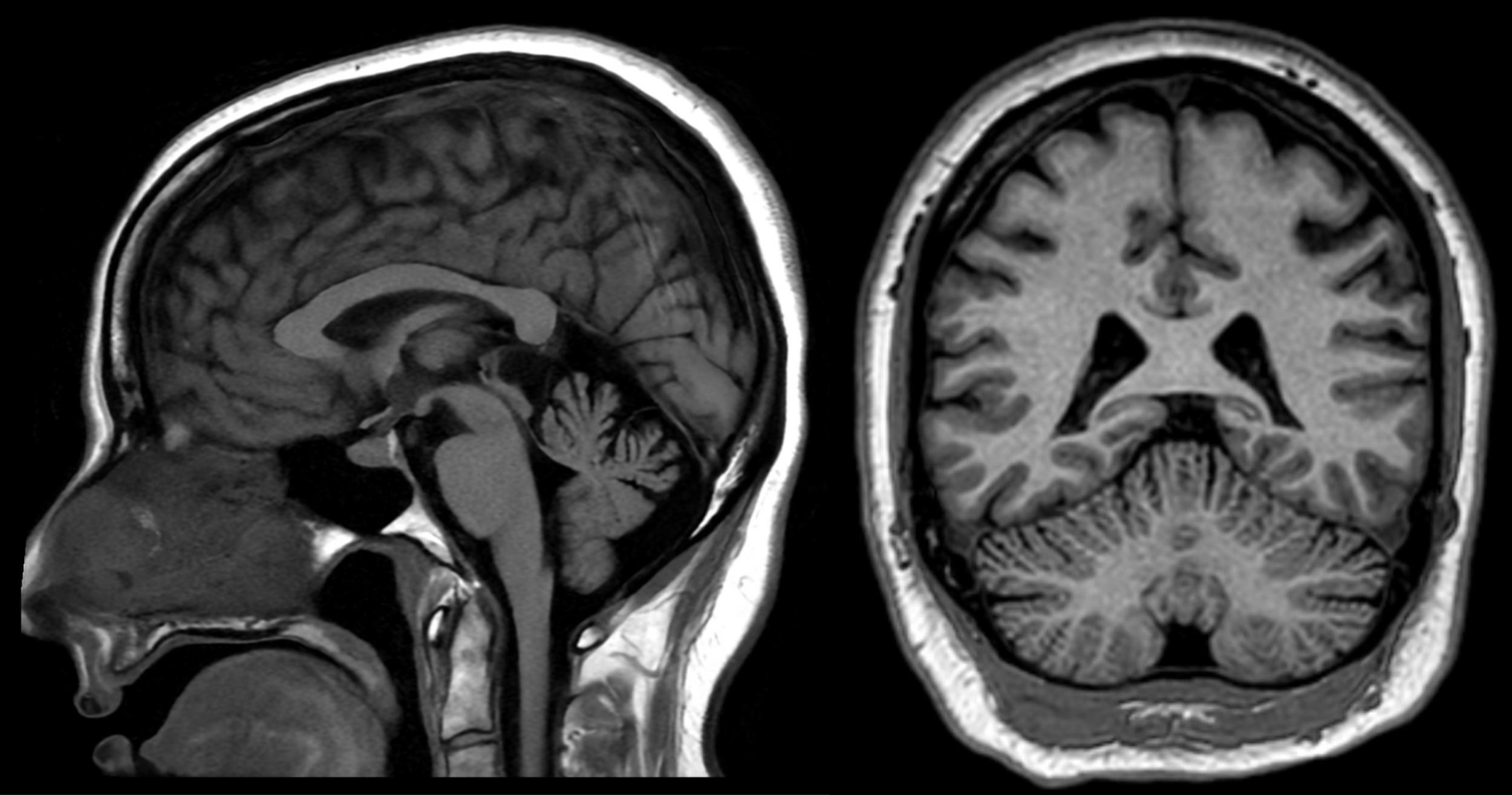
T1-weighted MRI showing mild cerebellar atrophy
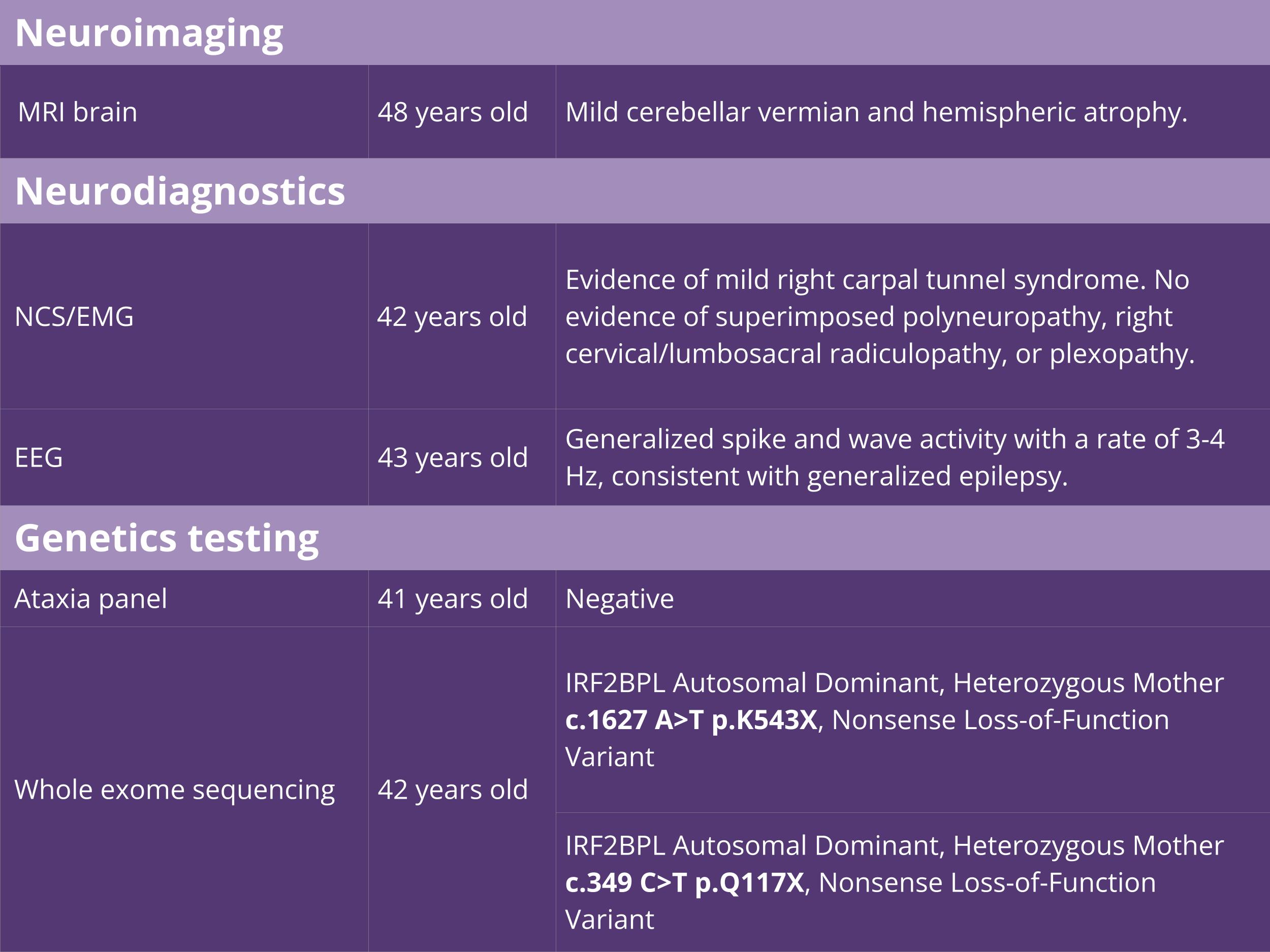
Summary of relevant diagnostics
References: 1. Vanagunas T, Seiwert EU, Larsh TR, Marcogliese PC, Pena LD. IRF2BPL-related disorder. In: Adam MP, Feldman J, Mirzaa GM, et al, eds. GeneReviews®. University of Washington, Seattle; November 21, 2024. Accessed April 11, 2025. https://www.ncbi.nlm.nih.gov/books/NBK609461/
2. Alatrash S, Street D, O’Driscoll M, Samra AD. Late-onset ataxia, chorea, cognitive impairment, and insomnia: expanding the phenotype of IRF2BPL-related disease. J Mov Disord. 2025;18(3):274-276. doi:10.14802/jmd.25030
To cite this abstract in AMA style:
S. de Groot, W. Rai. A Longitudinal Case of Adult-Onset Progressive Ataxia in a Patient with a Pathogenic Variant of IRF2BPL [abstract]. Mov Disord. 2026; 41 (suppl 1). https://www.mdsabstracts.org/abstract/a-longitudinal-case-of-adult-onset-progressive-ataxia-in-a-patient-with-a-pathogenic-variant-of-irf2bpl/. Accessed October 1, 2026.« Back to 2026 International Congress
MDS Abstracts - https://www.mdsabstracts.org/abstract/a-longitudinal-case-of-adult-onset-progressive-ataxia-in-a-patient-with-a-pathogenic-variant-of-irf2bpl/