
Category: Patient Perspectives
Objective: To characterize nutrition and food related concerns identified during supportive care visits for individuals with Parkinson’s disease (PD) and related disorders.
Background: Individuals with PD and related disorders benefit from holistic wellness support. Since December 2023, we have operated a supportive care clinic offering a patient-centered setting where individuals discuss concerns and wellness strategies. Nutrition is a common concern, but we currently lack a standardized framework to capture the multiple factors affecting diet and nutrition. Issues such as constipation, weight change, meal access barriers, and swallowing difficulties are often addressed separately rather than within a unified nutrition construct.
Method: We retrospectively reviewed 200 supportive care encounters conducted between 2023 to January 2026, and identified 51 involving nutrition or food-related questions. These 51 encounters were reviewed in detail, and categorized into four domains: constipation, weight loss, difficulty preparing or accessing meals, and general nutrition inquiry. Swallowing emerged as a fifth domain during chart review. Demographic variables included age, gender, ethnicity, diagnosis, and ZIP code as a proxy for socioeconomic status (SES). Associations between age and nutrition domains were assessed using t-tests and multivariable logistic regression; gender and SES differences using chi-square tests; and swallowing by diagnostic subtype using Fisher’s exact test.
Results: Demographic and statistical findings documented in [table1]. Constipation was associated with older age. Meal access did not differ by SES, suggesting non-financial contributors. Swallowing concerns were more common in atypical parkinsonism, and the low documentation in PD suggests possible under-identification when nutrition is assessed without explicit dysphagia framing.
Conclusion: One-quarter of patients and families reported nutrition-related concerns across five domains. Food and nutrition are central to perceptions of health and often become priorities when illness disrupts daily routines. Our findings support the development of a targeted questionnaire to systematically assess nutrition and dysphagia within supportive care models, with the goal of improving early identification of modifiable risk factors.
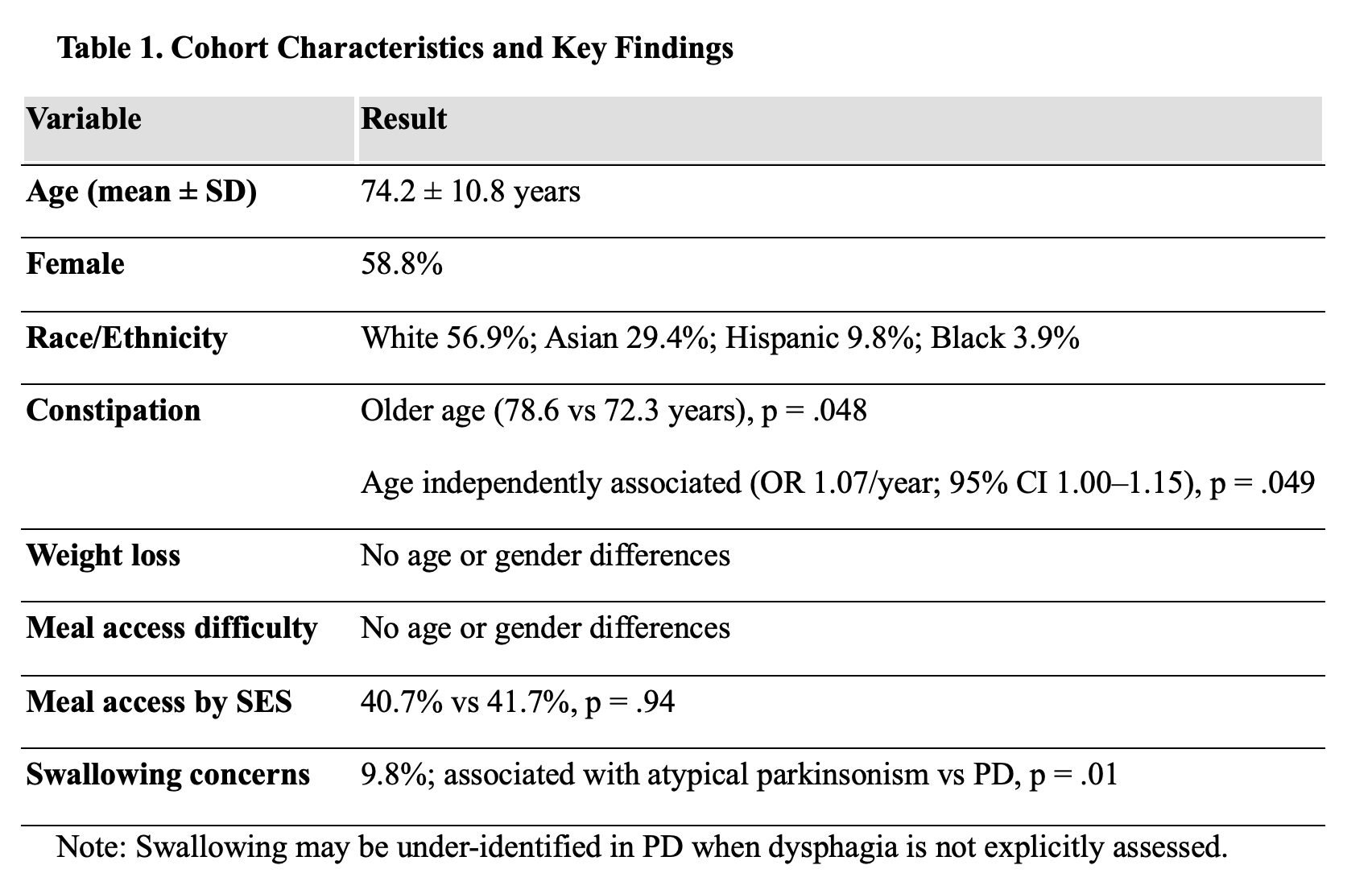
Cohort Characteristics and Key Findings
References: Bianchi VE, Rizzi L, Somaa F. The role of nutrition on Parkinson’s disease: a systematic review. Nutritional Neuroscience. 2022;26(7):1-24. doi:https://doi.org/10.1080/1028415x.2022.2073107
Mischley LK, Lau RC, Bennett RD. Role of Diet and Nutritional Supplements in Parkinson’s Disease Progression. Oxidative Medicine and Cellular Longevity. 2017;2017:1-9. doi:https://doi.org/10.1155/2017/6405278
Ó Breasail M, Smith MD, Tenison E, Henderson EJ, Lithander FE. Parkinson’s disease: the nutrition perspective. Proceedings of the Nutrition Society. 2022;81(1):12-26. doi:10.1017/S0029665121003645
Tennant R, Hiller L, Fishwick R, Platt S, Joseph S, Weich S, Parkinson J, Secker J, Stewart-Brown S. The Warwick-Edinburgh Mental Well-being Scale (WEMWBS): development and UK validation. Health Qual Life Outcomes. 2007;5:63. doi:10.1186/1477-7525-5-63
Seidl SE, Santiago JA, Bilyk H, Potashkin JA. The emerging role of nutrition in Parkinson’s disease. Frontiers in Aging Neuroscience. 2014;6. doi:https://doi.org/10.3389/fnagi.2014.00036
To cite this abstract in AMA style:
N. Hellmers, B. Katz, M. Bruno, H. Sarva. Nutrition and Dietary Assessment as a Wellness Factor in Parkinson’s Disease and Related Disorders [abstract]. Mov Disord. 2026; 41 (suppl 1). https://www.mdsabstracts.org/abstract/nutrition-and-dietary-assessment-as-a-wellness-factor-in-parkinsons-disease-and-related-disorders/. Accessed October 1, 2026.« Back to 2026 International Congress
MDS Abstracts - https://www.mdsabstracts.org/abstract/nutrition-and-dietary-assessment-as-a-wellness-factor-in-parkinsons-disease-and-related-disorders/