
Category: Parkinson's Disease: Surgical Therapy
Objective: To report a case of Parkinson’s disease (PD) in which two ablative procedures were performed without prior dopaminergic therapy, followed by significant clinical improvement after initiation of appropriate medical treatment.
Background: Functional ablative procedures such as thalamotomy and pallidotomy are typically reserved for patients with advanced PD whose symptoms remain disabling despite optimized pharmacological therapy. Demonstration of levodopa responsiveness is a fundamental step in selecting candidates for functional neurosurgery. Deviation from this treatment pathway may result in unnecessary surgical intervention and may complicate future neuromodulation strategies.
Method: We present a 52-year-old male, former police officer, with an 8-year history of PD. The patient underwent left thalamotomy in 2023 and right pallidotomy in 2025 at another institution. Notably, the patient had never received levodopa or other dopaminergic medications prior to these procedures. Upon presentation to our center, neurological assessment was performed using the Unified Parkinson’s Disease Rating Scale (UPDRS). Standard dopaminergic therapy was initiated and the patient was followed for three months.
Results: At baseline evaluation, the patient demonstrated severe motor impairment with a UPDRS score of 71. After initiation of dopaminergic therapy, substantial clinical improvement was observed. At three-month follow-up, the UPDRS score improved to 31, representing a 40-point reduction and marked functional recovery. Despite this improvement, prior ablative lesions altered basal ganglia circuitry and may complicate potential future deep brain stimulation (DBS) targeting and programming.
Conclusion: This case emphasizes the importance of adequate pharmacological evaluation before considering functional ablative surgery in Parkinson’s disease. The pronounced response to dopaminergic therapy indicates that appropriate first-line treatment had not been attempted prior to surgical intervention. Premature ablative procedures may not only be unnecessary but may also limit or complicate future neuromodulation strategies such as DBS.
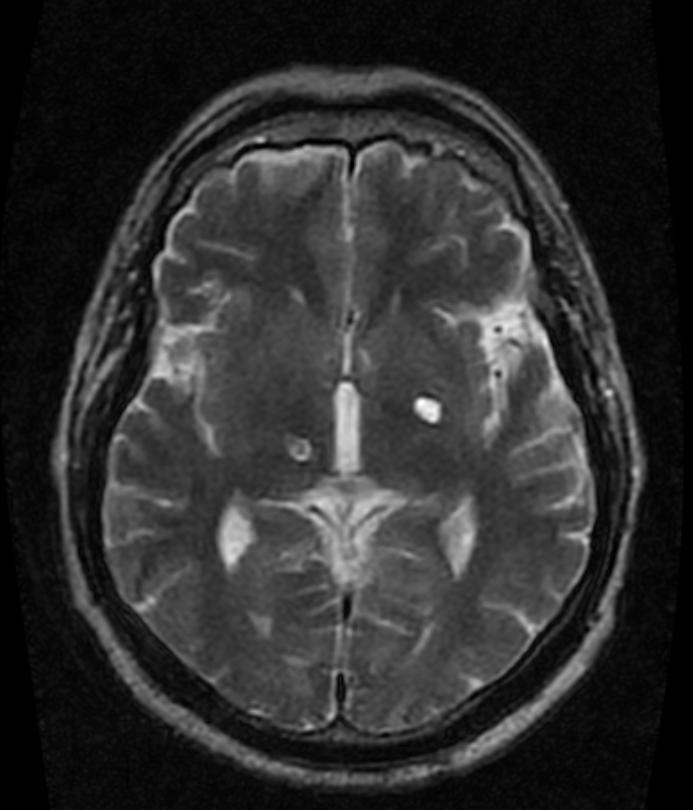
Axial MRI
To cite this abstract in AMA style:
B. Mukhammedaminov, N. Aripova, Y. Nishonova. Unnecessary Ablative Surgery in an Untreated Parkinson’s Disease Patient: Marked Clinical Improvement After Initiation of Dopaminergic Therapy [abstract]. Mov Disord. 2026; 41 (suppl 1). https://www.mdsabstracts.org/abstract/unnecessary-ablative-surgery-in-an-untreated-parkinsons-disease-patient-marked-clinical-improvement-after-initiation-of-dopaminergic-therapy/. Accessed October 1, 2026.« Back to 2026 International Congress
MDS Abstracts - https://www.mdsabstracts.org/abstract/unnecessary-ablative-surgery-in-an-untreated-parkinsons-disease-patient-marked-clinical-improvement-after-initiation-of-dopaminergic-therapy/