
Category: Ataxia
Objective: Spinocerebellar ataxia (SCA) is a group of neurodegenerative disorders. More than 40 microsatellite repeat loci have been associated with ataxia. The GCA repeat expansion in 5’UTR of the GLS gene in homozygous or compound heterozygous condition can cause ataxia and developmental delay with other clinical symptoms. In this study we explored the prevalence of expanded GCA repeats in the GLS gene in the North Indian SCA population.
Background: Worldwide, 20-60% of SCA cases are genetically uncharacterized (1). Kuilenburg et al. identified GCA tandem repeat expansion in 5’UTR of the GLS gene in three early-onset unrelated patients with overall developmental delay, progressive ataxia, and elevated levels of glutamine (2). The GLS gene encodes the brain and kidney-specific catalyst glutaminase and variations in the gene can cause physiological and structural abnormalities of the central nervous system (3,4,5).
Method: With consent 1305 SCA cases, negative for common SCA subtypes were enrolled. Blood samples were collected at department of Neurology, AIIMS and genetic screening was carried out at CSIR-IGIB. The samples were divided into 2 groups based on inheritance pattern and age of disease onset. Amplification of GCA repeat was performed using flanking PCR with labeled primers and analyzed using fragment analyzer. Samples with homozygous peaks were screened using repeat primed PCR for any possible large expansion.
Results: We did not observe any large GCA repeat expansion in the analyzed samples. Group-1 showed a repeat distribution from 4 to 33 GCA repeats; however, group-2 showed 4 to 31 GCA with the mode of 11 repeats. Data showed the bi-allelic distribution of 7 and 13 repeats in both the patient groups and controls. We also compared the repeat data with 1000 genome ethnic populations (6). Supporting the ethnic background, the mode of repeats found in our samples was high and in concordance with the SAS population compared to other populations (Fig-1). We can predict that repeat variability is high in our population.
Conclusion: We made efforts to find the frequency of large GCA repeat expansion in the GLS gene in the Indian SCA patient cohort among different age groups and inheritance patterns. We did not observe any significant GCA repeat variability. Overall, the study suggested that GLS gene repeat expansion mutation rarely present in our SCA patient population and needs to be further explored.
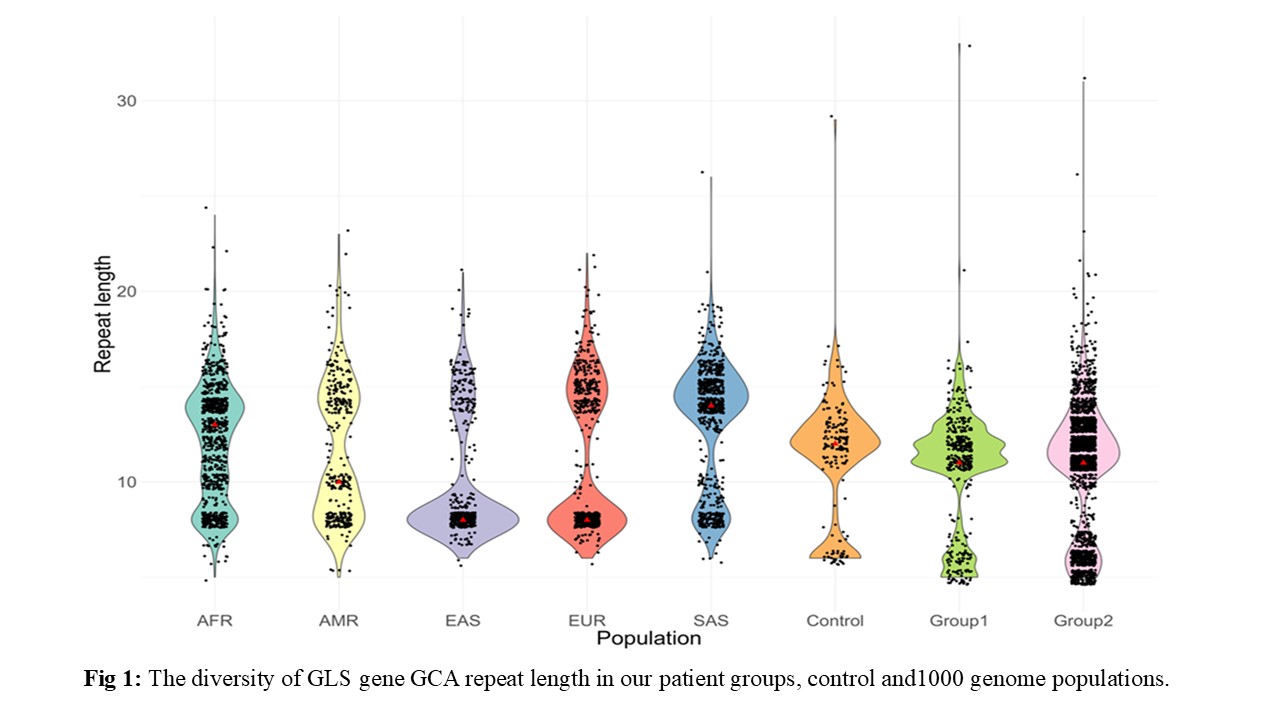
Figure 1
References: 1. Perlman S. Hereditary Ataxia Overview. 1998 Oct 28 [Updated 2022 Jun 16]. In: Adam MP, Mirzaa GM, Pagon RA, et al., editors. GeneReviews [Internet]. Seattle (WA): University of Washington, Seattle; 1993-2023. https://www.ncbi.nlm.nih.gov/books/NBK1138/
2. Van Kuilenburg, A. B. P., Tarailo-Graovac, M., Richmond, P. A., Drogemoller, B. I., Poµladi, M. A., Leen, R., Brand-Arzamendi, K., Dobritzsch, D., Dolzhenko, E., Eberle, M. A., Hayward, B., Jones, M. J., and 33 others. Glutaminase deficiency caused by short tandem repeat expansion in GLS. New Eng. J. Med. 380: 1433- 1441, 2019.
3. Lynch, D. S., Chelban, V., Vandrovcova, J., Pittman, A., Wood, N. W., Hoµlden, H.,2018. GLS loss of function causes autosomal recessive spastic ataxia and optic atrophy. Ann. Clin. Transl. Neurol. 5: 216-221.
4. Rumping, L., Buttner, B., Maier, O., Rehmann, H., Lequin, M., Schlump, J.-U., Schmitt, B., Schiebergen-Bronkhorst, B., Prinsen, H. C. M. T., Losa, M., Fingerhut, R., Lemke, J. R., Zwartkruis, F. J. T., Houwen, R. H. J., Jans, J. J. M., Verhoeven-Duif, N. M., van Hasselt, P. M., Jamra, R.,2019. Identification of a loss-of-function mutation in the context of glutaminase deficiency and neonatal epileptic encephalopathy. JAMA Neurol. 76: 342-350.
5. Rumping, L., Tessadori, F., Pouwels, P. J. W., Vringer, E., Wijnen, J. P., Bhogal, A. A., Savelberg, S. M. C., Duran, K. J., Bakkers, M. J. G., Ramos, R. J. J., Schellekens, P. A. W., Kroes, H. Y., and 16 others, 2019. GLS hyperactivity causes glutamate excess, infantile cataract and profound developmental delay. Hum. Molec. Genet. 28: 96-104.
6. 1000 Genomes Project Consortium. (2015). A global reference for human genetic variation. Nature, 526(7571), 68.
To cite this abstract in AMA style:
V. Suroliya, M. Kumar, B. Uppili, AK. Srivastava, M. Faruq. Assessment of GCA repeat expansion in the GLS gene among Indian patients with Spinocerebellar Ataxia [abstract]. Mov Disord. 2026; 41 (suppl 1). https://www.mdsabstracts.org/abstract/assessment-of-gca-repeat-expansion-in-the-gls-gene-among-indian-patients-with-spinocerebellar-ataxia/. Accessed October 1, 2026.« Back to 2026 International Congress
MDS Abstracts - https://www.mdsabstracts.org/abstract/assessment-of-gca-repeat-expansion-in-the-gls-gene-among-indian-patients-with-spinocerebellar-ataxia/