
Category: Pediatric Movement Disorders
Objective: To evaluate longitudinal neurological disease progression in the largest available worldwide cohort of adults with ataxia-telangiectasia.
Background: Ataxia-telangiectasia (AT) is a rare, multisystem neurodegenerative disorder with marked clinical heterogeneity. Longitudinal data on neurological progression remain limited, restricting understanding of disease mechanisms and therapeutic trial design.
Method: We analysed longitudinal Scale for the Assessment and Rating of Ataxia (SARA) data from the largest published adult AT cohort to date (n=82, age >16 years). Linear mixed-effects models were used to estimate baseline severity at the time of diagnosis and annual progression rates in classic and variant AT, and to examine clinical and genetic modifiers.
Results: Neurological impairment progressed with a mean SARA increase of 0.38 points per year. Adults with classic AT were more severely than those with variant AT, with SARA scores approximately 9–10 points higher. However neurological progression in adulthood was similar between classic and variant AT (0.33 vs 0.41 points/year), including 15 individuals with the antisense oligonucleotide targetable c.5763-1050A>G variant.
Conclusion: Although AT subtypes differ substantially in childhood and adolescence, neurological decline converges to a similar pace in adulthood, irrespective of subtype or genotype. SARA remains a useful outcome measure but may underestimate progression in advanced disease and non-cerebellar domains. These findings inform counselling, prognostication, and the design of interventional trials, including mutation-specific therapies
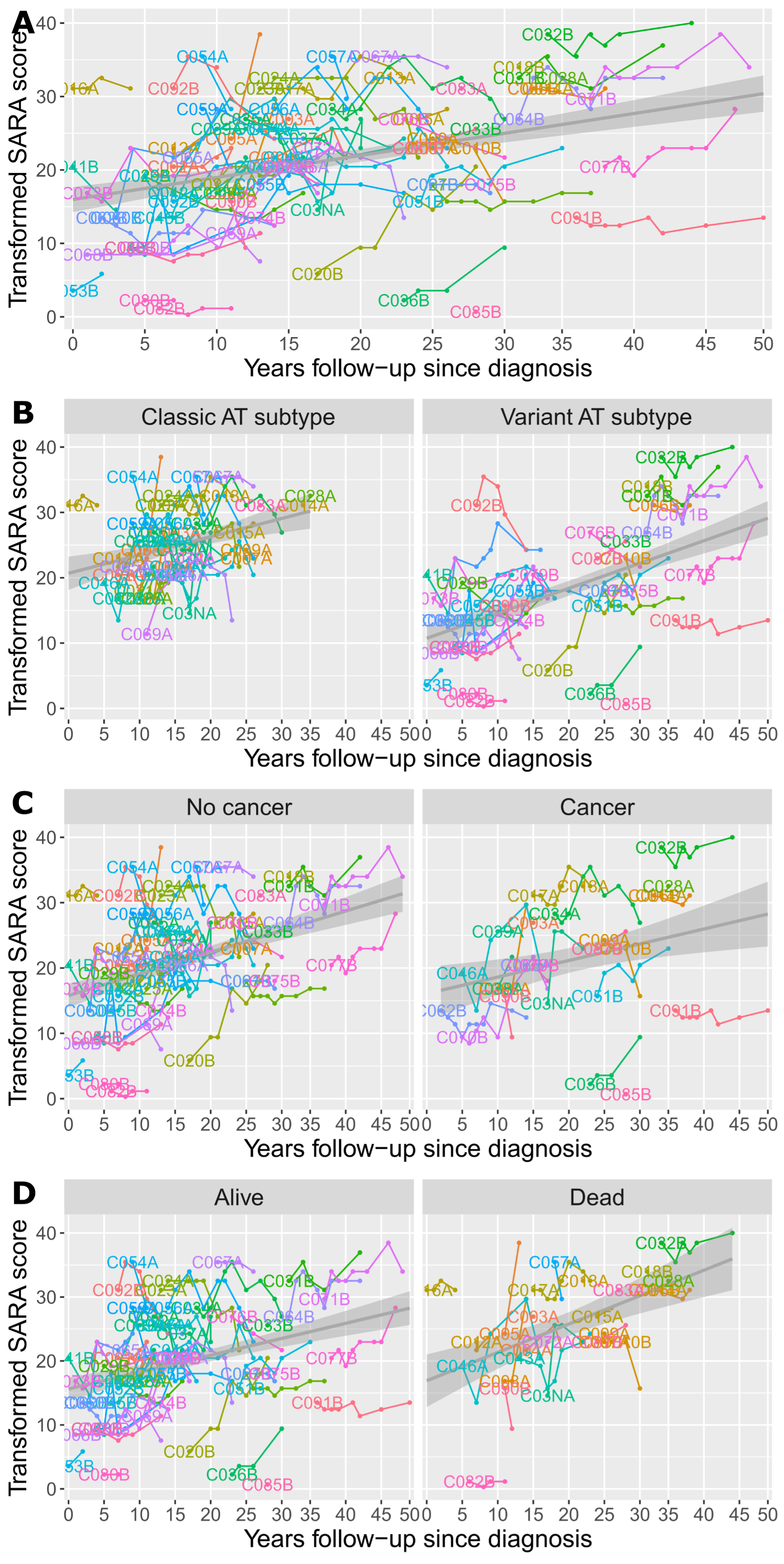
Longitudinal SARA trajectories per participant
References: 1. Rothblum-Oviatt C, Wright J, Lefton-Greif MA, McGrath-Morrow SA, Crawford TO, Lederman HM. Ataxia telangiectasia: a review. Orphanet J Rare Dis. 2016;11(1):159.
2. Taylor AMR, Rothblum-Oviatt C, Ellis NA, et al. Chromosome instability syndromes. Nat Rev Dis Primers 2019;5(1):64.
3. Tiet MY, Horvath R, Hensiek AE. Ataxia telangiectasia: What the neurologist needs to know. Pract Neurol. 2020;20(5):404–414.
4. Schon K, van Os NJH, Oscroft N, et al. Genotype, extrapyramidal features, and severity of variant ataxia-telangiectasia. Ann Neurol. 2019;85(2),170–180.
5. van Os NJH, Haaxma CA, van der Flier M, et al. Ataxia-telangiectasia: recommendations for multidisciplinary treatment. Dev Med Child Neurol. 2017;59(7):680-689.
6. Kim J, Woo S, de Gusmao M, et al. A framework for individualized splice-switching oligonucleotide therapy. Nature. 2023;619(7971):828–836.
7. Barone G, Groom A, Reiman A, et al. Modelling ATM mutant proteins from missense changes confirms retained kinase activity. Hum Mut. 2009;30(8):1222-1230.
8. Jonker AH, Tataru EA, Graessner H, et al. The state-of-the-art of N-of-1 therapies and the IRDiRC N-of-1 development roadmap. Nat Rev Drug Discov. 2025;24(1):40-56.
9. Ferreira CR. The burden of rare diseases. Am. J. Med. Genet. A. 2019;179:885–892.
10. Petley E, Yule A, Alexander S, Ojha S, Whitehouse WP. The natural history of ataxia-telangiectasia (A-T): A systematic review. PloS one. 2022;17(3):e0264177.
11. Schmitz-Hübsch T, Du Montcel ST, Baliko L, et al. Scale for the assessment and rating of ataxia: Development of a new clinical scale. Neurology. 2006;66(11):1717–1720.
12. Reiman A, Srinivasan V, Barone G, et al. Lymphoid tumours and breast cancer in ataxia telangiectasia; substantial protective effect of residual ATM kinase activity against childhood tumours. Br J Cancer. 2011;105(4):586–591.
13. Jia, J. et al. Biomarker changes during 20 years preceding Alzheimer’s disease. New Engl J Med, 2024;390:712–722.
14. Pinheiro José C. & Douglas M. Bates. Mixed-Effects Models in S and S-PLUS. Mixed-Effects Models in S and S-PLUS (Springer, New York, 2000).
15. Proust-Lima, C., Philipps, V. & Liquet, B. Estimation of extended mixed models using latent classes and latent processes: The R package lcmm. J Stat Softw. 2017;78:1–56.
16. Box GEP & Cox DR. An analysis of transformations. Journal of the Royal Statistical Society, Series B. 1964;26:211–252.
17. Claeskens G & Hjort NL. Model Selection and Model Averaging. Model Selection and Model Averaging (Cambridge University Press, 2008).
18. Ghizoni Teive HA ,Ferreira Camargo CH, Munhoz RP. More than ataxia – Movement disorders in ataxia-telangiectasia, Parkinsonism & Related Disorders. 2018;46:3-8.
19. Theis M, Donath H, Woelke S, et al. Peripheral polyneuropathy in children and young adults with ataxia-telangiectasia. Eur J Neurol. 2023;30(12),3842–3853.
20. Perez-Lloret S, van de Warrenburg B, Rossi M, et al. Assessment of Ataxia Rating Scales and Cerebellar Functional Tests: Critique and Recommendations. Movement disorders. 2021;36(2):283–297.
21. Traschütz A, Adarmes-Gómez AD, Anheim M, et al. Responsiveness of the Scale for the Assessment and Rating of Ataxia and Natural History in 884 Recessive and Early Onset Ataxia Patients. Ann Neurol. 2023;94:470-485.
22. Klockgether T, Synofzik M, AGI working group on COAs and Registries. Consensus Recommendations for Clinical Outcome Assessments and Registry Development in Ataxias: Ataxia Global Initiative (AGI) Working Group Expert Guidance. Cerebellum. 2024;924-930.
23. Maas R, van de Warrenburg BPC. Exploring the clinical meaningfulness of the Scale for the Assessment and Rating of Ataxia: A comparison of patient and physician perspectives at the item level. Parkinsonism & related disorders, 2021;91:37–41.
24. Moulaire P, Poulet PE, Petit E, et al. Temporal Dynamics of the Scale for the Assessment and Rating of Ataxia in Spinocerebellar Ataxias. Mov Disord. 2023;38(1):35-44.
To cite this abstract in AMA style:
AE. Hensiek, L. Bottolo, MY. Tiet, E. Harrison, H. Biggs, E. Ashby, C. Olympio, N. Everett, R. Horvath. Neurological disease progression in adults with ataxia telangiectasia – a longitudinal study [abstract]. Mov Disord. 2026; 41 (suppl 1). https://www.mdsabstracts.org/abstract/neurological-disease-progression-in-adults-with-ataxia-telangiectasia-a-longitudinal-study/. Accessed October 1, 2026.« Back to 2026 International Congress
MDS Abstracts - https://www.mdsabstracts.org/abstract/neurological-disease-progression-in-adults-with-ataxia-telangiectasia-a-longitudinal-study/