
Category: Parkinson's Disease (Other)
Objective: This scoping review serves to provide an overview of the methods and effects of different ImGTS on various aspects of physical function (e.g., balance, gait, mobility, cardiovascular endurance, coordination, UE function, and dual-task performance) by mapping out available and accessible literature.
Background: Conventional rehabilitation is effective in managing physical impairments in Parkinson’s disease (PD), but long-term adherence may be limited by reduced motivation. Immersive gamification technology systems (ImGTS) offer an engaging, safe, and potentially effective approach to improve physical function. Despite growing interest, the scope and characteristics of literature on the effects of ImGTS on PD remain unclear.
Method: This review followed the Arksey and O’Malley framework. PubMed, Scopus, Web of Science, PEDro, CINAHL, and Cochrane Library were systematically searched, complemented by backward snowballing. Studies were selected using a double-screening approach. Data extraction and quality assessment were done by individual reviewers, followed by team discussions. Results were summarized using narrative synthesis and descriptive statistics.
Results: Twenty-nine studies of various designs were included in this review. Participants were predominantly older adults (67.62 (7.92) years), male (65%), in mild to moderate PD stages. Studies used immersive virtual reality (n=16), semi-immersive virtual reality (n=2), augmented reality (n=9), mixed reality (n=1), and/or a combination of two (n=1). Games were task-based, goal-oriented, recreational, and had multiple games and levels. Physical function outcomes most commonly assessed were balance (n=18) and gait (n=18). Improvements were consistently reported in balance (n=17) and gait measures (n=16), while effects on upper extremity function, coordination, and upper or lower extremity strength were more variable, with varying statistical significance.
Conclusion: ImGTS shows potential in improving physical function in PD. Yet evidence is limited by heterogeneity in methods and inconsistent definitions of “immersive” and “gamification”. Future studies should build on current evidence with robust study designs and explore developing and testing contextualized ImGTS for people with PD.
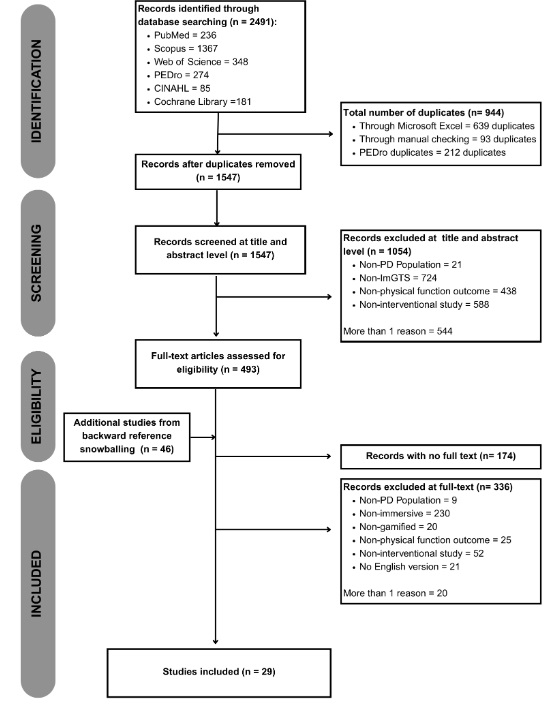
Figure 1: PRISMA flowchart
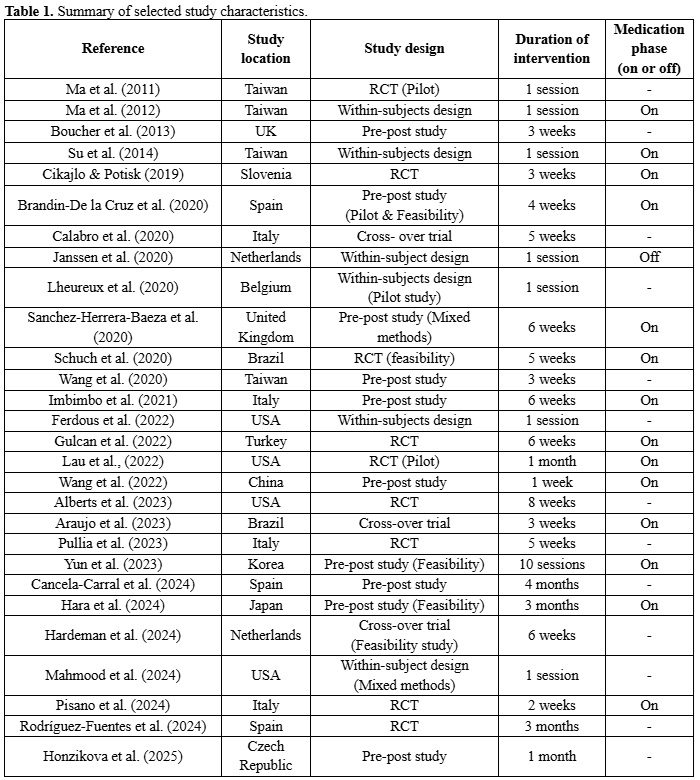
Table 1: Summary of Selected Study Characteristics
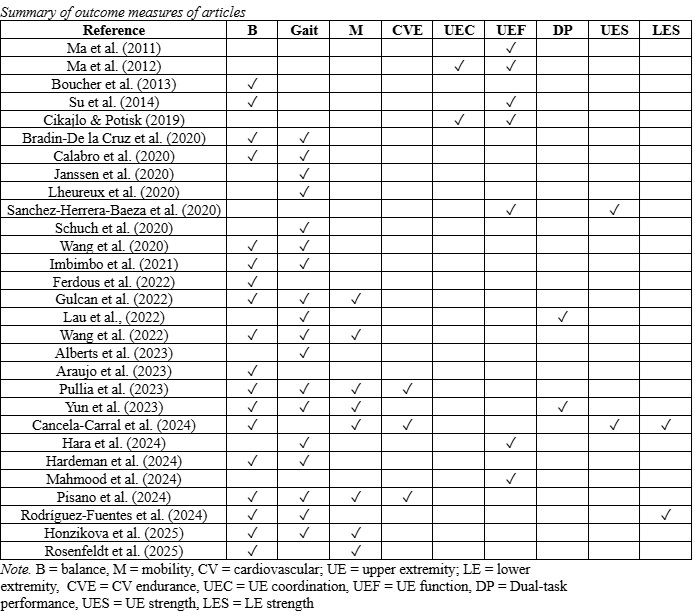
Table 2: Summary of Outcome Measures of Articles
To cite this abstract in AMA style:
KI. Guitones, ME. Aguila. Effects of Immersive Gamification Technology on the Physical Function of People with Parkinson’s Disease: A Scoping Review [abstract]. Mov Disord. 2026; 41 (suppl 1). https://www.mdsabstracts.org/abstract/effects-of-immersive-gamification-technology-on-the-physical-function-of-people-with-parkinsons-disease-a-scoping-review/. Accessed October 1, 2026.« Back to 2026 International Congress
MDS Abstracts - https://www.mdsabstracts.org/abstract/effects-of-immersive-gamification-technology-on-the-physical-function-of-people-with-parkinsons-disease-a-scoping-review/