
Objective: To evaluate the efficacy and safety of vitamin C (VITC) for treating restless legs syndrome (RLS) using evidence exclusively from randomized controlled trials (RCTs).
Background: VITC has been proposed as a potential therapy for RLS due to its antioxidant properties and possible modulation of dopaminergic pathways. Several RCTs have assessed its impact on symptom severity and related clinical outcomes, but findings have been inconsistent.
Method: A systematic review of PubMed and Google Scholar of RCTs comparing VITC to placebo or active comparators in adults with RLS was conducted. The primary outcome was change in International Restless Legs Scale (IRLS) scores. Secondary outcomes included itching, categorical RLS symptom severity, and sleep disturbance. Adverse events such as nausea and dyspepsia were also investigated. Random‑ and fixed‑effects models were applied. Heterogeneity was quantified using I².
Results: Four RCT arms from two studies contributed to the IRLS analysis (n=119). In subgroup analysis, VITC was significantly more effective than placebo (MD –8.12 points; 95% CI –11.52 to –4.71; p<0.001), while demonstrating no meaningful difference compared with vitamin E (MD 0.10; 95% CI –3.42 to 3.62) or pramipexole (MD 0.59; 95% CI –4.18 to 5.36) [Figure 1]. VITC also improved sleep outcomes (RD 0.36; 95% CI 0.17 to 0.54; p<0.001). However, effects on itching (RR 0.82; 95% CI 0.18–3.75) and global RLS severity (RR 0.80; 95% CI 0.20–3.31) varied substantially across subgroups, reflecting heterogeneity in clinical response. Nausea (RR 0.32; 95% CI 0.04–2.94) [Figure 2] and dyspepsia (RR 3.00; 95% CI 0.33–27.33) [Figure 3] remained infrequent adverse events and did not differ significantly between treatment groups.
Conclusion: VITC may reduce RLS severity compared with placebo, though benefits are inconsistent across comparators and limited by high heterogeneity. Evidence for secondary outcomes is mixed and largely derived from single‑study data. Larger, rigorously designed RCTs are needed to clarify VITC’s therapeutic role in RLS.
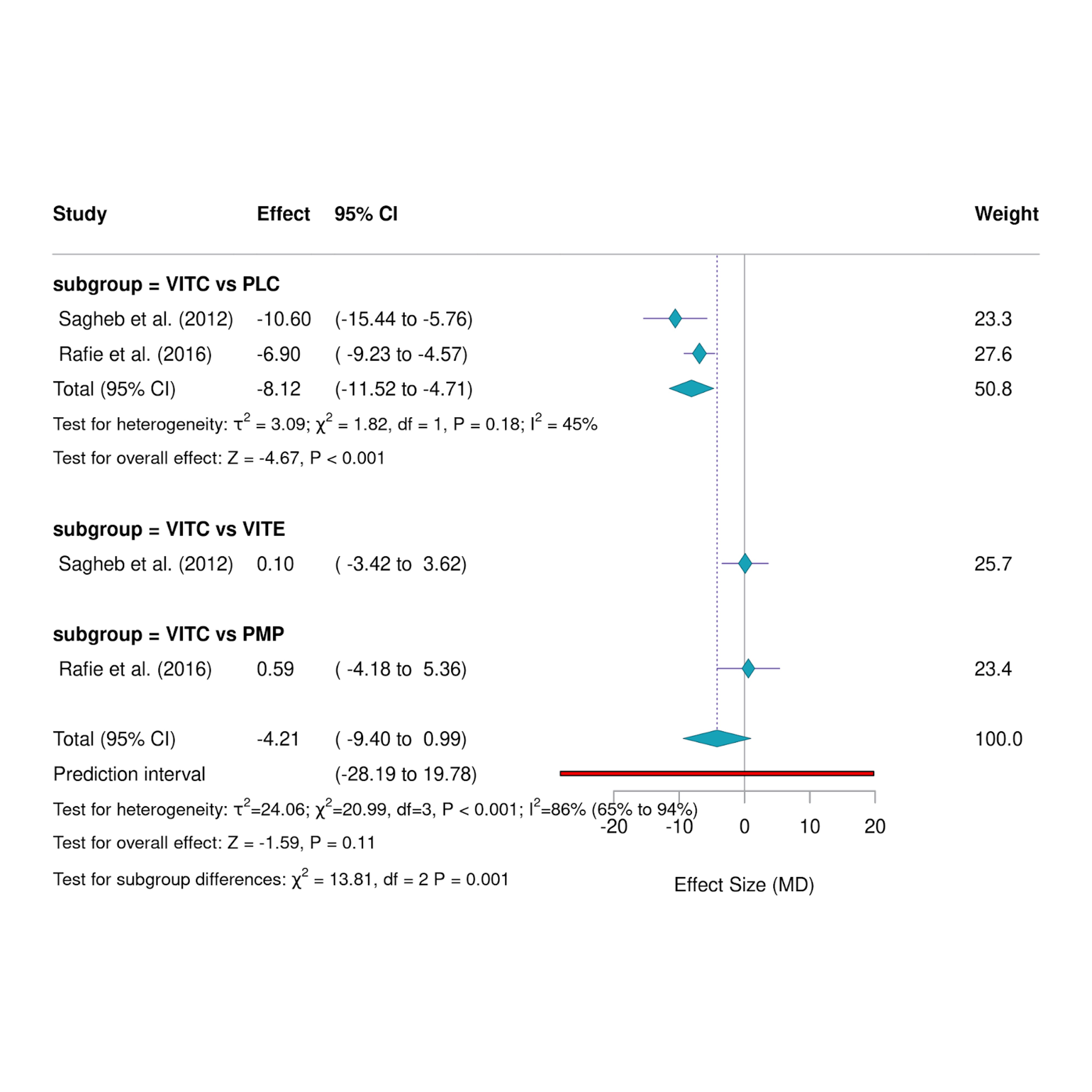
Figure 1. Pooled MD of IRLS.
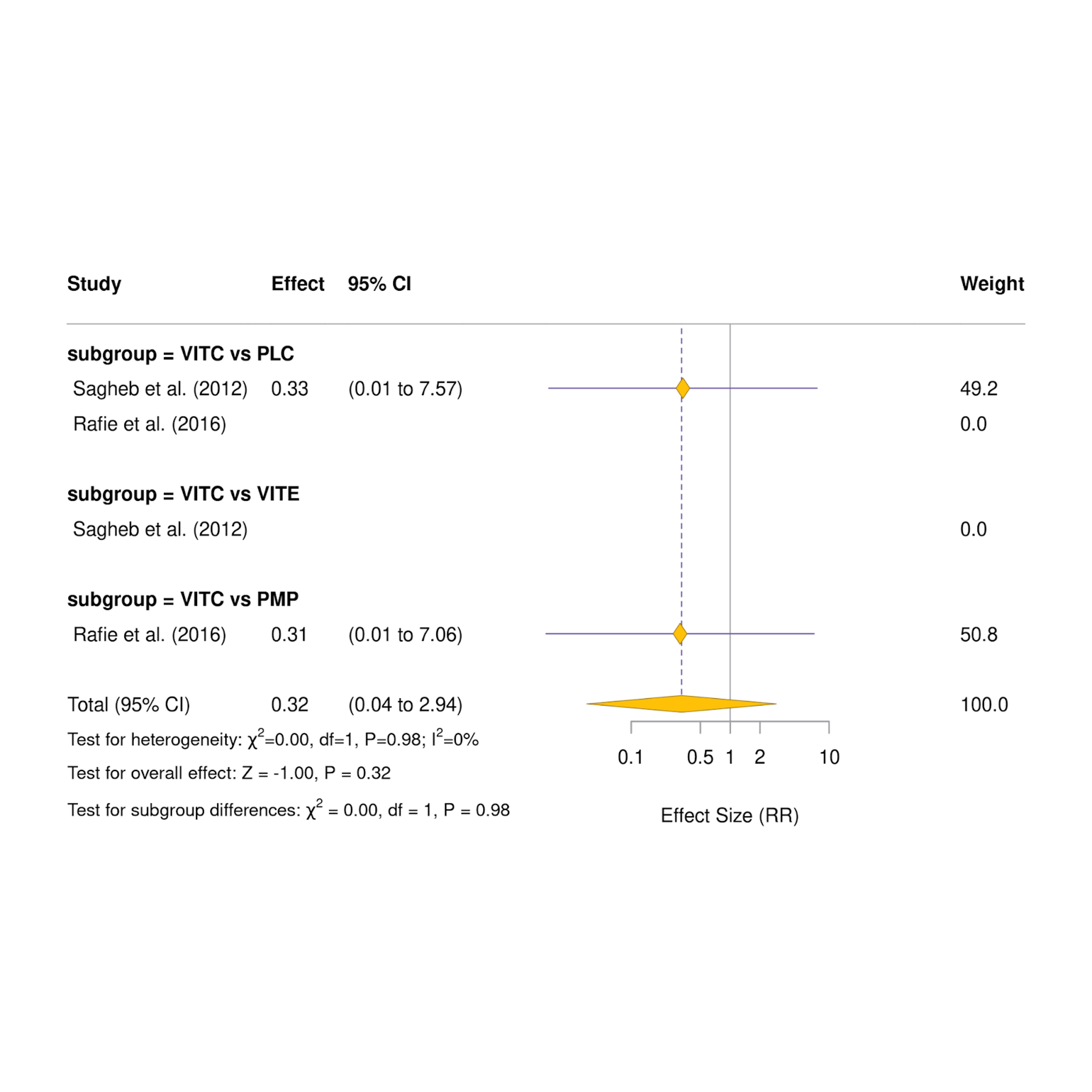
Figure 2. Pooled RR of nausea.
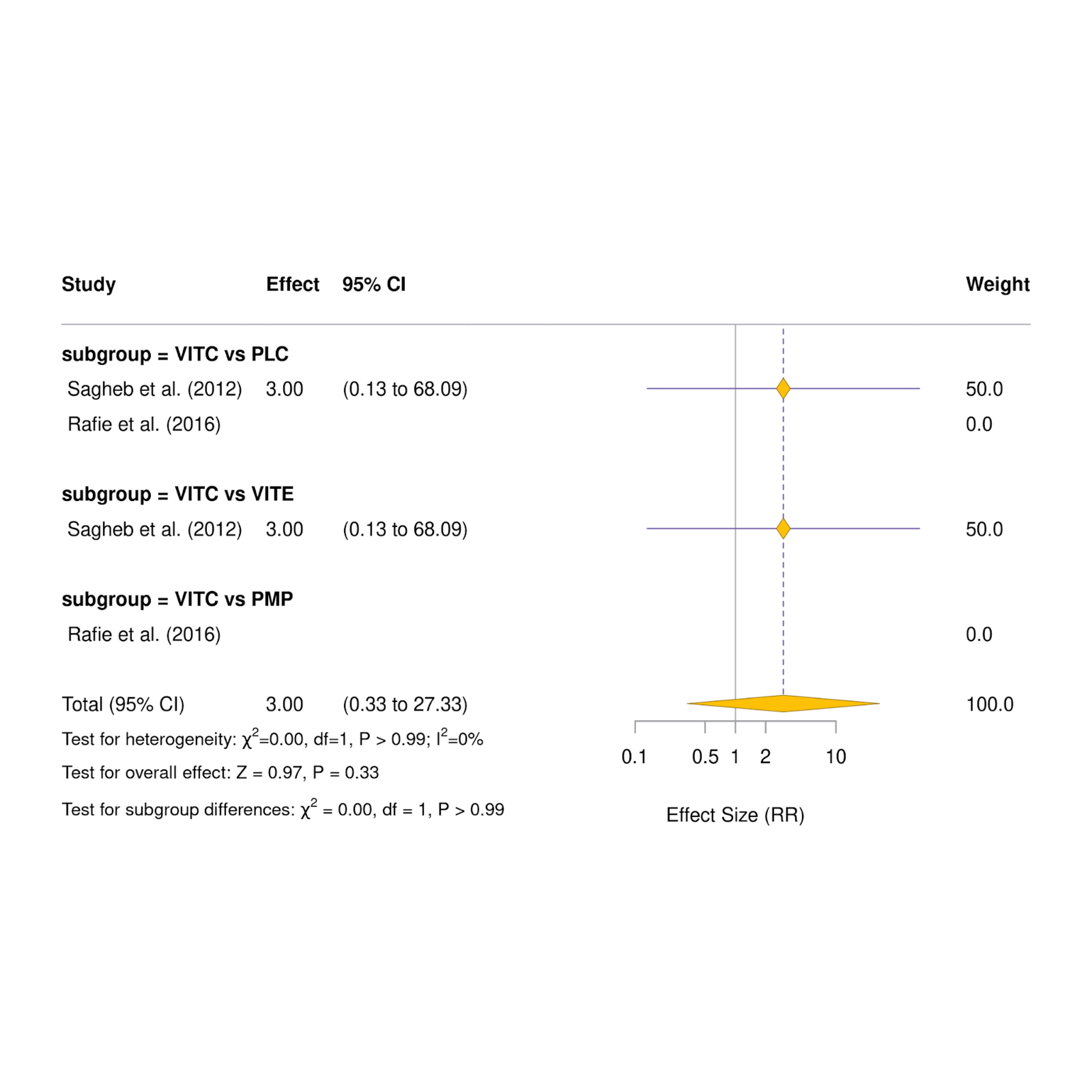
Figure 3. Pooled RR of dispepsia.
To cite this abstract in AMA style:
A. Fornari Caprara, J. Pitton Rissardo, J. Patino, A. Mcgarry, I. Walker. Efficacy of Vitamin C for Restless Legs Syndrome: A Systematic Review and Meta‑analysis of Randomized Controlled Trials [abstract]. Mov Disord. 2026; 41 (suppl 1). https://www.mdsabstracts.org/abstract/efficacy-of-vitamin-c-for-restless-legs-syndrome-a-systematic-review-and-meta-analysis-of-randomized-controlled-trials/. Accessed October 1, 2026.« Back to 2026 International Congress
MDS Abstracts - https://www.mdsabstracts.org/abstract/efficacy-of-vitamin-c-for-restless-legs-syndrome-a-systematic-review-and-meta-analysis-of-randomized-controlled-trials/