
Objective: To evaluate whether gout influences the risk of Parkinson’s disease (PD) and whether PD influences the subsequent risk of gout.
Background: Gout and PD share potential mechanistic pathways involving urate metabolism, oxidative stress, and neuroinflammation. However, epidemiologic studies examining their association have produced inconsistent findings.
Method: A PubMed search identified studies reporting hazard ratios (HRs) for gout preceding PD (Gout→PD) and PD preceding gout (PD→Gout). Random‑effects models with inverse‑variance weighting were applied. Sex‑stratified analyses were performed when available. Heterogeneity was quantified using I², and publication bias was evaluated using trim‑and‑fill and multiple fail‑safe N methods.
Results: Five studies provided thirteen study‑level estimates of gout to PD risk [Figure 1]. The pooled HR was 2.86 (95% CI 2.76–2.96; I² = 74.5%). Female‑specific analyses showed HR 3.21 (95% CI 2.91–3.55), and male‑specific analyses showed HR 2.61 (95% CI 2.45–2.79). Trim‑and‑fill identified no missing studies, and Rosenthal’s fail‑safe N was 831. Two studies evaluated PD to gout risk [Figure 2], yielding a pooled HR of 1.65 (95% CI 1.42–1.90; I² = 0%). Females had HR 1.75 (95% CI 1.36–2.26), and males HR 1.60 (95% CI 1.34–1.91). The fail‑safe N was 1, reflecting the limited available evidence.
Conclusion: Gout was associated with a higher risk of PD, and PD was associated with a higher risk of subsequent gout. These findings suggest shared pathways involving systemic inflammation, purine metabolism, and urate regulation. Further mechanistic and longitudinal studies are needed to clarify how these biological processes link gout and PD.
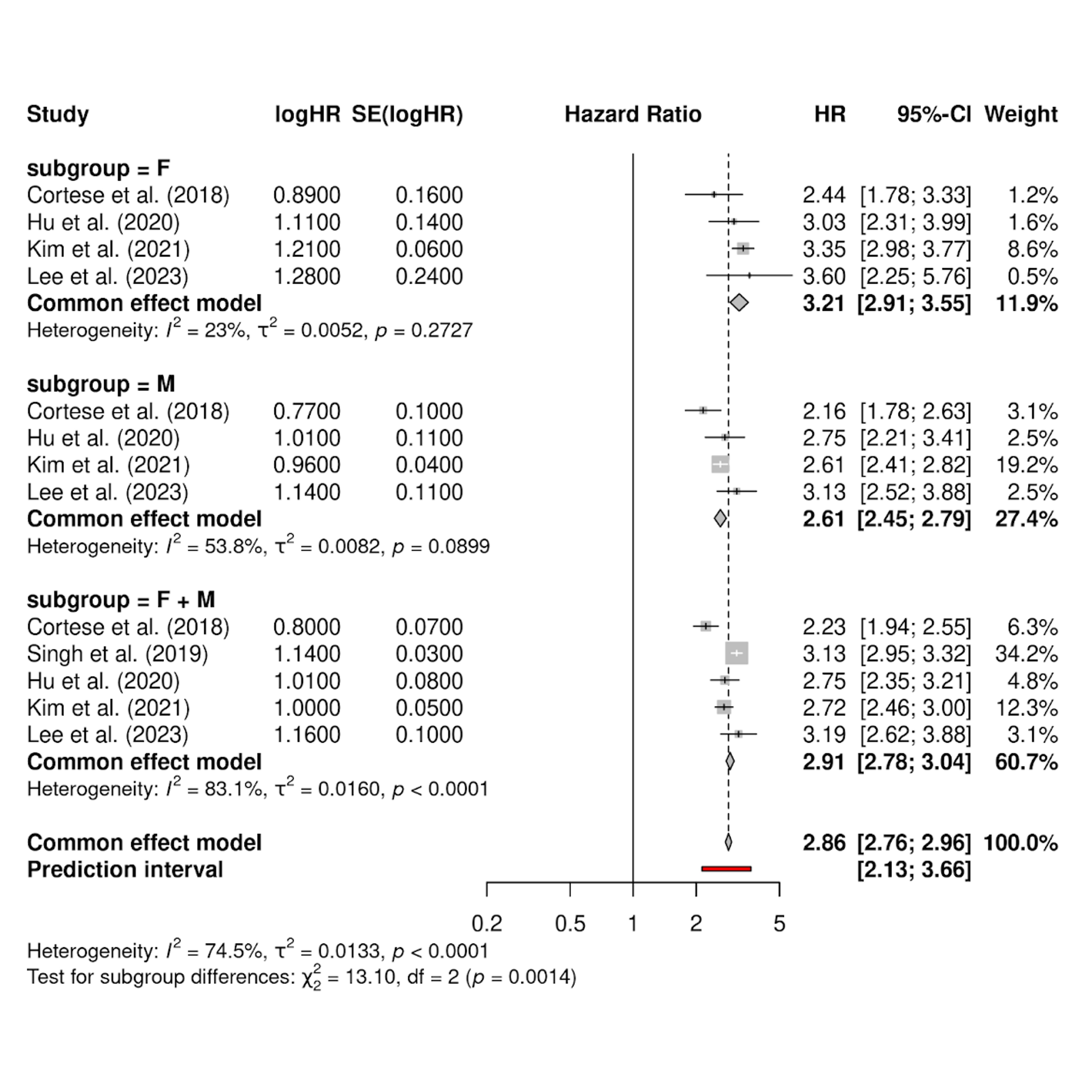
Figure 1. Gout to PD risk.
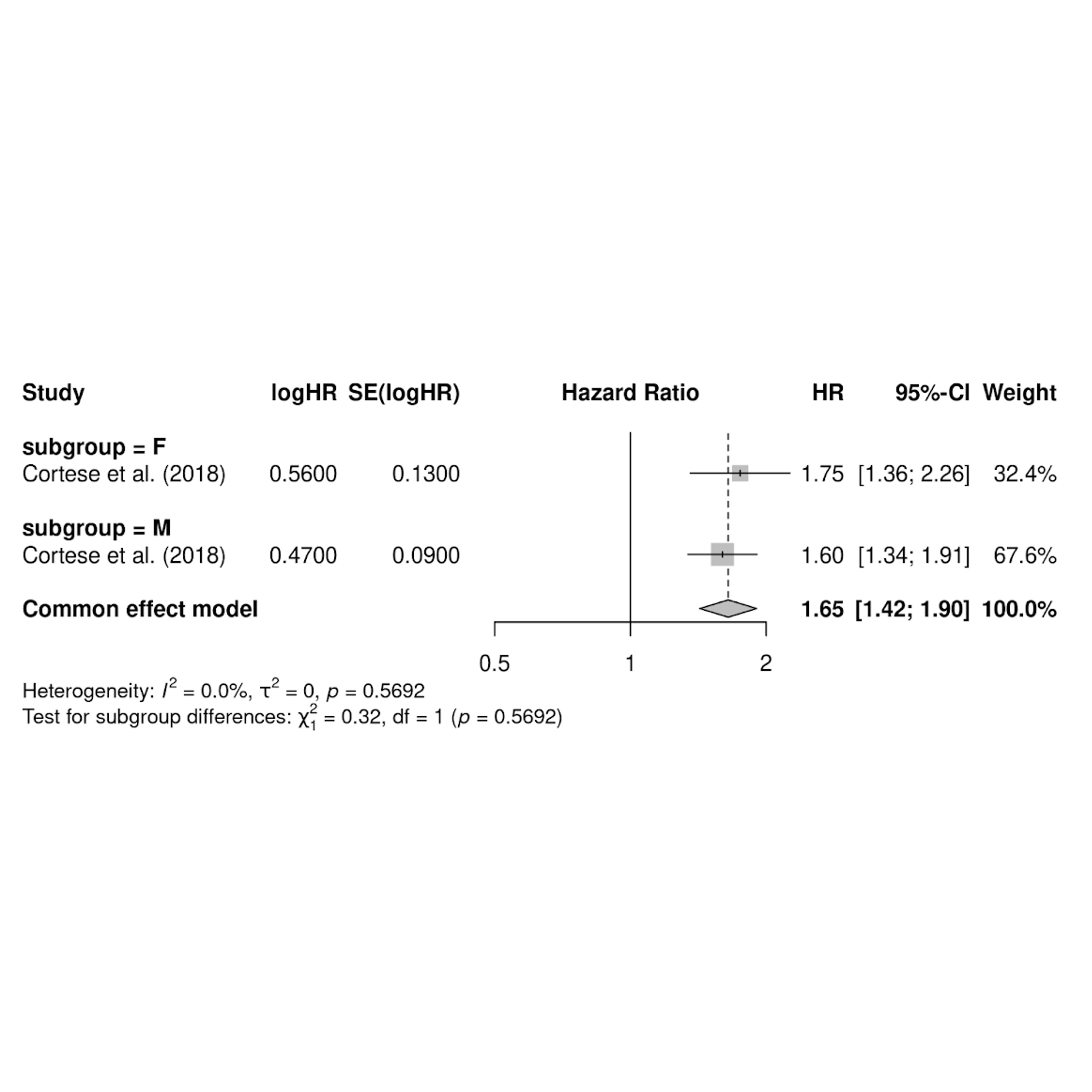
Figure 2. PD to gout risk.
To cite this abstract in AMA style:
V. Byroju, J. Pitton Rissardo, J. Patino, A. Fornari Caprara, A. Mcgarry, I. Walker. Bidirectional Association Between Gout and Parkinson’s Disease: A Systematic Review and Meta-Analysis [abstract]. Mov Disord. 2026; 41 (suppl 1). https://www.mdsabstracts.org/abstract/bidirectional-association-between-gout-and-parkinsons-disease-a-systematic-review-and-meta-analysis/. Accessed October 1, 2026.« Back to 2026 International Congress
MDS Abstracts - https://www.mdsabstracts.org/abstract/bidirectional-association-between-gout-and-parkinsons-disease-a-systematic-review-and-meta-analysis/