
Category: Pediatric Movement Disorders
Objective: To evaluate the feasibility of the identification of catatonia by trained raters through remote viewing of motor assessments across patients with differing motor profiles [1].
Background: Catatonia remains an under-recognized condition due to variability in assessment instruments and reliance on in-person examination [2,3]. We are developing a structured checklist allowing trained raters to identify catatonic symptoms by virtual observation of motor assessments [1]. Its feasibility in hypokinesis and hyperkinesis is to be determined [4-6].
Method: Videos of motor assessments of males with hypokinesis and hyperkinesis were presented online to an international team [Figure 1] of trained raters for independent scoring on instruments to assess catatonia [7-9] including a tool under development to identify catatonia [1] and a scale to assess overall function of children [10]. There were 4-6 sequential sessions for each participant. After independently scoring all instruments while viewing the videos on individual monitors, raters met for a consensus conference to agree on scores for each item. If the raters could not agree on a score, then a period (.) was entered to be coded as missing.
Results: For both patients, mean rating scores closely paralleled consensus scores across the catatonia instruments [1,7-9] over sequential sessions [Figure 2]. The lower panel of Figure 2 of the male with hyperkinesis showed disagreements among raters to obtain consensus about the perceived movements for the final session. Rating scores from instruments in Figure 2 demonstrated an inverse relationship with the Children’s Global Assessment Scale (CGAS) [Figure 3] scores in both participants, consistent with higher CGAS values reflecting better overall functioning. The upper panel of Figure 3 of the male with hypokinesis demonstrated decreased CGAS scores corresponding to worsening overall functioning as his disease progressed over the years of his evaluation. The lower panel of Figure 3 of the male with hyperkinesis demonstrated lower CGAS scores corresponding to his reduced functioning in the second and third sessions related to extended episodes of self-injury.
Conclusion: The administration of our protocol to patients with hypokinesis and hyperkinesis is feasible. This procedure facilitates the identification of characteristics of catatonia and overall functioning in chronological sessions.
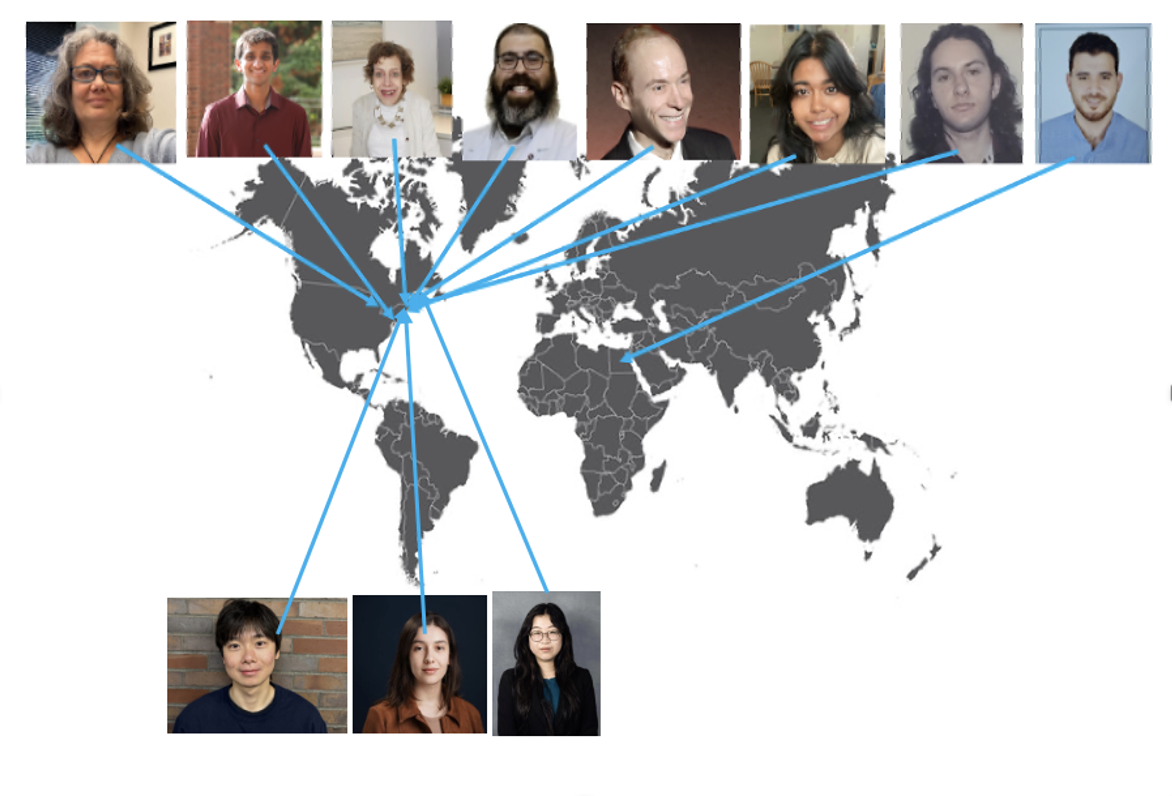
Figure 1. International Map of Raters
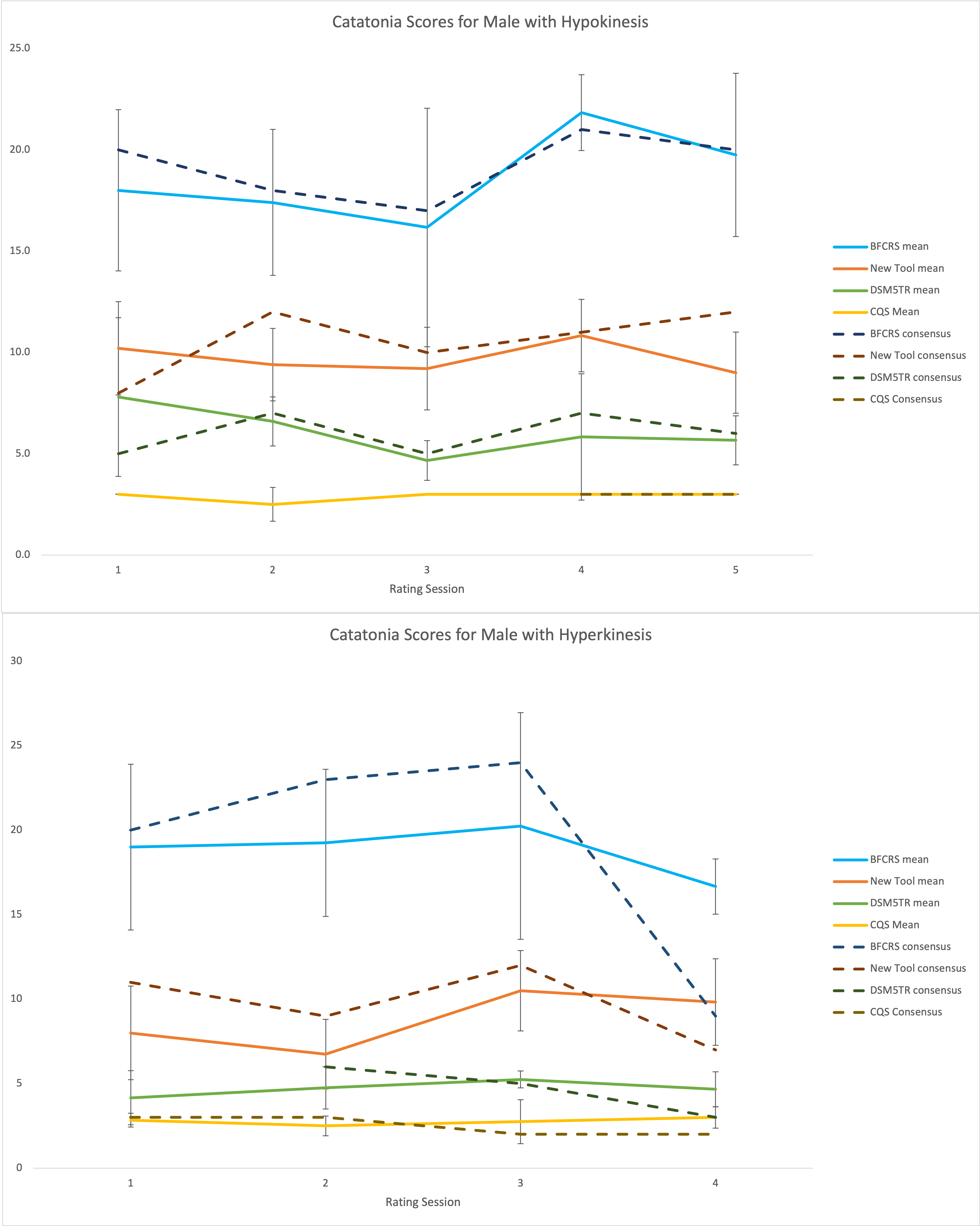
Figure 2. Scores of Catatonia Tools
![Figure 3. Children's Global Assessment Scale [10]](https://www.mdsabstracts.org/wp-content/uploads/2026/09/0988_1474_000475_3.png)
Figure 3. Children’s Global Assessment Scale [10]
References: 1. Kadubandi N, Elshourbagy A, Smith L, Balousha A, Tacik P, Barnett J, Brasic J. Development of a rating instrument to identify catatonia by virtual viewing of motor assessments [abstract]. Mov Disord. 2025; 40 (suppl 1). https://www.mdsabstracts.org/abstract/development-of-a-rating-instrument-to-identify-catatonia-
by-virtual-viewing-of-motor-assessments/.
2. Llesuy JR, Medina M, Jacobson KC, Cooper JJ. Catatonia Under-Diagnosis in the General Hospital. J Neuropsychiatry Clin Neurosci. 2018;30(2):145-151. doi:10.1176/appi.neuropsych.17060123
3. Wortzel JR, Maeng DD, Francis A, Oldham MA. Prevalent Gaps in Understanding the Features of Catatonia Among Psychiatrists, Psychiatry Trainees, and Medical Students. J Clin Psychiatry. 2021;82(5):21m14025. Published 2021 Aug 17. doi:10.4088/JCP.21m14025
4.Kadubandi N, Elshourbagy A, Brašić J. Feasibility of reliable, remote assessment of a 13-year-old boy who stopped talking [abstract]. Mov Disord. 2024; 39 (suppl 1):
S735-S736.
https://www.mdsabstracts.org/abstract/feasibility-of-reliable-remote-assessment-of-a-13-year-old-boy-who-stopped-talking/
5.Kadubandi N, Elshourbagy A, Smith L, Balousha A, Tacik P, Barnett J, Brasic J. Feasibility of reliable, remote assessment of a 13-year-old boy who stopped talking. Zenodo, V10, 2025. https://doi.org/10.5281/zenodo.15801759
6.Kadubandi N, Elshourbagy A, Tasmiya A, Epstein A, Smith L, Balousha A, van Emde Boas M, Rezq H, Tacik P, Barnett J, Brasic JR. Development of a rating instrument to identify catatonia by virtual viewing of motor assessments. Zenodo, V3, 2025. https://doi.org/10.5281/zenodo.16061703
7. American Psychiatric Association. Diagnostic and Statistical Manual of Mental Disorders, Fifth Edition, Text Revision (DSM-5-TR)®, Arlington, Virginia, USA: American Psychiatric Association, 2023, 119.
8.Bush G, Fink M, Petrides G, Dowling F, Francis A. Catatonia. I. Rating scale and standardized examination. Acta Psychiatr Scand 1996; 93:129-136.
9. Luccarelli J, Kalinich M, Wilson JE, Liu J, Fuchs C, Francis A, Heckers S, Fricchione G, Smith JR. The Catatonia Quick Screen (CQS): A Rapid Screening Tool for Catatonia in Adult and Pediatric Populations. medRxiv 2024. https://doi.org/10.1101/2024.11.26.24317940
10. Shaffer D, Gould MS, Brasic J, Ambrosini P, Fisher P, Bird H, Aluwahlia S. A children’s global assessment scale (CGAS). Arch Gen Psychiatry. 1983;16(11):1228-1231. PubMed PMID: 6639293.
To cite this abstract in AMA style:
N. Kadubandi, A. Elshourbagy, A. Tasmiya, M. van Emdeboas, R. Aydin, A. Epstein, R. Guo, L. Smith, N. Li, J. Barnett, J. Brasic. Feasibility of Remote Identification of Catatonia Across Different Motor Presentations [abstract]. Mov Disord. 2026; 41 (suppl 1). https://www.mdsabstracts.org/abstract/feasibility-of-remote-identification-of-catatonia-across-different-motor-presentations/. Accessed October 1, 2026.« Back to 2026 International Congress
MDS Abstracts - https://www.mdsabstracts.org/abstract/feasibility-of-remote-identification-of-catatonia-across-different-motor-presentations/