
Objective: To evaluate the clinical effectiveness of CSAI and associated changes in vitamin B status, homocysteine (Hcy) levels, and nutritional outcomes in patients with advanced PD.
Background: Patients with Parkinson’s disease (PD) receiving device-aided therapies (DATs) frequently experience vitamin B depletion and nutritional challenges. However, the effects of continuous subcutaneous apomorphine infusion (CSAI) on vitamin B status and nutritional outcomes in advanced PD remain unclear.
Method: This was a prospective observational cohort study in a single centre.Thirty patients with advanced PD were enrolled between January 2023 and March 2025. Clinical, biochemical, and nutritional assessments were performed at baseline and after three months. Motor outcomes included daily OFF hours, dyskinesia hours, Hoehn and Yahr stage, and the Unified Parkinson’s Disease Rating Scale (UPDRS). Biochemical measures comprised serum vitamins B₁, B₆, B₁₂, folate, and plasma Hcy levels. Nutritional status was assessed using body weight, body mass index (BMI), and the Mini Nutritional Assessment–Short Form (MNA-SF).
Results: Thirty participants (mean age 68.5 ± 9.2 years; disease duration 12.0 ± 3.9 years; Hoehn & Yahr 3.7 ± 0.7) completed follow-up. After three months of CSAI, daily OFF hours, dyskinesia hours, and UPDRS Part IV scores decreased significantly (p < 0.05 for all). The oral levodopa daily dose was significantly reduced (p < 0.001). Serum vitamin B₁ and B₁₂ levels increased significantly, while Hcy levels showed a modest but significant reduction (p < 0.05). Body weight, BMI, and total MNA-SF score remained unchanged (p > 0.05). However, MNA-SF categories shifted toward improved nutritional classification (p = 0.008). Adjunctive antiparkinsonian medications were significantly reduced, while levodopa remained universally prescribed.
Conclusion: CSAI significantly reduced motor complications and oral levodopa exposure. Secondary analyses showed selective biochemical improvements with stable overall nutritional status. Findings should be interpreted considering the observational design, lack of control group, and short follow-up.
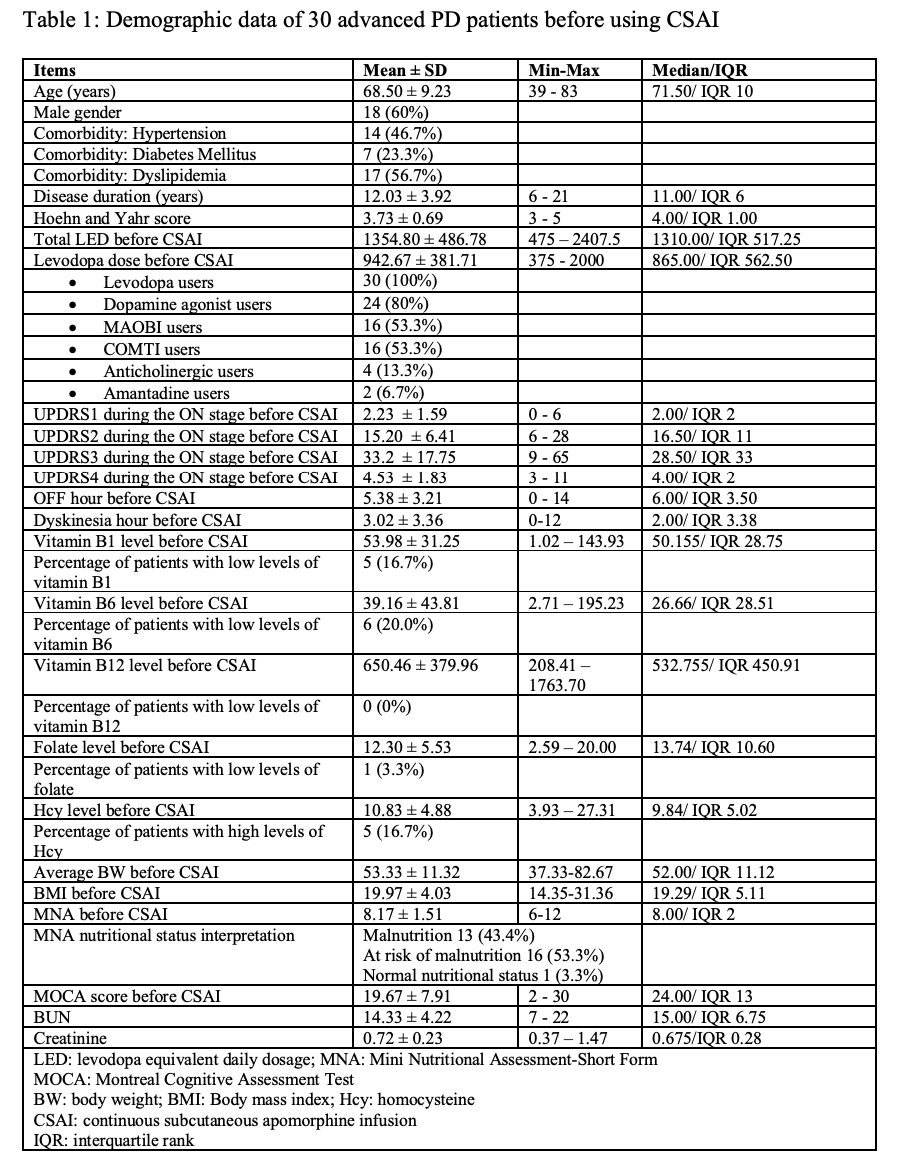
Table 1 MDS 2026
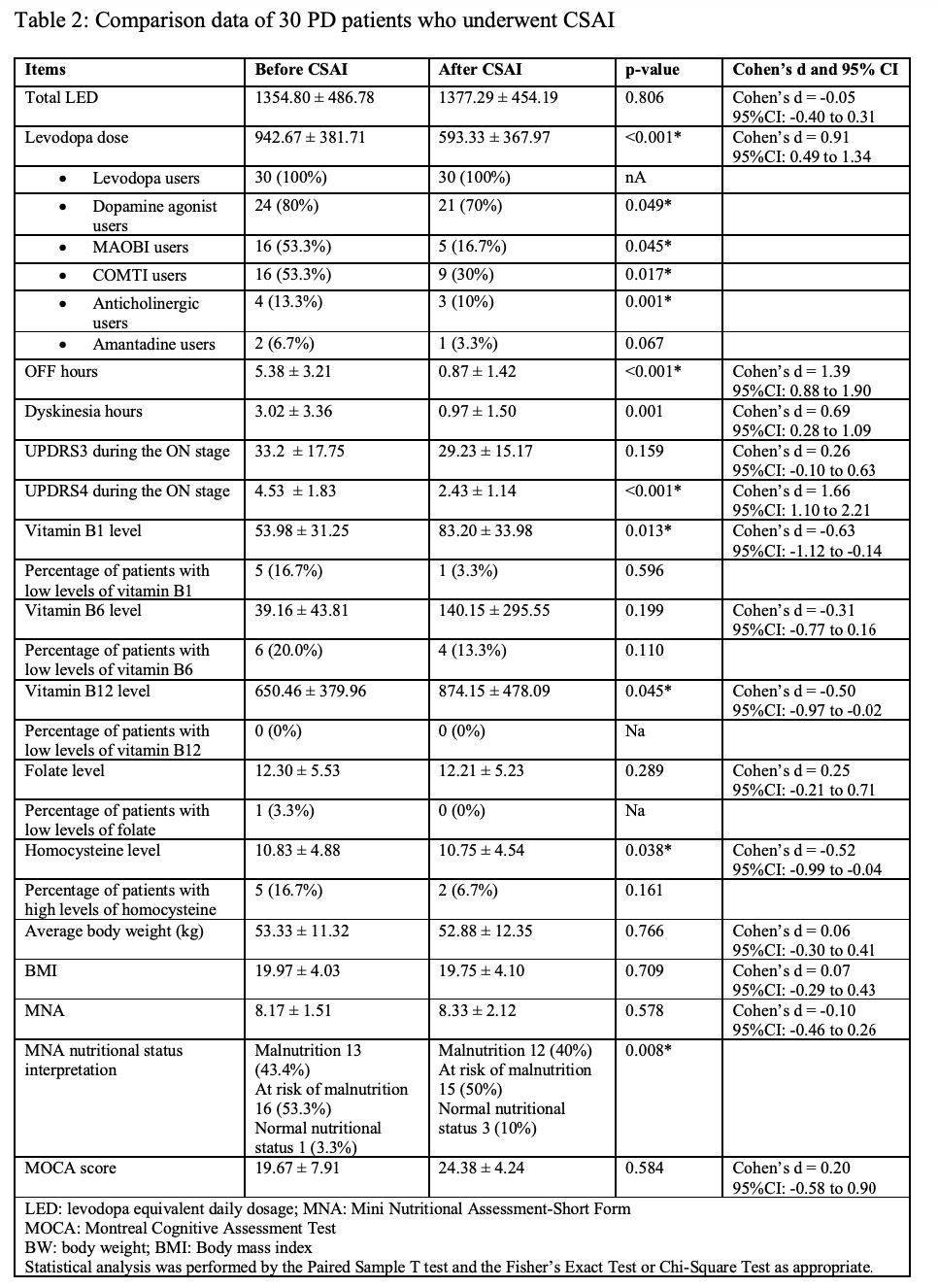
Table 2 MDS 2026
References: 1. Phokaewvarangkul O, Bhidayasiri R, Garcia-Ruiz P, et al. Homocysteine, vitamin B metabolites, dopamine-substituting compounds, and symptomatology in Parkinson’s disease: clinical and therapeutic considerations. J Neural Transm (Vienna) 2023; 130: 1451-1462. 2023/08/21. DOI: 10.1007/s00702-023-02684-9.
2. Phokaewvarangkul O, Markaki I, Moes HR, et al. Vital nutrition: enhancing health in advanced Parkinson’s disease with device-aided therapies. J Neural Transm (Vienna) 2025 2025/04/25. DOI: 10.1007/s00702-025-02935-x.
3. Phokaewvarangkul O, Anan C, Phimpha A, et al. Early factors for predicting discontinuation to subcutaneous Apomorphine infusion in Parkinson’s disease: A prospective analysis of the Thai Apomorphine Registry. Parkinsonism Relat Disord 2021; 91: 146-151. 2021/10/09. DOI: 10.1016/j.parkreldis.2021.09.022.
To cite this abstract in AMA style:
O. Phokaewvarangkul, N. Rattanapitak, P. Kuwattanasuchati, R. Bhidayasiri. Biochemical and Nutritional Changes During Continuous Subcutaneous Apomorphine Infusion in Advanced Parkinson’s Disease: Findings from an Observational Cohort [abstract]. Mov Disord. 2026; 41 (suppl 1). https://www.mdsabstracts.org/abstract/biochemical-and-nutritional-changes-during-continuous-subcutaneous-apomorphine-infusion-in-advanced-parkinsons-disease-findings-from-an-observational-cohort/. Accessed October 1, 2026.« Back to 2026 International Congress
MDS Abstracts - https://www.mdsabstracts.org/abstract/biochemical-and-nutritional-changes-during-continuous-subcutaneous-apomorphine-infusion-in-advanced-parkinsons-disease-findings-from-an-observational-cohort/