
Objective: To determine which disease-related variables are independently associated with severity of psychosis in Parkinson’s Disease.
Background: Parkinson’s disease (PD) is a multisystem disorder in which nonmotor symptoms substantially contribute to morbidity and quality of life. Although prior longitudinal studies have identified predictors of psychosis onset, few have examined predictors of psychosis severity, which may better reflect overall disease burden.
Method: We conducted a 3-year longitudinal cohort study of people with PD recruited from the University of Virginia outpatient Movement Disorders Clinic. Participants completed a baseline and three annual follow-up visits assessing motor and nonmotor symptoms. Individuals with dementia (MoCA <21 or clinical diagnosis) were excluded. Psychosis severity was measured using the Scale for the Assessment of Positive Symptoms–Parkinson’s Disease (SAPS-PD). Multivariable negative binomial generalized estimating equation regression analyses were performed to identify independent predictors of psychosis severity.
Results: Of the 105 participants who completed baseline visits, 67 completed the year-three visit. Greater autonomic dysfunction was independently associated with a 1.26 adjusted-fold change (AFΔ) in the SAPS-PD (95% CI: [1.02, 1.54], p = 0.028). Longer disease duration (AFΔ=1.40, 95% CI: [1.10, 1.79], p = 0.007), greater depressive symptoms (AFΔ=1.4, 95% CI: [1.16, 1.75], p = 0.001), and motor severity (AFΔ=1.54, 95% CI: [1.24,1.92], p <0.001) were also associated with higher psychosis severity. Older age was associated with lower psychosis severity (AFΔ=0.66, 95% CI: [0.45, 0.98], p = 0.037).
Conclusion: Autonomic dysfunction and depressive symptoms were independently associated with greater psychosis severity in PD. While prior studies have largely focused on predictors of psychosis onset, these findings suggest that specific nonmotor domains—particularly autonomic and affective symptoms—may contribute to variability in psychosis severity once symptoms emerge. The association between autonomic dysfunction and psychosis severity raises the possibility that broader subcortical or monoaminergic network involvement may contribute to more severe psychotic manifestations in PD. To our knowledge, few prior studies have examined predictors of psychosis severity, highlighting the need for further investigation into mechanisms driving heterogeneity in PD psychosis.
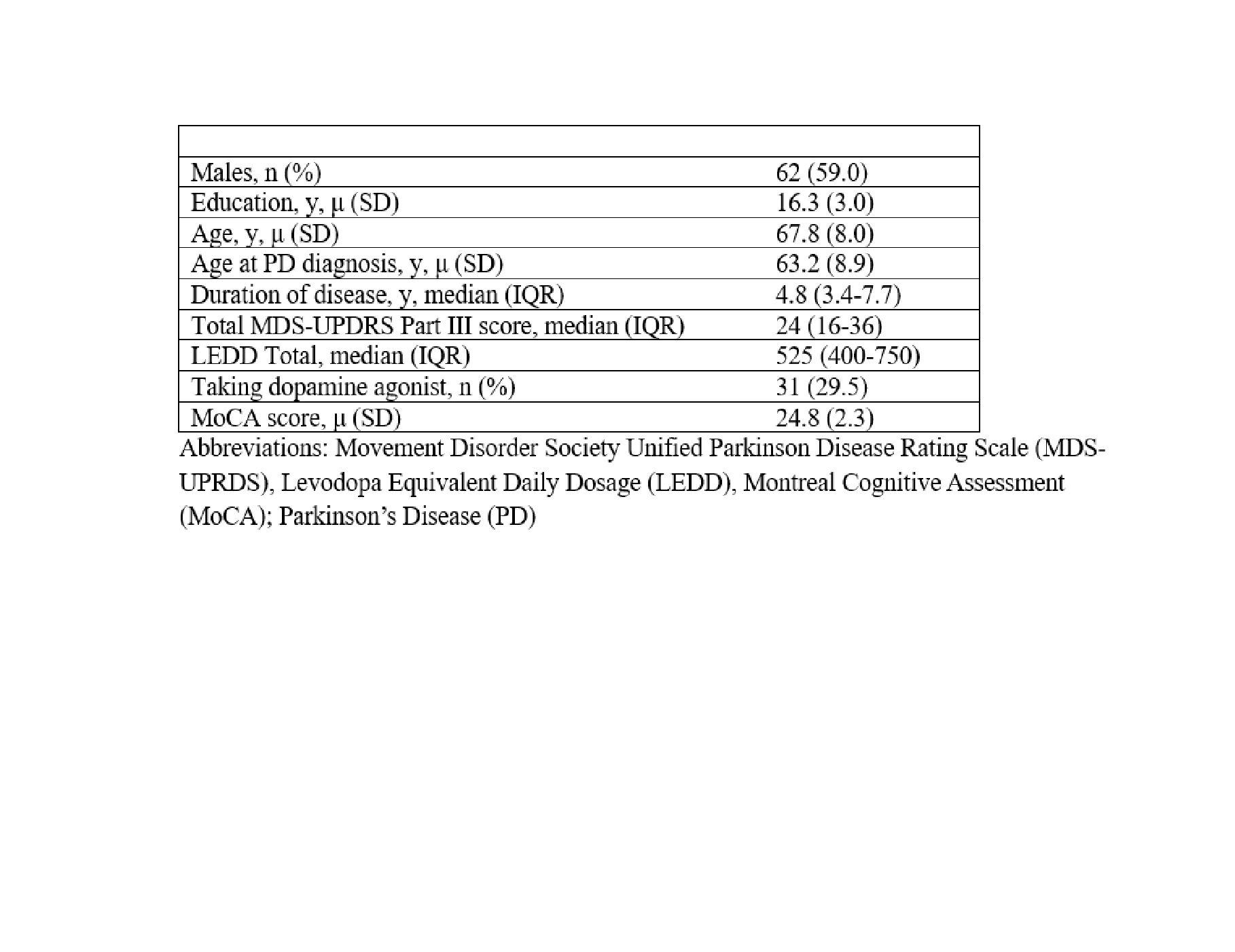
Participant Characteristics
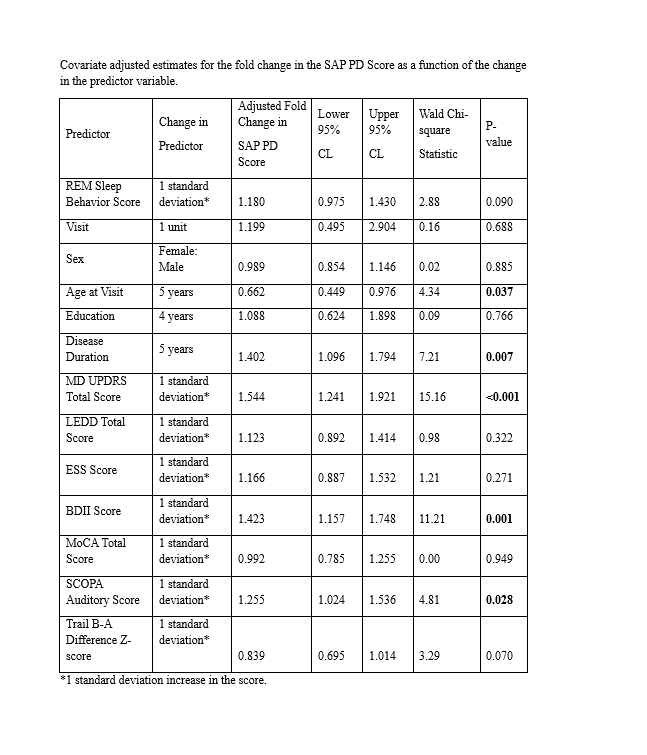
Covariate-Adjusted SAP PD Score Fold Changes
To cite this abstract in AMA style:
R. Sharma, J. Flanigan, B. Shah, J. Patrie. Predictors of Severity of Psychosis in Parkinson’s Disease: A 3-year longitudinal cohort study [abstract]. Mov Disord. 2026; 41 (suppl 1). https://www.mdsabstracts.org/abstract/predictors-of-severity-of-psychosis-in-parkinsons-disease-a-3-year-longitudinal-cohort-study/. Accessed October 1, 2026.« Back to 2026 International Congress
MDS Abstracts - https://www.mdsabstracts.org/abstract/predictors-of-severity-of-psychosis-in-parkinsons-disease-a-3-year-longitudinal-cohort-study/