
Category: Education in Movement Disorders
Objective: This study aimed to evaluate the quality, reliability, and engagement characteristics of YouTube videos on Parkinson’s disease using standardized assessment tools.
Background: Parkinson’s disease (PD) is a neurodegenerative disorder with an increasing global burden. Patients and caregivers increasingly turn to YouTube for health information, yet the quality and reliability of PD-related content remain inadequately characterized.
Method: A systematic search of YouTube was conducted in October 2023. Videos between 20 seconds and 10 minutes in English were included. Two independent raters assessed 108 videos using the modified DISCERN (mDISCERN) tool and the Global Quality Score (GQS). Interrater agreement was evaluated using weighted Cohen’s kappa. Kruskal-Wallis tests, Dunn’s post-hoc comparisons, Mann-Whitney U tests, and Spearman correlations were used for analysis.
Results: Among 108 videos, 102 (94.4%) were classified as useful and 6 (5.6%) as misleading. Health information websites were the most common source (60.2%). Quality scores varied significantly by source (p < 0.001); physician-made videos scored highest, while independent users scored lowest. Misleading videos had significantly lower mDISCERN and GQS scores with large effect sizes. Engagement metrics (views, likes) showed only weak correlations with quality (ρ = 0.23–0.31). Interrater agreement was substantial (weighted κ = 0.827 for mDISCERN; 0.818 for GQS).
Conclusion: YouTube contains a high proportion of useful PD-related content, but quality is heavily source-dependent. Engagement metrics are poor indicators of reliability. Patients should be guided toward content from credentialed healthcare professionals and established institutions.
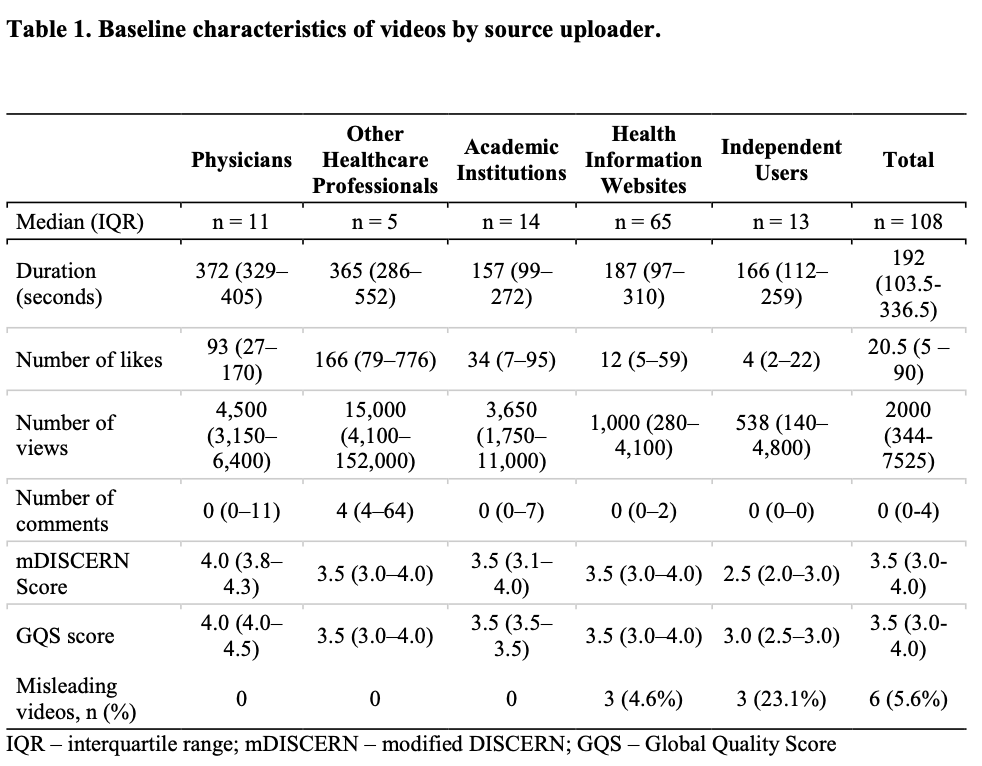
Baseline characteristics by source uploader
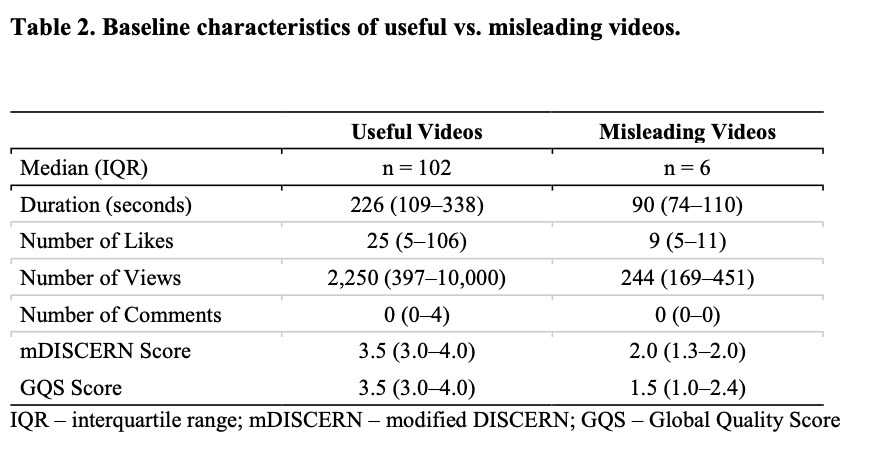
Useful vs. misleading videos
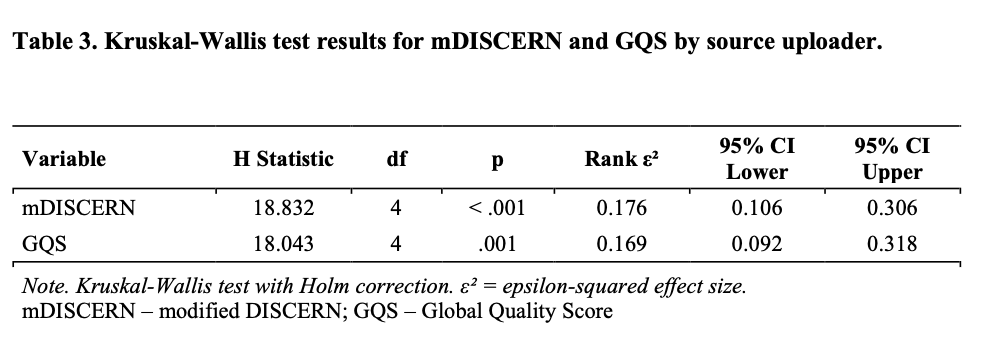
Comparison of GQS and mDISCERN
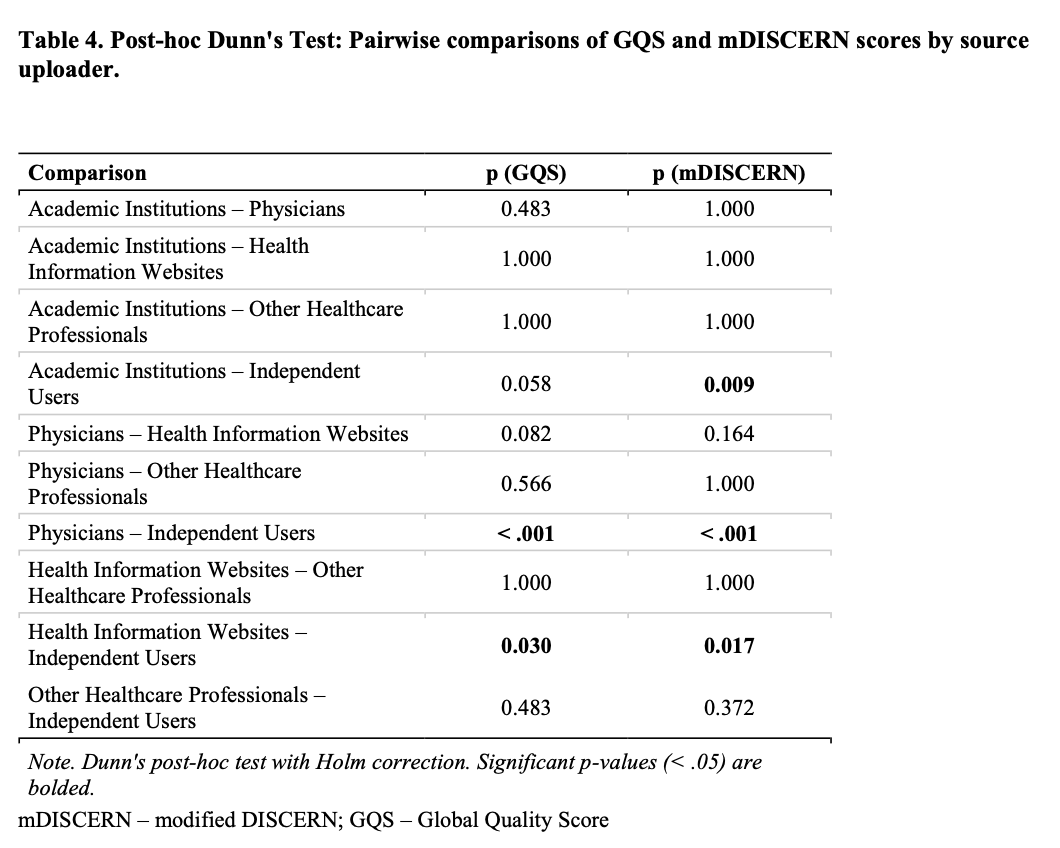
Comparison by source uploader
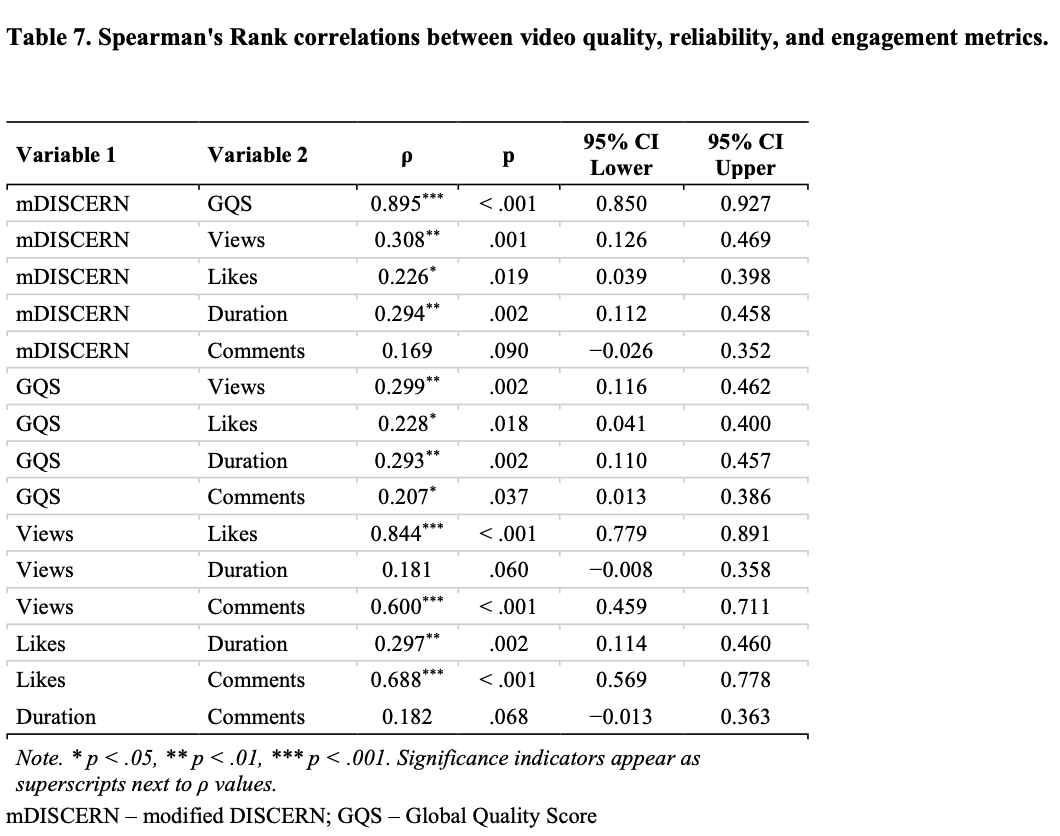
Correlation: video quality and engagements
To cite this abstract in AMA style:
KJ. Baladjay, LM. Bagares, RD. Jamora. Evaluating YouTube as a source of health information on Parkinson’s disease [abstract]. Mov Disord. 2026; 41 (suppl 1). https://www.mdsabstracts.org/abstract/evaluating-youtube-as-a-source-of-health-information-on-parkinsons-disease/. Accessed October 1, 2026.« Back to 2026 International Congress
MDS Abstracts - https://www.mdsabstracts.org/abstract/evaluating-youtube-as-a-source-of-health-information-on-parkinsons-disease/