
Category: AI, Technology, Telemedicine (Other)
Objective: We propose a new non-invasive, wearable, ambulatory, and cost-effective virtual imaging platform, Neurotwain, to screen individuals and obtain a baseline test to evaluate risk and help track progress over time. We use artificial intelligence (AI) to generate digital neuro-twins for modeling disease progression and personalized treatment.
Background: Neurotwain’s building blocks are 1) eXtended reality-based brain Stimuli with Eye and Tactile tracking (XSET) to indirectly record task-evoked brain activity [figure1] and 2) AI-based predictive models for generating virtual images and digital neuro-twins. XSET provides visual and/or auditory behavioral paradigms while performing synchronized recording of subject’s tactile interaction, eye movement (e.g., saccade, fixation, smooth pursuit), and pupil size [figure2]. Neurotwain can probe the activity and dysfunction of brainstem nuclei, the earliest site for Alzheimer’s disease (AD) and Parkinson’s Disease (PD). The locus ceruleus (LC), a small nucleus deep in the brainstem, cannot be imaged with reliable diagnostic accuracy.
Method: We use task-based physiological recordings and AI-enhanced computational models to create virtual images and digital neuro-twins to predict 1) type of cognitive disorder and neuropathological staging, 2) disease progression, and 3) behavior of the brain to non-invasive neuromodulation and other therapeutic interventions. Sympathetic neurocircuitry linking the LC to the pupil allows Neurotwain to measure dynamic pupil dilation as a non-invasive marker of LC activity and cognitive health in AD. Neurotwain tracks saccades during oculomotor tasks to probe parasympathetic function and detect early-stage PD.
Results: Principal component analysis (PCA) of extracted XSET features, from capturing gaze trajectories during the anti-saccade tasks, shows clear separation between 13 PD subjects and 7 healthy controls (HC). [figure3]. At-home tests response dynamics were consistent across environments, suggesting the robustness of the XSET device in capturing eye and tactile parameters in both settings. Future testing over the next few months will explore this further.
Conclusion: Neurotwain is a non-invasive, AI-driven platform using physiological biomarkers to detect and monitor neurodegenerative disease. It enables scalable, personalized tracking in both clinical and at-home settings.
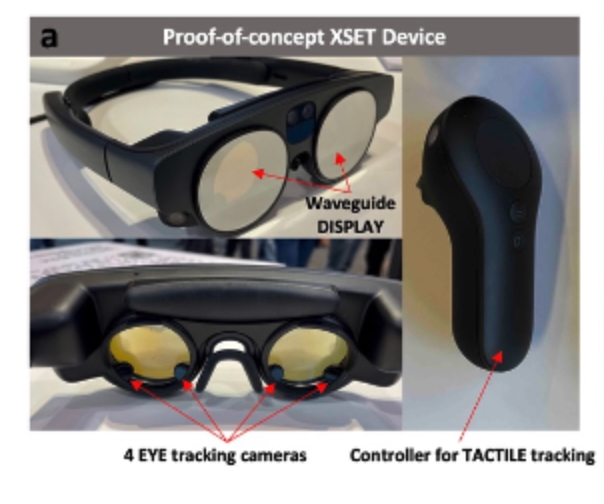
XSET device
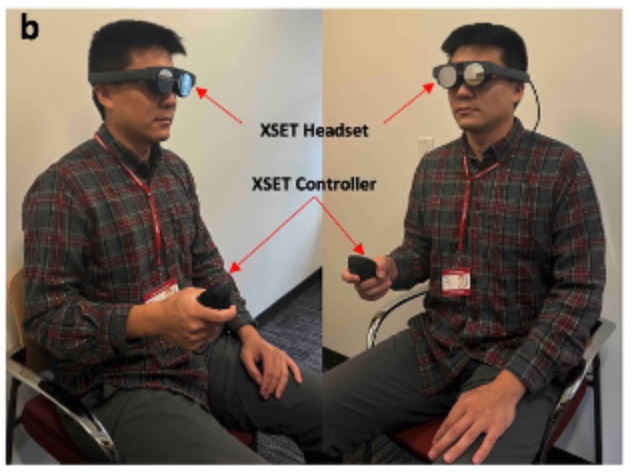
A human subject wearing XSET for PD diagnosis.
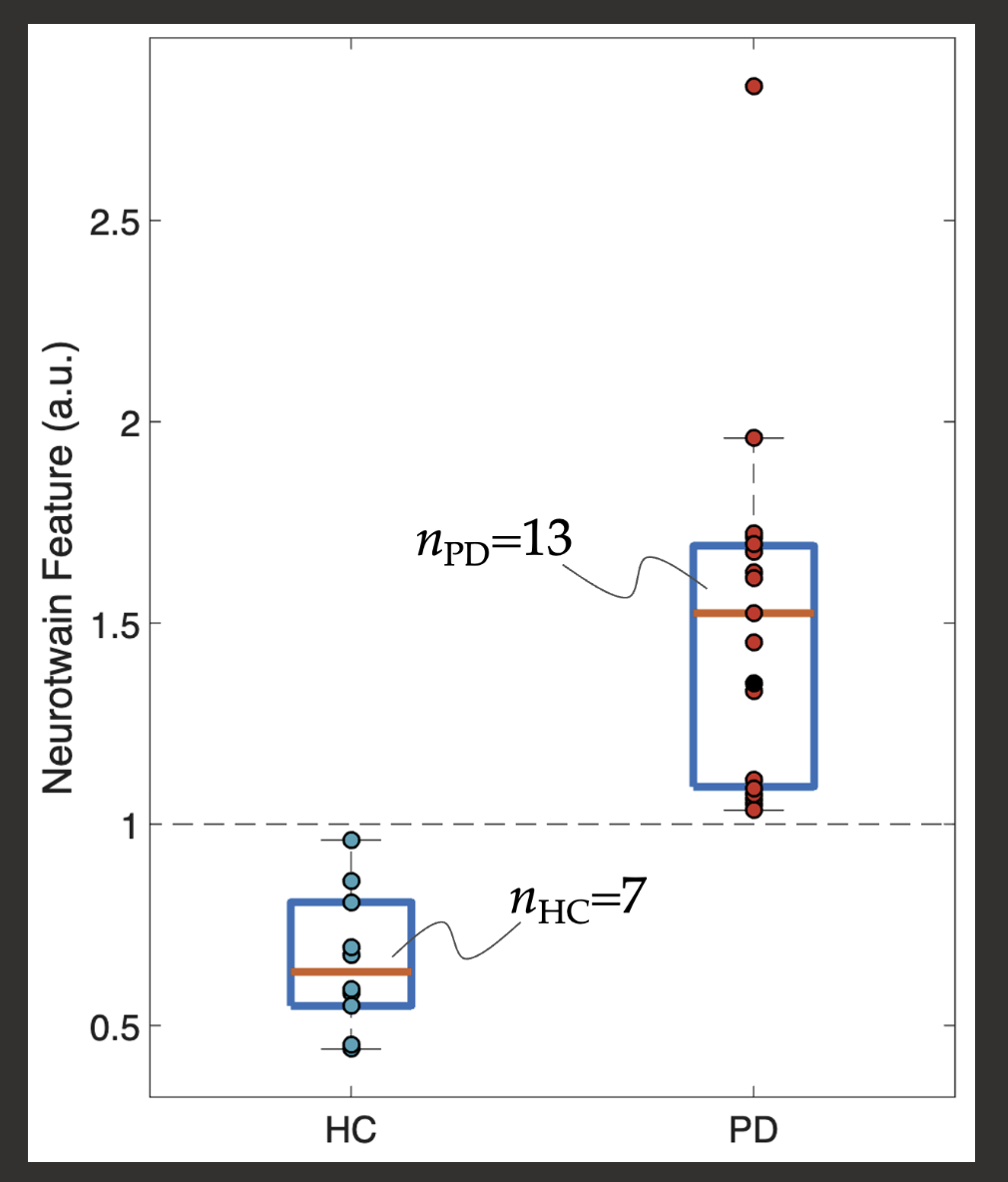
XSET classification results
To cite this abstract in AMA style:
N. Hellmers, M. Mcmichael, G. Chiang, M. Sabuncu, S. Sichani, G. Cusimano, Z. Leng, H. Sarva, A. Goldan. Neurotwain: Extended-reality based virtual brain imaging for one-stop-shop diagnosis and progression of Parkinson’s Disease [abstract]. Mov Disord. 2026; 41 (suppl 1). https://www.mdsabstracts.org/abstract/neurotwain-extended-reality-based-virtual-brain-imaging-for-one-stop-shop-diagnosis-and-progression-of-parkinsons-disease/. Accessed October 1, 2026.« Back to 2026 International Congress
MDS Abstracts - https://www.mdsabstracts.org/abstract/neurotwain-extended-reality-based-virtual-brain-imaging-for-one-stop-shop-diagnosis-and-progression-of-parkinsons-disease/