
Category: Parkinson's Disease (Other)
Objective: To evaluate patients’ and caregivers’ perceptions of patient-centered care for persons with Parkinson’s disease (PwPD) across three healthcare facilities in southern Ghana, and to explore differences in processes of care between primary and tertiary services.
Background: Patient-centered care is critical for improving quality of life and clinical outcomes in PwPD [1]. However, disparities in service delivery and caregiver support may affect perceptions of care [2]. Understanding these differences provides insight into gaps in healthcare provision and informs strategies for strengthening rehabilitation systems.
Method: A cross-sectional survey was conducted among PwPD, recruited from two teaching hospitals (TH) and one primary-level facility (PF), using the Measure of Processes of Care for Adults (MPOC-A) questionnaire (Appendix 1: Permission). Fifty-two patients completed the survey with their caregivers. Demographic characteristics and domain scores were summarized using descriptive statistics in SPSS V29. The Kruskal–Wallis test compared domain scores across sites at a significance level of p<0.02.
Results: Seventy-five PwPD (61.3% male) with mean(SD) age 66.8(9.6) years were included (Table 1). The caregivers [TH1=29; PF=18; TH2=5] had a median age of 53 years (range 19–82); 76.9% were female, and most commonly spouses (36.5%) or adult children (32.7%). Respectful and supportive care scored highest (mean 6.77±0.44), while provision of specific information scored lowest (mean 2.53±1.26) (Table 2). Significant differences were observed across three MPOC-A domains among sites (Table 2). The PF, which integrates physiotherapy and structured support group activities into routine care, demonstrated significantly higher scores for coordinated and comprehensive care and information provision compared to the TH (Table 2). Across all sites, inadequate provision of both general and specific information emerged as a consistent gap.
Conclusion: PwPD and caregivers’ perceptions underscore the importance of integrated, supportive services to enhance patient-centred care for PwPD. Persistent gaps in information provision highlight the need for systematic education within multidisciplinary care models. Strengthening coordinated, information-rich services may improve the quality of care and support for PwPD and their families.
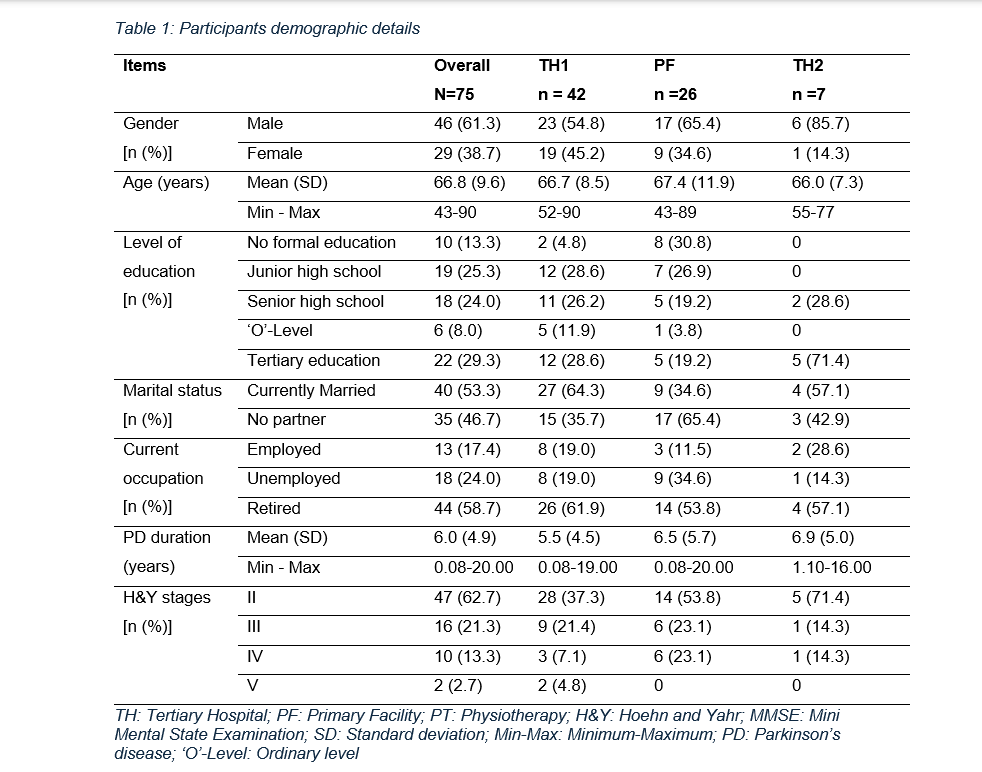
Table 1: Participants demographic details
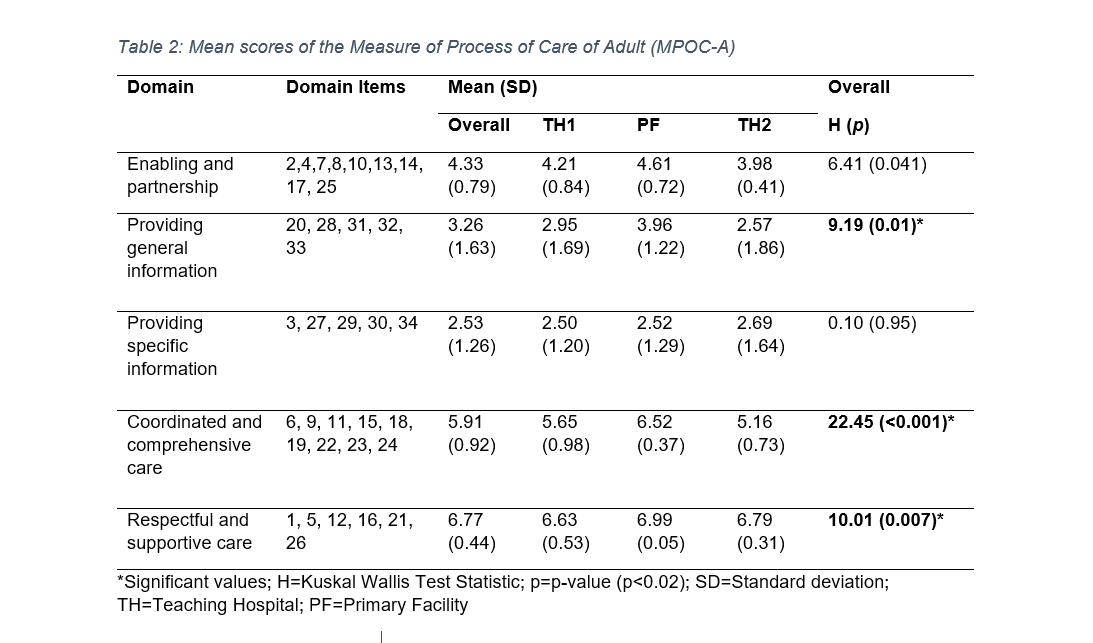
Table 2: Mean scores of the MPOC-A
Appendix 1: Permission from CanChild to use MPOC-A
References: 1. Eggers, C., et al. (2018). Patient centred care improves quality of life in Parkinson’s disease. Journal of Neurology.
2. Aye YM, Liew S, Neo SX, Li W, Ng H-L, Chua S-T, Zhou W-T, Au W-L, Tan E-K, Tay K-Y, Tan LC-S and Xu Z (2020) Patient-Centric Care for Parkinson’s Disease: From Hospital to the Community. Front. Neurol. 11:502. doi: 10.3389/fneur.2020.00502
To cite this abstract in AMA style:
M. Agoriwo, M. Unger, C. Joseph, E. Franzén. Patient-centered Parkinson’s services and integrated primary care in southern Ghana: patient and caregiver perceptions from a cross-sectional survey [abstract]. Mov Disord. 2026; 41 (suppl 1). https://www.mdsabstracts.org/abstract/patient-centered-parkinsons-services-and-integrated-primary-care-in-southern-ghana-patient-and-caregiver-perceptions-from-a-cross-sectional-survey/. Accessed October 1, 2026.« Back to 2026 International Congress
MDS Abstracts - https://www.mdsabstracts.org/abstract/patient-centered-parkinsons-services-and-integrated-primary-care-in-southern-ghana-patient-and-caregiver-perceptions-from-a-cross-sectional-survey/