
Category: Tremor
Objective: To evaluate the safety and therapeutic potential of dual-site repetitive transcranial magnetic stimulation (rTMS) targeting the supplementary motor area (SMA) and cerebellum in medication-refractory essential tremor (ET), and to explore whether cerebellar stimulation frequency influences clinical response.
Background: Essential tremor is a highly prevalent and disabling network disorder driven by dysfunctional cerebello–thalamo–cortical oscillations[1]. Up to half of patients achieve insufficient control with first-line pharmacotherapy, while invasive neuromodulation remains accessible to only a small minority[2]. Noninvasive, network-oriented neuromodulation offers a scalable therapeutic alternative[3]. Prior studies focusing on single-site cerebellar stimulation have yielded inconsistent results, suggesting that isolated node modulation may be insufficient[4]. Given the SMA’s central role as a cortical hub within the tremor network, simultaneous modulation of cortical and cerebellar nodes may enhance therapeutic impact[5].
Method: In this prospective exploratory study, eight adults with ET refractory to pharmacotherapy underwent five consecutive days of dual-site rTMS. All participants received inhibitory SMA stimulation (1 Hz, 110% resting motor threshold-RMT) followed by cerebellar stimulation (90% RMT). Participants were allocated to either inhibitory (1 Hz) or excitatory (10 Hz) cerebellar protocols. Outcomes were assessed at baseline, day 5, and day 30 using the Fahn–Tolosa–Marin (FTM) Tremor Rating Scale (primary endpoint), Activities of Daily Living, and QUEST quality-of-life measures.
Results: Dual-site stimulation produced significant tremor reduction across the cohort. Dominant-hand FTM scores decreased 50% at day 5 (p=0.009), persistent at day 30 with a slight decline (p=0.006 vs baseline). Both cerebellar frequencies yielded comparable benefit with a tendency to greater improvement, not statistically significant, in high frequency group. Treatment was safe and well tolerated.
Conclusion: Multi-target SMA–cerebellar rTMS demonstrated safety and meaningful tremor. The data supports a network-modulation strategy and defies the deterministic frequency-dependent mechanism. These findings position dual-site noninvasive neuromodulation as a promising, scalable therapeutic bridge between pharmacological failure and invasive procedures. Randomized sham-controlled trials are encouraged.
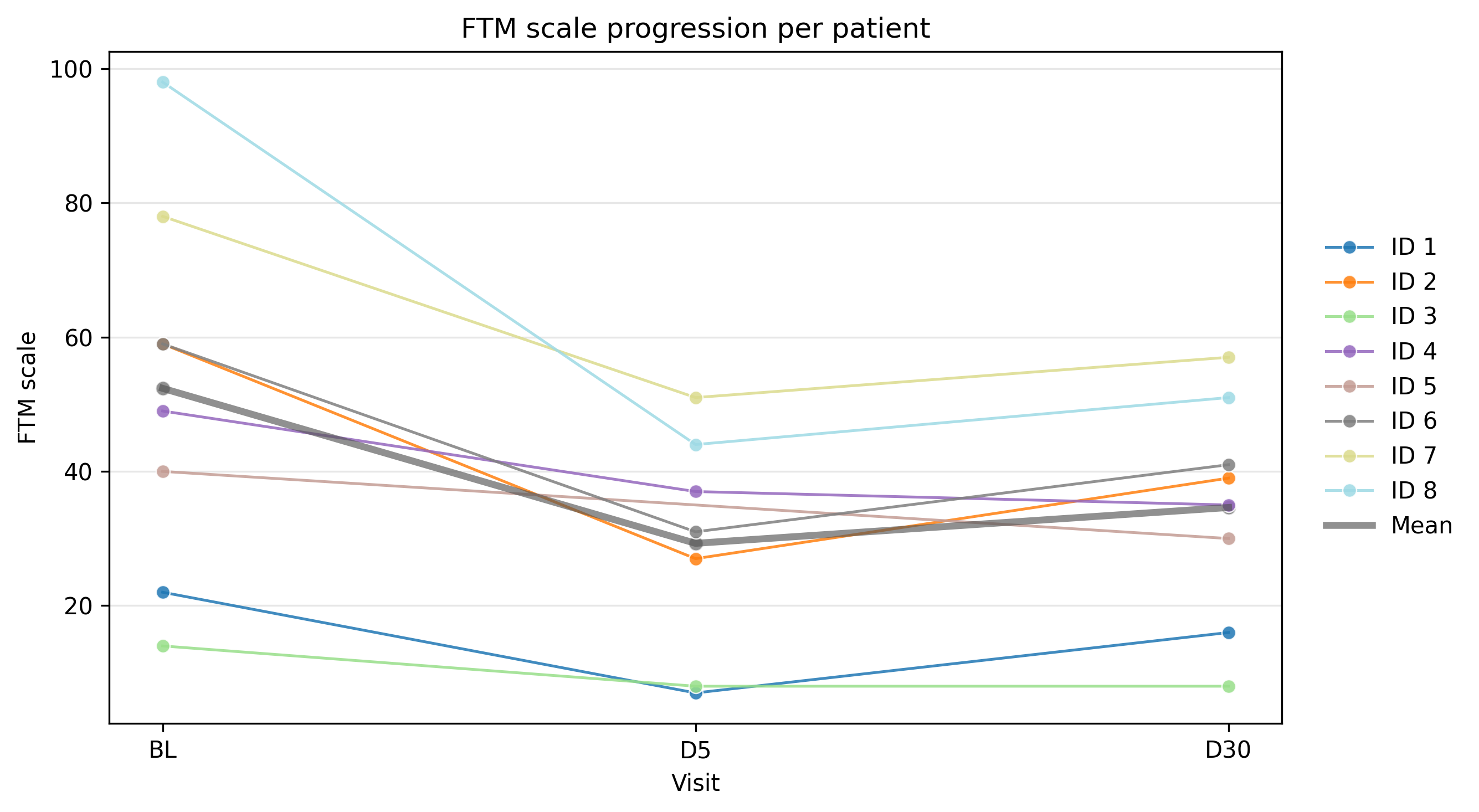
Total FTM progression
References: [1] Song P, Zhang Y, Zha M, Yang Q, Ye X, Yi Q, et al. The global prevalence of essential tremor, with emphasis on age and sex: A meta-analysis. J Glob Health 2021;11:04028. https://doi.org/10.7189/jogh.11.04028.
[2] Mukherjee A, Pandey S. Current and Emerging Therapeutic Targets for Essential Tremor: A Critical Appraisal of Recent Preclinical and Clinical Studies. Movement Disord Clin Pract 2025:mdc3.70147. https://doi.org/10.1002/mdc3.70147.
[3] Shih LC, Pascual-Leone A. Non-invasive Brain Stimulation for Essential Tremor. Tremor and Other Hyperkinetic Movements 2017;7:458. https://doi.org/10.5334/tohm.377.
[4] Kang N, Cauraugh JH. Does non-invasive brain stimulation reduce essential tremor? A systematic review and meta-analysis. PLoS ONE 2017;12:e0185462. https://doi.org/10.1371/journal.pone.0185462.
[5] Badran BW, Glusman CE, Austelle CW, Jenkins S, DeVries WH, Galbraith V, et al. A Double-Blind, Sham-Controlled Pilot Trial of Pre-Supplementary Motor Area (Pre-SMA) 1 Hz rTMS to Treat Essential Tremor. Brain Stimulation 2016;9:945–7. https://doi.org/10.1016/j.brs.2016.08.003.
To cite this abstract in AMA style:
A. Falcone, T. Caetano, M. Soares, C. Tanaka, K. Montes-Silva, E. Reis Barbosa, R. Benhart Carra, R. Gisbert Cury. Dual-site rTMS for Essential Tremor [abstract]. Mov Disord. 2026; 41 (suppl 1). https://www.mdsabstracts.org/abstract/dual-site-rtms-for-essential-tremor/. Accessed October 1, 2026.« Back to 2026 International Congress
MDS Abstracts - https://www.mdsabstracts.org/abstract/dual-site-rtms-for-essential-tremor/