
Objective: To evaluate longitudinal weight/BMI trajectory classes in PwP and their association with motor progression and quality of life (QoL).
Background: Weight homeostasis is frequently deranged in PD. Weight loss and malnutrition are significant, often neglected systemic non-motor features that may precede motor diagnosis and persist throughout the disease course, increasing risks of dyskinesia, cognitive decline, falls and mortality. However, the impact of specific longitudinal trajectories on multi-domain progression remains poorly understood.
Method: A longitudinal ReMePARK cohort analysis was conducted, including PwP with ≥ 2 visits. Weight (kg) and BMI (kg/m²) were recorded at each visit to calculate annualized change rates (βkg/year, βBMI/year). Motor progression was assessed via MDS-UPDRS Part III and HY stage. Non-motor burden via MDS-NMS, and health-related QoL via PDQ-8. Latent Class Growth Analysis (LCGA) identified distinct weight/BMI trajectory classes. Linear Mixed Models determined association between trajectory classes and clinical outcomes, adjusting for age, sex, disease duration, and LEDD.
Results: Analysis included 742 observations (260 patients, 55% female, Mean age 61.3±13, Mean disease duration 7.5±6, Mean NMS 43.9±34.6). Linear mixed-effects models showed fixed-effect slopes: -0.778 kg/ (weight) and -0.043 kg/m²/y (BMI).
Adjusted Linear regression models showed weight loss (negative slope) was associated with faster MDS-UPDRS I-III increases (non-motor symptoms, functional impairment, and motor severity) as opposed to part IV. Substituting BMI for weight generally weakened across most sub-scales, except for motor symptoms.
Regarding QoL, negative association for both weight (β=-0.2419, p <0.001) and BMI (β=-0.2326, p=0.030) predicted more rapid PDQ-8 worsening. Still, NMS burden showed a stronger statistical significance in the model. Overall, longitudinal weight loss links to a more aggressive and disabling multi domain trajectory.
Conclusion: Weight maintenance correlated with slower MDS-UPDRS progression. Unintentional weight loss independently predicts accelerated motor/ non-motor decline, functional impairment (ADL), and worsening QoL. These findings suggest weight reduction reflects disease severity, serving as a clinical “red flag.” Routine weight monitoring provides key prognostic information, highlighting the need for nutritional/metabolic assessment in comprehensive PD management.
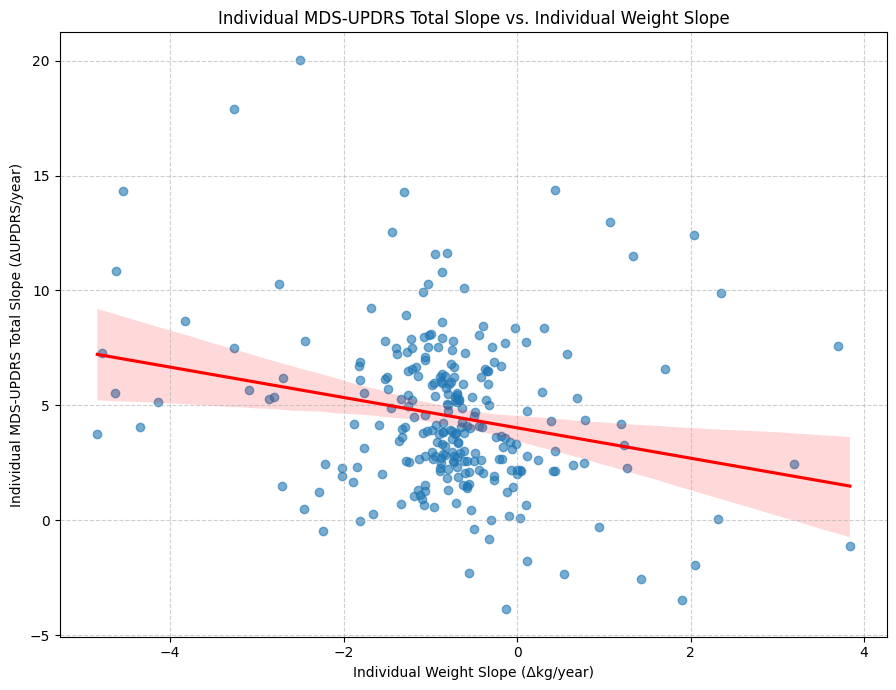
MDS-UPDRS Total Slope vs Individual Weight Slope
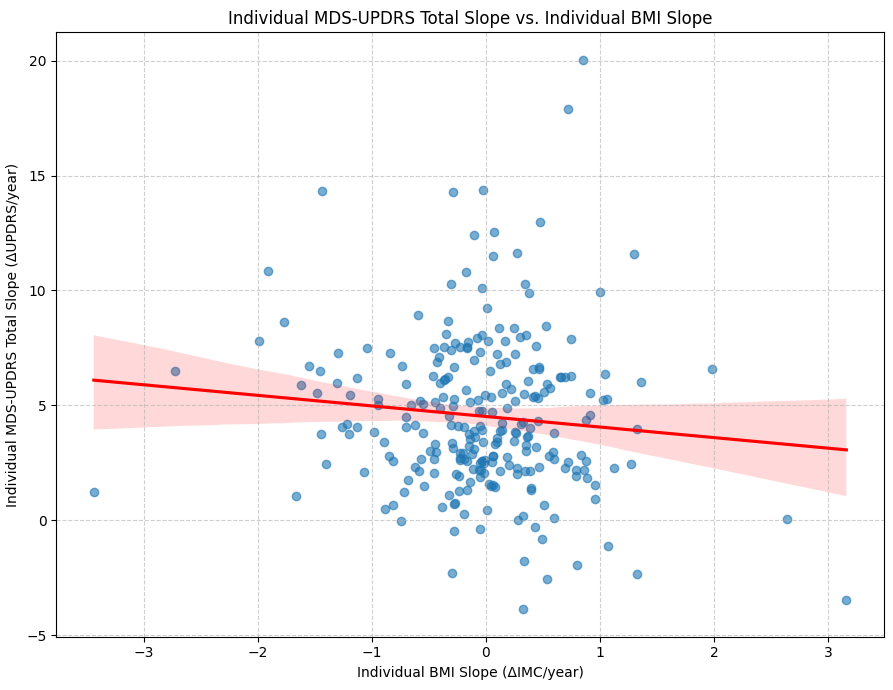
MDS-UPDRS Total Slope vs Individual BMI Slope
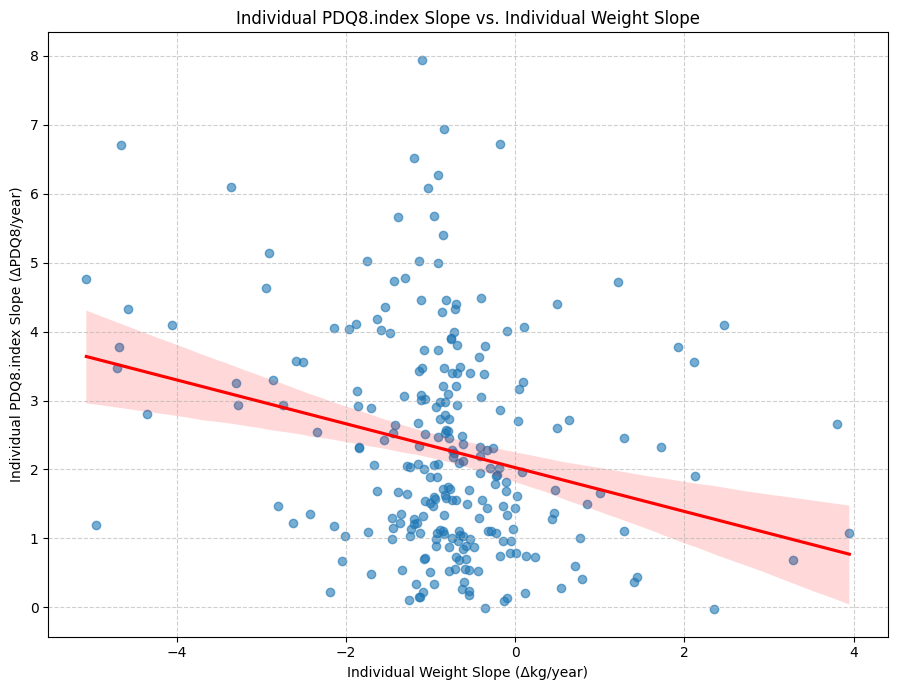
PDQ8.index Slope vs Individual Weight Slope
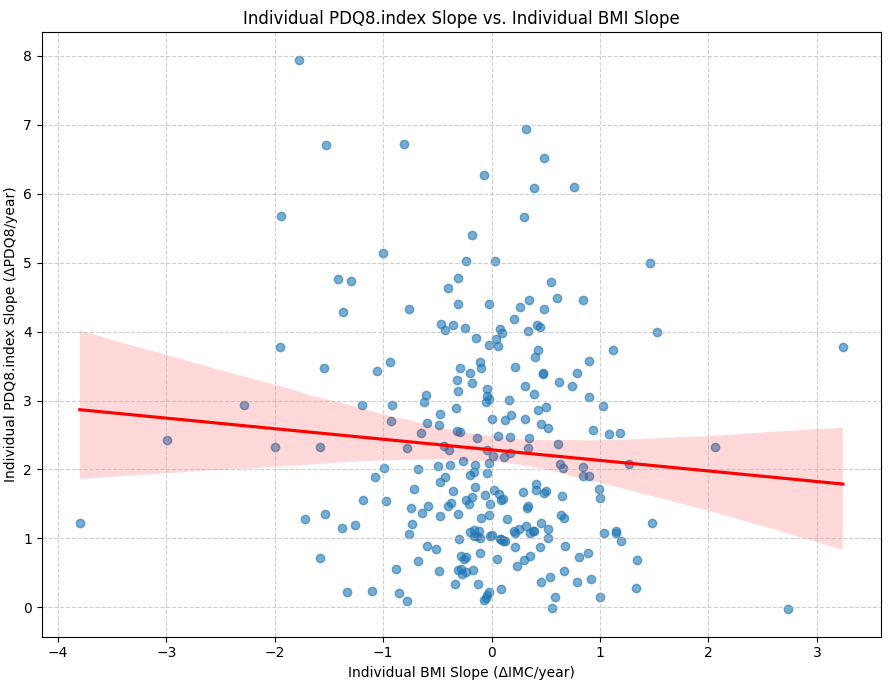
PDQ8.index Slope vs Individual BMI Slope
To cite this abstract in AMA style:
K. Sánchez-Ramírez, N. Sánchez-Lorenzo, A. Beltrán-Torres, M. Rocha-de-León, E. Ramírez-Benitez, A. Cervantes-Arriaga, M. Rodríguez-Violante. Longitudinal Weight/BMI Trajectories and Their Clinical Impact on Parkinson’s Disease. [abstract]. Mov Disord. 2026; 41 (suppl 1). https://www.mdsabstracts.org/abstract/longitudinal-weight-bmi-trajectories-and-their-clinical-impact-on-parkinsons-disease/. Accessed October 1, 2026.« Back to 2026 International Congress
MDS Abstracts - https://www.mdsabstracts.org/abstract/longitudinal-weight-bmi-trajectories-and-their-clinical-impact-on-parkinsons-disease/