
Objective: We evaluated the impact of NeuroOrb, a novel, accessible “Serious Gaming” computerised cognitive training (CT) platform, on cognitive function, mood and quality of life (QoL) in individuals with Parkinson’s disease (PD).
Background: PD is associated with a significant risk of cognitive impairment, with approximately 26% of individuals developing dementia within five years of PD diagnosis. CT has shown promise in maintaining cognition; however, traditional methods are often inaccessible for individuals with PD due to motor difficulties, diminished reward sensitivity and heightened apathy.
Method: 75 individuals with PD (48 male/27 female, average disease duration = 9 years) were randomly assigned to the NeuroOrb (n=25), CogCafe (puzzle-based activities active control (n=25)), or Normal Activity passive control (n=25) group. Participants in the NeuroOrb or CogCafe groups engaged with their intervention for three hours per week over six weeks, while the passive control group engaged in their activities as per their usual schedule. Cognitive function, mood, and QoL were assessed pre- and post-intervention, and again at six-months, using a comprehensive battery of assessments.
Results: Following six weeks of engagement, the NeuroOrb group significantly improved in global cognition (p=0.028), an effect not seen in either the CogCafe or Normal Activity groups. Within specific cognitive domains, the benefits of NeuroOrb were less clear, with no statistically significant changes observed between the NeuroOrb, CogCafe or Normal Activity groups at either follow-up timepoint. There were no significant group differences in mood or QoL at baseline, 6-weeks, or 6-months. Additionally, no significant group x time interactions were observed in any cognitive domain, or in mood or QoL, at either timepoint post-intervention.
Conclusion: The significant improvement in global cognition following six weeks of engagement with NeuroOrb suggests at least short-term benefits for individuals with PD. However, further research with larger samples is required to determine the extent to which NeuroOrb provides cognitive improvement over time. Additionally, combining CT tools with adjunct interventions, such as neurostimulation, may further enhance cognitive outcomes, particularly in individuals with cognitive impairment.
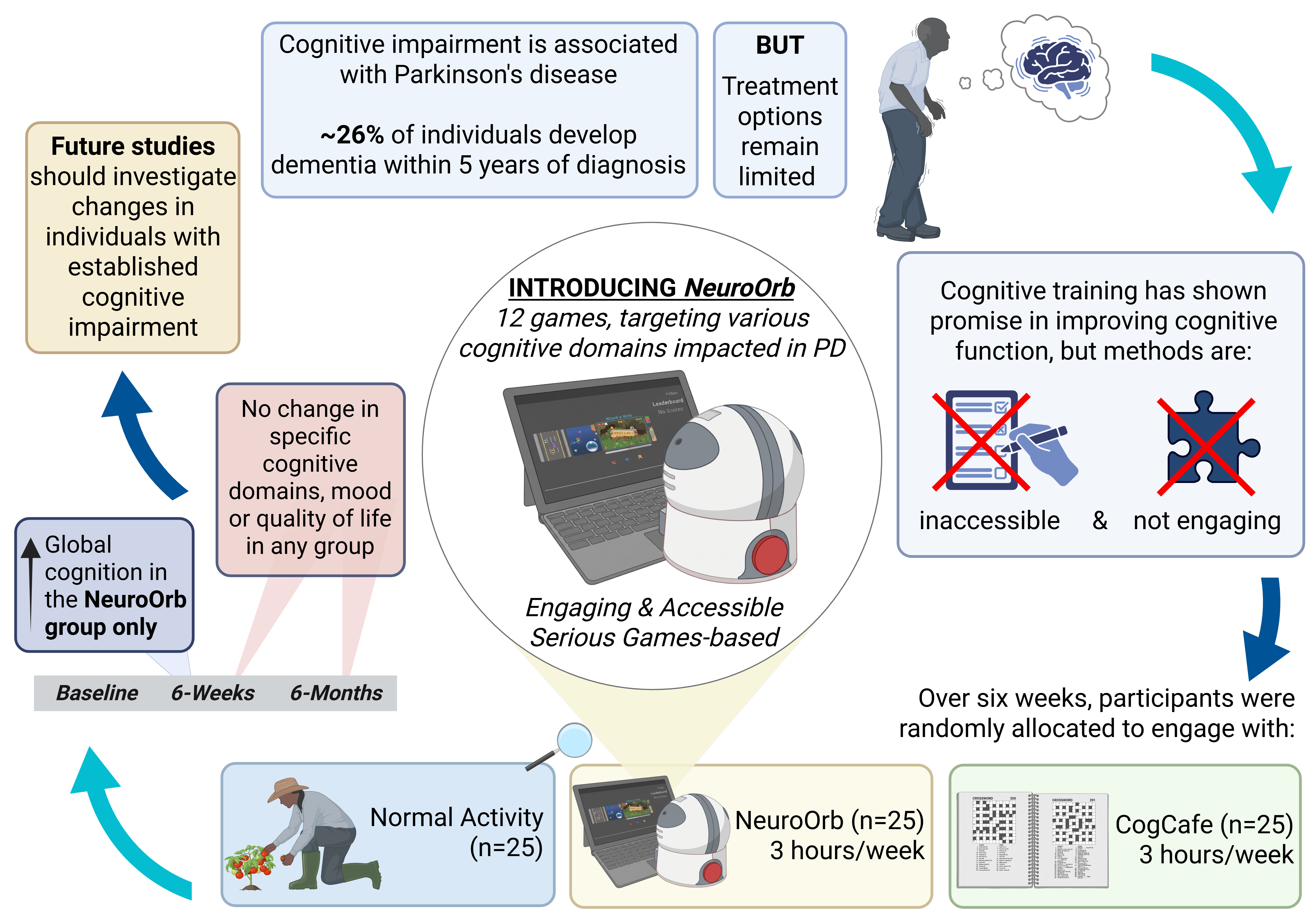
Graphical Abstract
To cite this abstract in AMA style:
M. Homes-Vickers, A. Mcnamara, A. Leonard, D. Hobbs, L. Collins-Praino. Changing the ‘Game’: The Impact of ‘Serious Games’-based Cognitive Training on Cognitive Function in Parkinson’s Disease [abstract]. Mov Disord. 2026; 41 (suppl 1). https://www.mdsabstracts.org/abstract/changing-the-game-the-impact-of-serious-games-based-cognitive-training-on-cognitive-function-in-parkinsons-disease/. Accessed October 1, 2026.« Back to 2026 International Congress
MDS Abstracts - https://www.mdsabstracts.org/abstract/changing-the-game-the-impact-of-serious-games-based-cognitive-training-on-cognitive-function-in-parkinsons-disease/