
Category: Parkinson’s Disease: Clinical Trials
Objective: To examine the feasibility and preliminary effects of a 4-week high-intensity multimodal training (HIMT) program [1], delivered through group-based weighted dance, for people with Parkinson’s disease (PD).
Background: HIMT, characterized by alternating high- and low-intensity exercise to combine aerobic and strength training within one session, has been shown effective in healthy adults [1]. However, existing HIMT protocols commonly rely on gym‑based resistance machines, potentially limiting accessibility and adherence. Dance is a motivating activity; when structured as HIMT and paired with external loading, it may provide an enjoyable approach to improving fitness while supporting adherence [2].
Method: People with mild PD (Hoehn & Yahr 1-2.5) were recruited in a single-group, 4-week HIMT program (12 sessions, 30 min/session, 3 sessions/week). Each session comprised 4×4-minute high-intensity intervals (two aerobic intervals and two weighted intervals), targeting ≥77% HRpeak (defined as the highest heart rate recorded during a symptom-limited graded exercise test using a recumbent stepper) [Figure 1]. Feasibility criteria were defined a priori as: recruitment rate ≥50%, attendance ≥75%, retention ≥80%, and no serious adverse events. Exploratory pre–post outcomes included Timed Up and Go Test (TUG), MDS-UPDRS-III, Five Times Sit-to-Stand Test (5TSST), 6-Minute Walk Test (6MWT), and Mini Balance Evaluation System Test (MiniBEST).
Results: Thirteen participants (mean age 63.4 ± 8.0 years) enrolled. Recruitment rate reached 81.3% of eligible participants, although eligibility among those screened was 33.3%. Attendance was 89.7% and retention was 92.3%. No serious intervention-related adverse events occurred. Target heart rate was achieved during 85.6% of high-intensity intervals. Significant improvements were observed in TUG (mean difference [MD] -1.79s, p=0.012), MDS-UPDRS-III (MD -4.42 points, p=0.023), and 5TSST (MD -2.03s, p=0.003). Positive trends were noted in 6MWT (MD +25.5m, p=0.05) and MiniBEST (MD +2.33, p=0.074). Participant satisfaction was high (median 8/10).
Conclusion: A 4-week group-based weighted-dance HIMT program is feasible, low-risk, and highly acceptable for individuals with mild PD, with strong adherence and fidelity to the targeted intensity. The improvements in functional mobility and motor severity suggest potential benefit and support evaluation in larger trials.
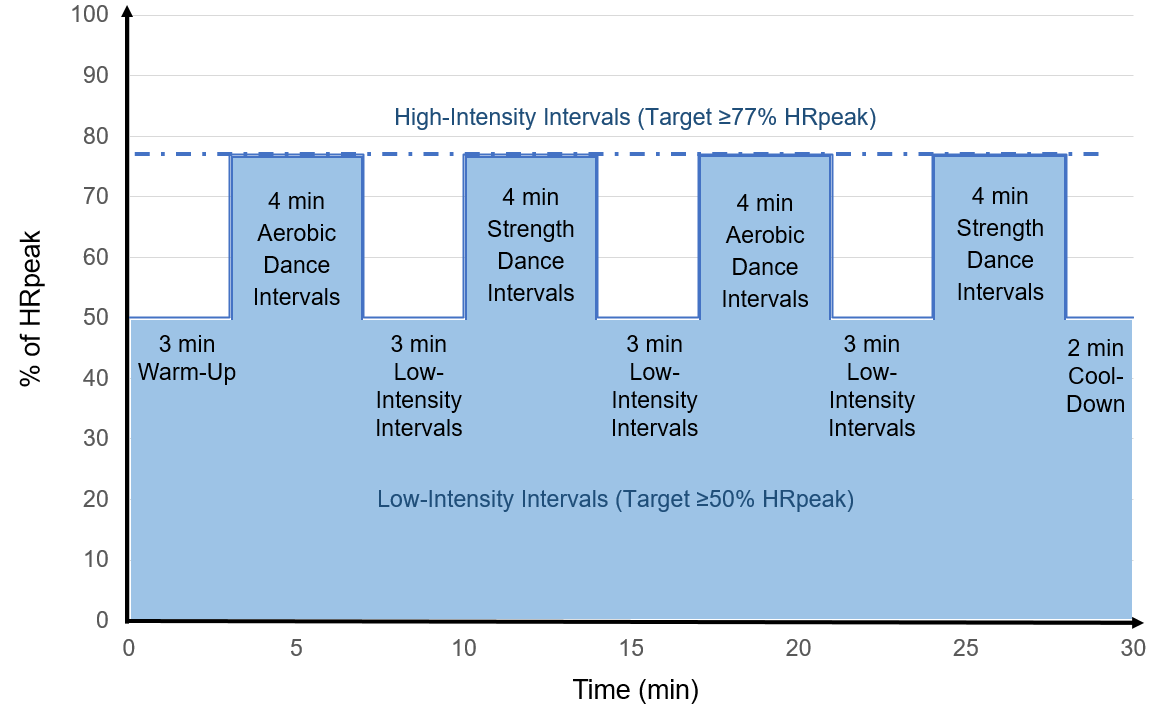
Exercise Protocol for HIMT
References: [1] Sharp T, Grandou C, Coutts AJ, Wallace L. The Effects of High-Intensity Multimodal Training in Apparently Healthy Populations: A Systematic Review. Sports Med Open 2022;8(1):43.
[2] Ferrusola-Pastrana A, Fullerton CL, Meadows SN. Group-based exercise for Parkinson’s: a qualitative study of participants and partners’ perceptions of an exercise class delivered through a community-university collaboration. BMC Geriatrics 2024;24(1).
To cite this abstract in AMA style:
Y. Chen, S. Lai, C. Xu, K. Liu, L. Lo, T. Cheng, C. Li, C. Lui, Y. Wang, J. Jiang, Y. Wang, M. Huang. High-Intensity Multimodal Training Through Group-Based Weighted Dance for Parkinson’s Disease: A Feasibility Study [abstract]. Mov Disord. 2026; 41 (suppl 1). https://www.mdsabstracts.org/abstract/high-intensity-multimodal-training-through-group-based-weighted-dance-for-parkinsons-disease-a-feasibility-study/. Accessed October 1, 2026.« Back to 2026 International Congress
MDS Abstracts - https://www.mdsabstracts.org/abstract/high-intensity-multimodal-training-through-group-based-weighted-dance-for-parkinsons-disease-a-feasibility-study/