
Category: Parkinson’s Disease: Clinical Trials
Objective: To evaluate a 12-session SPEAK OUT!® program’s effects on swallowing in advanced PD, comparing outcomes between medication-only and DBS-treated patients.
Background: Oropharyngeal dysphagia is common in PD. Due to shared neuromuscular control, voice therapy may provide cross-system benefits for swallowing, though evidence in advanced PD and DBS remains limited.
Method: A non-randomized controlled trial was conducted, including 38 advanced PD patients (Hoehn & Yahr stage 3-5) with dysphagia. Participants were assigned to one of three groups: 1) Medication plus voice therapy, 2) DBS plus voice therapy, and 3) Control (medication alone without an intervention). The intervention groups received 12 sessions of the Thai SPEAK OUT!® voice therapy program over 8 weeks. Outcomes were assessed at baseline and at week 8. The primary outcome was the change in Swallowing Disturbance Questionnaire (SDQ) scores. Secondary outcomes included Lingual MMT, MDADI-TH, PDQ-8, VHI, MPT, CPP, voice intensity, and formant frequency
Results: From a total of 38 advanced PD patients enrolled across three groups: Control (no intervention) (mean age 74.4; duration 10y), Medication plus voice therapy (68.9; 11y), and DBS plus voice therapy (59.6; 17y). Voice therapy improved swallowing outcomes (SDQ total scores) in both intervention groups (Medication: p < 0.001; DBS: p = 0.037), with no significant difference between the groups. Voice therapy groups showed significantly greater changes in SDQ pharyngeal scores than the control (p < 0.001). Significant differences in MDADI changes were observed between voice therapy groups (p < 0.001). The medication plus voice therapy group showed better performance than the control group in PDQ-8 (p < 0.001), maximum phonation time (p = 0.047), and CPP across sustained-vowel (p = 0.034) and reading tasks (p = 0.005). While the small DBS sample size necessitates cautious interpretation, participants reported enhanced family communication and a sense of being valued.
Conclusion: This study highlights the clinical value of multidisciplinary rehabilitation in advanced PD. The findings suggest that voice therapy extends beyond speech improvement to positively influence swallowing function, ultimately enhancing patient care and quality of life.
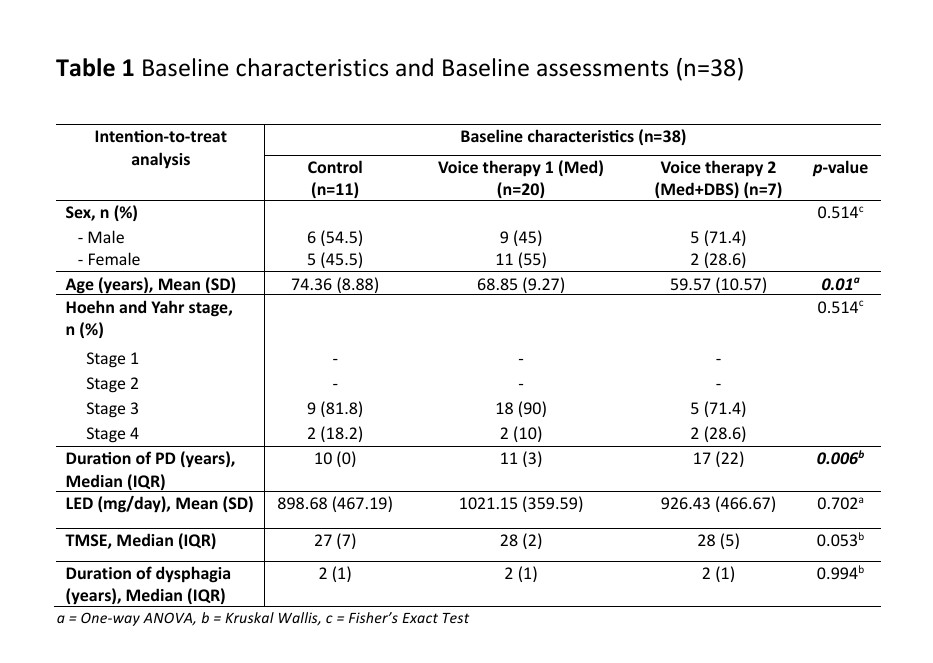
table1
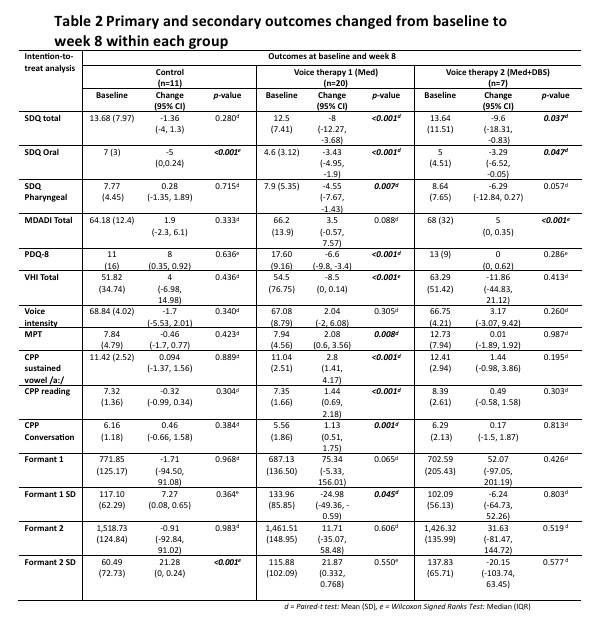
Table 2
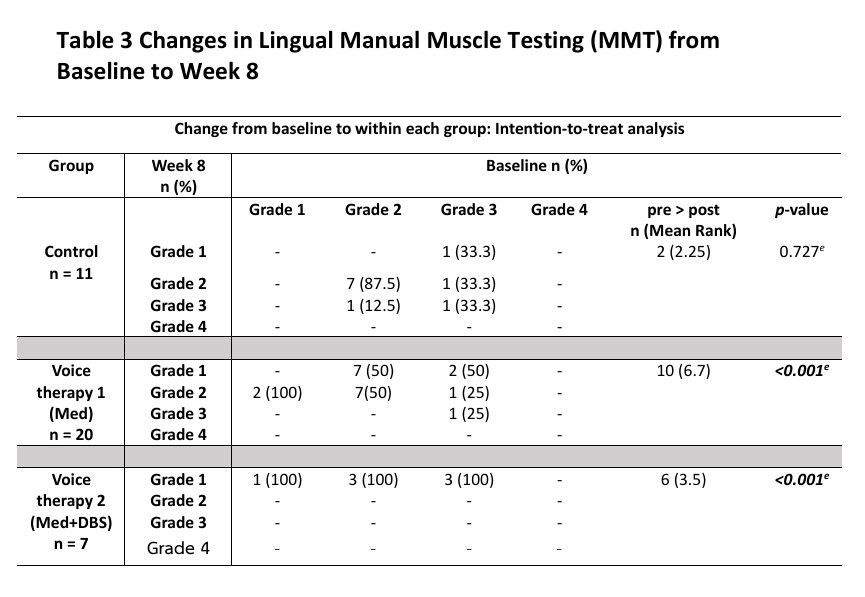
Table 3
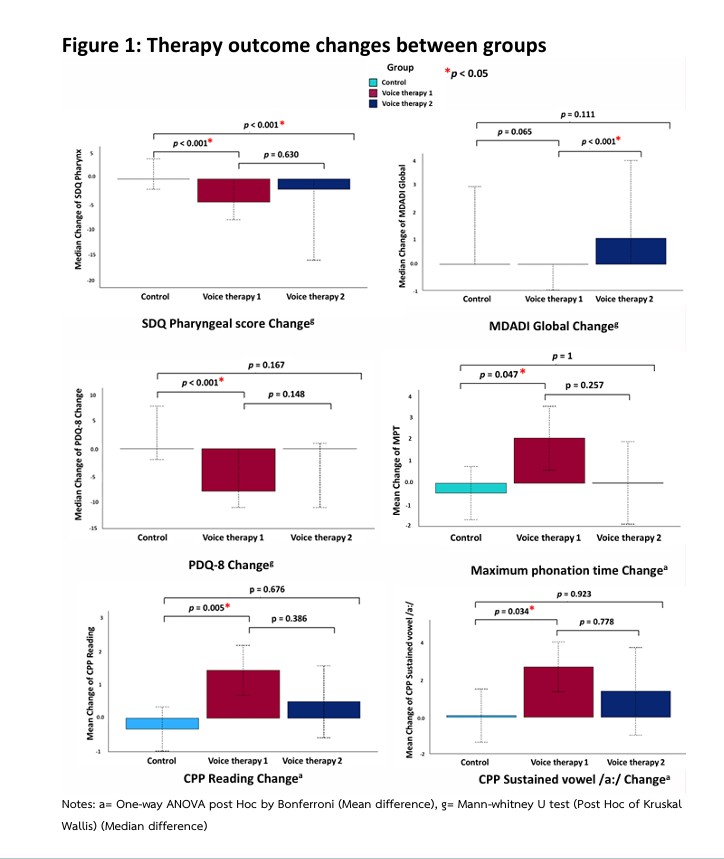
Figure 1
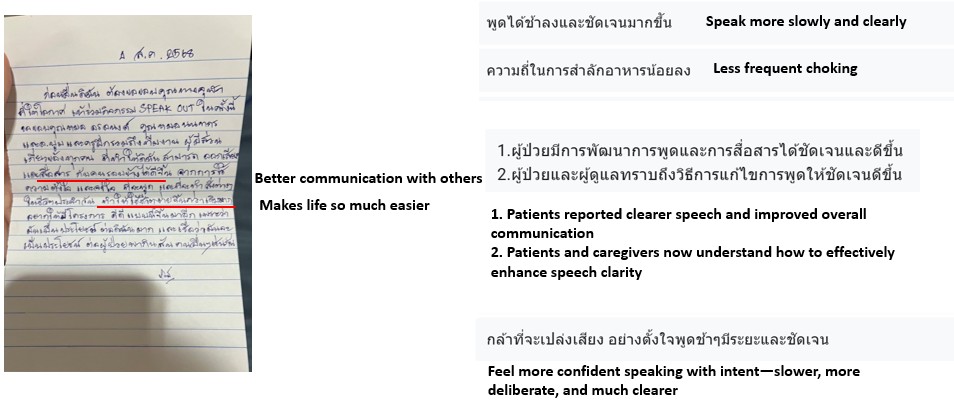
Figure 2 Reflections from Participants
References: 1. Cohen JT, Manor Y. Swallowing disturbance questionnaire for detecting dysphagia. Laryngoscope. 2011;121(7):1383-7.
2. Behrman A, Cody J, Elandary S, Flom P, Chitnis S. The Effect of SPEAK OUT! and The LOUD Crowd on Dysarthria Due to Parkinson’s Disease. Am J Speech Lang Pathol. 2020;29(3):1448-65.
3. Miles A, Jardine M, Johnston F, de Lisle M, Friary P, Allen J. Effect of Lee Silverman Voice Treatment (LSVT LOUD(R)) on swallowing and cough in Parkinson’s disease: A pilot study. J Neurol Sci. 2017;383:180-7.
4. El Sharkawi A, Ramig L, Logemann JA, Pauloski BR, Rademaker AW, Smith CH, et al. Swallowing and voice effects of Lee Silverman Voice Treatment (LSVT): a pilot study. J Neurol Neurosurg Psychiatry. 2002;72(1):31-6.
5. Stegemoller EL, Hibbing P, Radig H, Wingate J. Therapeutic singing as an early intervention for swallowing in persons with Parkinson’s disease. Complement Ther Med. 2017;31:127-33.
6. Park A, Jang SJ, Kim NE, Kim TH, Sohn YH, Kim H, Cho SR. Swallowing Outcomes Following Voice Therapy in Multiple System Atrophy with Dysphagia: Comparison of Treatment Efficacy with Parkinson’s Disease. Dysphagia. 2022;37(1):198-206.
To cite this abstract in AMA style:
N. Likhitwitayawuid, S. Jitwiriyanont, K. Nantanukul, R. Bhidayasiri, O. Phokaewvarangkul. Can Voice Therapy Improve Swallowing in Advanced Parkinson’s Disease? A Comparison of SPEAK OUT!® Outcomes in Patients With Deep Brain Stimulation and Medical Therapy [abstract]. Mov Disord. 2026; 41 (suppl 1). https://www.mdsabstracts.org/abstract/can-voice-therapy-improve-swallowing-in-advanced-parkinsons-disease-a-comparison-of-speak-out-outcomes-in-patients-with-deep-brain-stimulation-and-medical-therapy/. Accessed October 1, 2026.« Back to 2026 International Congress
MDS Abstracts - https://www.mdsabstracts.org/abstract/can-voice-therapy-improve-swallowing-in-advanced-parkinsons-disease-a-comparison-of-speak-out-outcomes-in-patients-with-deep-brain-stimulation-and-medical-therapy/