
Objective: To characterize longitudinal trajectories of alanine aminotransferase (ALT) and aspartate aminotransferase (AST) activity and the neutrophil-to-lymphocyte ratio (NLR) in Parkinson’s disease (PD) and healthy controls (HC), and to examine whether patterns differ across genetic PD subgroups carrying mutations in the leucine-rich repeat kinase 2 (LRRK2 G2019S) or glucocerebrosidase (GBA1, 9 founder mutations) genes.
Background: ALT and AST are routinely measured, and NLR can be derived from standard blood counts. Some studies found lower ALT activity and higher NLR in PD, while results for AST are mixed. However, prior studies have largely relied on cross-sectional data, limiting insight into longitudinal trajectories and clinical correlates.
Method: Repeated laboratory and clinical measures were analyzed from BEAT-PD, a longitudinal natural history cohort enriched for genetically defined PD and at-risk carriers.
Results: The cohort included 175 individuals with PD (63 idiopathic PD, 51 LRRK2-PD and 61 GBA1-PD) and 345 non-manifesting individuals (74 non-manifesting LRRK2 carriers, 94 non-manifesting GBA1 carriers, and 177 HC). ALT activity was consistently lower in PD across analyses and longitudinally declined in PD while slightly increasing in HC, with small absolute changes over a median 4-year follow-up. In PD, lower ALT activity was associated with longer disease duration; this relationship persisted after accounting for increasing dopaminergic medication dosages, suggesting it was not explained solely by pharmacological exposure. Differences in AST and NLR were less consistent across analyses. These blood analytes did not meaningfully differ between genetic PD subgroups. Among non-manifesting individuals, NLR correlated with the probability of prodromal PD at one timepoint.
Conclusion: Decreased ALT activity in PD with a progressive decline over time may reflect intrinsic disease-related pathophysiology rather than a purely pharmacological effect. While effect sizes were small and not currently clinically actionable, these findings support ALT as a candidate biomarker of PD risk and disease progression, with potential relevance for early detection and disease-modifying interventions.
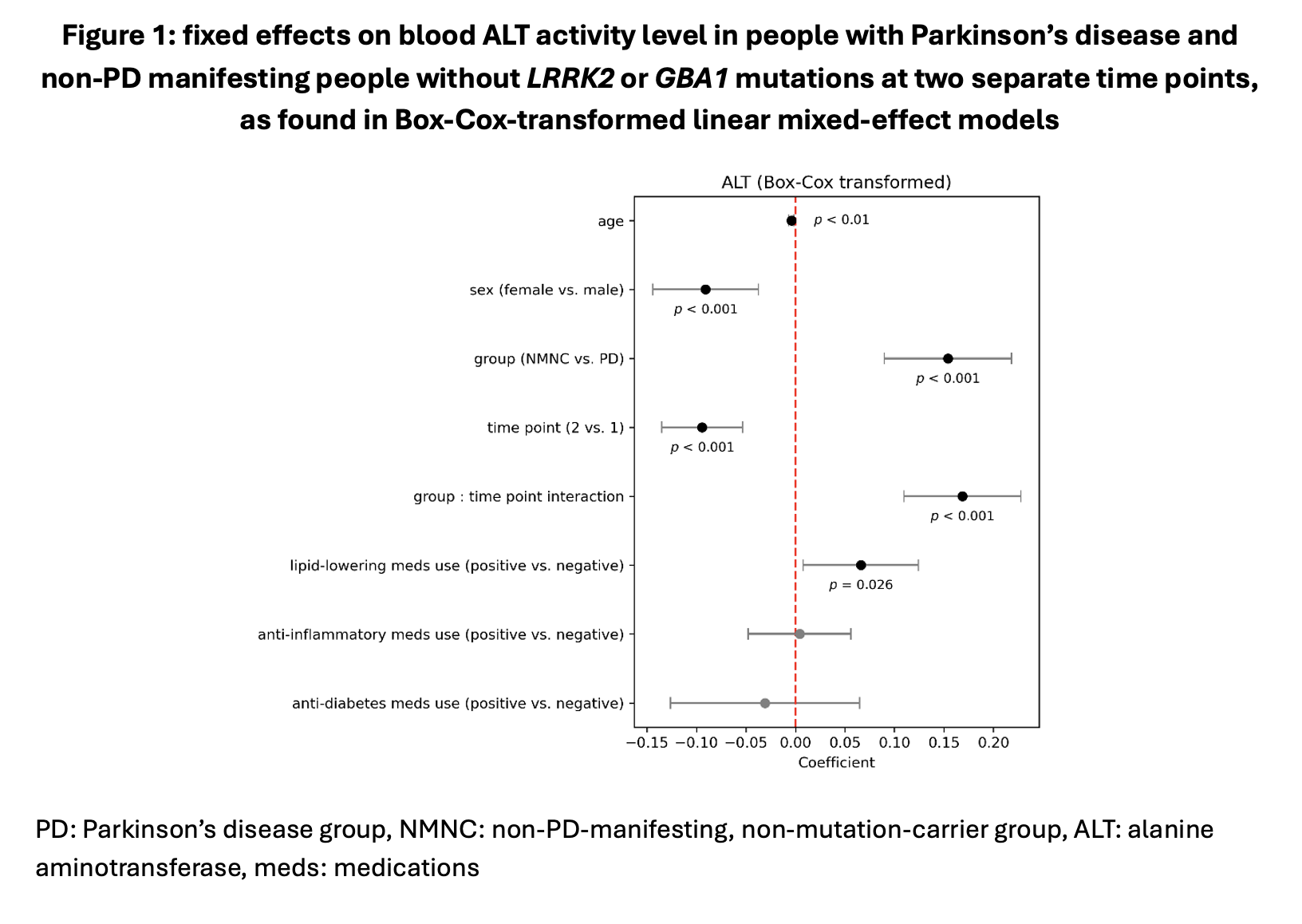
Figure 1
To cite this abstract in AMA style:
G. Maayan Eshed, M. Shemesh, N. Omer, R. Alcalay, M. Gana-Weisz, O. Goldstein, A. Mirelman, A. Thaler. Longitudinal Decline of Alanine Aminotransferase Activity in Parkinson’s Disease and Its Association with Disease Duration [abstract]. Mov Disord. 2026; 41 (suppl 1). https://www.mdsabstracts.org/abstract/longitudinal-decline-of-alanine-aminotransferase-activity-in-parkinsons-disease-and-its-association-with-disease-duration/. Accessed October 1, 2026.« Back to 2026 International Congress
MDS Abstracts - https://www.mdsabstracts.org/abstract/longitudinal-decline-of-alanine-aminotransferase-activity-in-parkinsons-disease-and-its-association-with-disease-duration/