
Objective: To estimate the prevalence and distribution of depressive symptoms in PwP and identify demographic and clinical factors associated with depression across European cohorts available in the Global Parkinson’s Genetics Program (GP2)
Background: Depression is one of the most common non-motor symptoms of Parkinson’s disease (PD) and a major contributor to reduced quality of life. The presence and severity of depressive symptoms in individuals with PD (PwP) are the result from neurobiological, psychosocial, and disease-specific mechanisms.
Method: Data from European PD cohorts were obtained from the GP2 Release 11 (Table 1). Depressive symptoms were assessed using the Beck Depression Inventory (BDI) and the Geriatric Depression Scale (GDS-15). Prevalence of clinically relevant depressive symptoms was calculated using established cutoffs (BDI ≥13; GDS-15 ≥5). Depression scores were standardized as z-scores based on the control distribution for each instrument to enable pooled analyses. Associations with clinical variables were evaluated using Wilcoxon rank-sum tests, and differences across Hoehn and Yahr stages using the Kruskal–Wallis test. Independent predictors of depression severity were examined with multiple linear regression including sex, history of depression, comorbidities, age at onset, and UPDRS Parts II and III. Analyses were performed in R.
Results: Clinically relevant depressive symptoms were present in 23.3% of PwP using the BDI and 18.2% using the GDS-15. In pooled analyses with standardized depression z-scores, scores were significantly associated with history of depression (p < 0.001) and comorbid diseases (p = 0.022), but not sex (p = 0.30). Depression scores also differed across Hoehn and Yahr stages (p < 0.001). In multivariable linear regression, history of depression (β = 0.39, p = 0.0028) and higher UPDRS Part II scores (β = 0.039, p = 0.0011) were associated with higher depression z-scores. Sex, age at onset, Hoehn and Yahr stage, comorbid diseases, and UPDRS Part III were not significant predictors. The overall model was significant (p < 0.001) and explained ~16–19% of the variance.
Conclusion: Depressive symptoms are common among PwP across European cohorts. Standardizing depression scores to control populations enabled pooled analyses across instruments and identified clinical factors associated with greater depressive burden in PD.
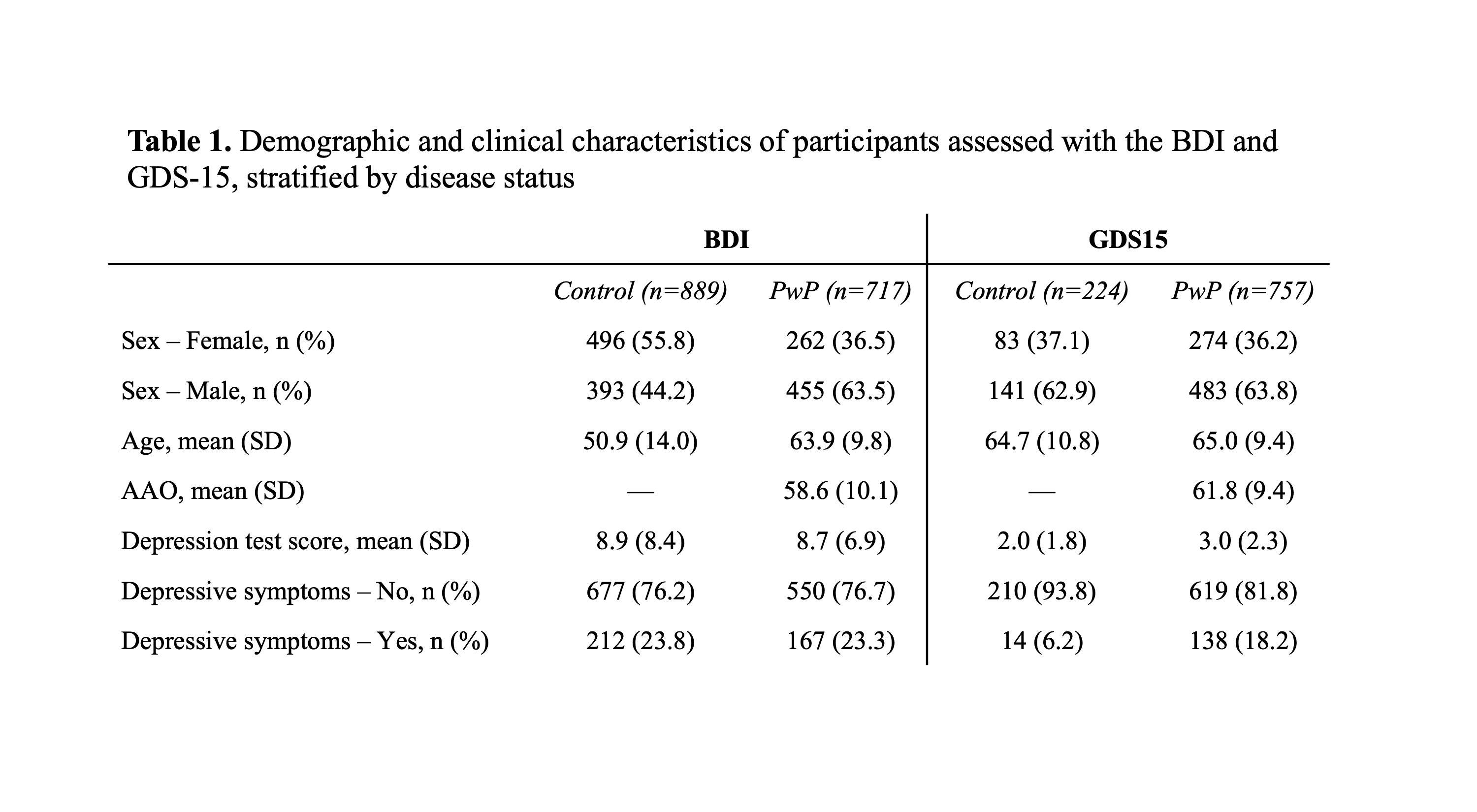
Table 1
To cite this abstract in AMA style:
P. Reyes-Pérez, T. Perinan, D. Delgado, A. Lazaro-Figueroa, A. Medina-Rivera, A. Ruiz-Contreras, S. Alcauter-Solorzano. Prevalence and clinical predictors of depressive symptoms in Parkinson’s Disease: an analysis from the Global Parkinson’s Genetics Program [abstract]. Mov Disord. 2026; 41 (suppl 1). https://www.mdsabstracts.org/abstract/prevalence-and-clinical-predictors-of-depressive-symptoms-in-parkinsons-disease-an-analysis-from-the-global-parkinsons-genetics-program/. Accessed October 1, 2026.« Back to 2026 International Congress
MDS Abstracts - https://www.mdsabstracts.org/abstract/prevalence-and-clinical-predictors-of-depressive-symptoms-in-parkinsons-disease-an-analysis-from-the-global-parkinsons-genetics-program/