
Category: Parkinson’s Disease: Clinical Trials
Objective: To evaluate the safety, feasibility, and potential cognitive effects of high-frequency rTMS targeting the left DLPFC in Veterans with PD-MCI.
Background: Cognitive impairment is a common and disabling non-motor feature of Parkinson’s disease (PD), contributing to functional decline and reduced quality of life. Pharmacologic treatment options remain limited. Repetitive transcranial magnetic stimulation (rTMS) is a non-invasive neuromodulation technique that can modulate cortical networks involved in cognition. Stimulation of the dorsolateral prefrontal cortex (DLPFC), a key node of executive control networks, may improve cognitive function in PD. However, data evaluating rTMS for PD-related mild cognitive impairment (PD-MCI), particularly in Veterans, remain limited.
Method: In this randomized, double-blind, sham-controlled trial, Veterans aged ≥50 years with idiopathic PD and PD-MCI were randomized to receive active or sham rTMS targeting the left DLPFC. Active stimulation was delivered at 110% of resting motor threshold at 15 Hz with 5-second trains (40 trains per session) over 10 sessions. Neuropsychological assessments were performed at baseline, endpoint, and one-month follow-up. The primary outcome was change in executive function measured by the NIH-EXAMINER Executive Composite Score. Secondary outcomes included memory, processing speed, and functional measures. Safety was assessed through adverse event monitoring and review of concomitant medications.
Results: Thirteen participants completed the trial (active rTMS n=7; sham n=6). rTMS was well tolerated, with no seizures, syncope, or serious stimulation-related adverse events. Review of concomitant psychoactive and other CNS-active medications revealed no safety concerns. Preliminary analysis showed no between-group difference in NIH-EXAMINER scores; however, the active group demonstrated a within-group trend toward improvement in executive function (p=0.1). Anxiety symptoms improved significantly within the active group (p=0.03).
Conclusion: High-frequency rTMS targeting the left DLPFC appears safe and feasible in Veterans with PD-MCI. Preliminary findings suggest potential improvement in executive function and anxiety symptoms in the active treatment group. Larger studies are needed to confirm the cognitive benefits of rTMS as a neuromodulatory approach for cognitive impairment in Parkinson’s disease.
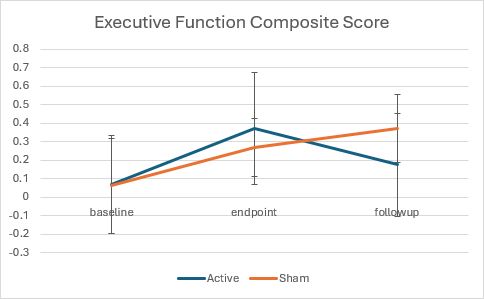
Improvement in executive function composite score
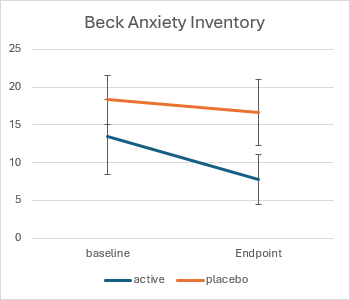
Improvement in Beck Anxiety Inventory
To cite this abstract in AMA style:
Y. Kim, S. Walker, K. Colletta, A. Umbarger, S. Kletzel. High-Frequency rTMS for Cognitive Impairment in Parkinson’s Disease: A Randomized Sham-Controlled Trial in Veterans [abstract]. Mov Disord. 2026; 41 (suppl 1). https://www.mdsabstracts.org/abstract/high-frequency-rtms-for-cognitive-impairment-in-parkinsons-disease-a-randomized-sham-controlled-trial-in-veterans/. Accessed October 1, 2026.« Back to 2026 International Congress
MDS Abstracts - https://www.mdsabstracts.org/abstract/high-frequency-rtms-for-cognitive-impairment-in-parkinsons-disease-a-randomized-sham-controlled-trial-in-veterans/