
Objective: To characterise olfactory dysfunction in early‑onset Parkinson’s disease (EOPD).
Background: Olfactory loss is a frequent non‑motor feature of Parkinson’s disease and often precedes motor onset, but data in EOPD are limited. Prior work in mainly late‑onset cohorts shows high hyposmia prevalence, selective odor vulnerability, male disadvantage, and links to disease duration and (in some studies) cognition and RBD.
Method: In a cross‑sectional study, 156 EOPD patients (motor onset ≤50 years) completed a 12‑item odor identification test (orange, leather, cinnamon, peppermint, banana, grapefruit, mixture (licorice), coffee, clove, pineapple, rose, fish), MoCA, Beck Depression Inventory, and an RBD1Q. Non‑parametric statistics (Spearman, Mann–Whitney U, chi‑square, point‑biserial correlations) were applied.
Results: In the total cohort (n=156), subjective smell loss was reported by 94 patients (60.3%) whereas objective hyposmia (Sniffin’ Sticks score <10) was present in 123 (78.8%); subjective complaint showed moderate performance overall (sensitivity 68.3%, specificity 69.7%) and concordance in women (66.7%, 79.2%) but not in men (70.4%, 44.4%). Mean identification score was 7.0 ± 2.5/12 (≈42% errors).
Best recognised odorants were fish (84.0% correct) and orange (81.4%); the most difficult were grapefruit (41.0%), pineapple (42.9%), cinnamon (43.9%), and leather (45.8%).
Total olfactory score correlated negatively with disease duration (ρ=−0.306, p=0.0008) but not age of onset. Orange (r=−0.416, p<0.0001), grapefruit (r=−0.331, p=0.0003), coffee, and rose showed duration‑dependent decline. Men made more errors than women (5.52 vs 4.61; p=0.0226), largest for mixture (41.9% vs 64.5%; p=0.0092). Olfaction was unrelated to MoCA or depression; RBD was not associated with smell or cognition.
Conclusion: EOPD shows marked olfactory impairment with odor‑specific vulnerability: citrus (orange, grapefruit) and complex odors (coffee, rose) are most sensitive to disease duration. Findings align with reports of progressive smell loss and male disadvantage in PD, but show no association with cognition or RBD, consistent with a younger, cognitively preserved phenotype(1). Orange/grapefruit as progression‑sensitive and mixture as sex‑sensitive markers are novel, supporting brief targeted olfactory tests for EOPD.
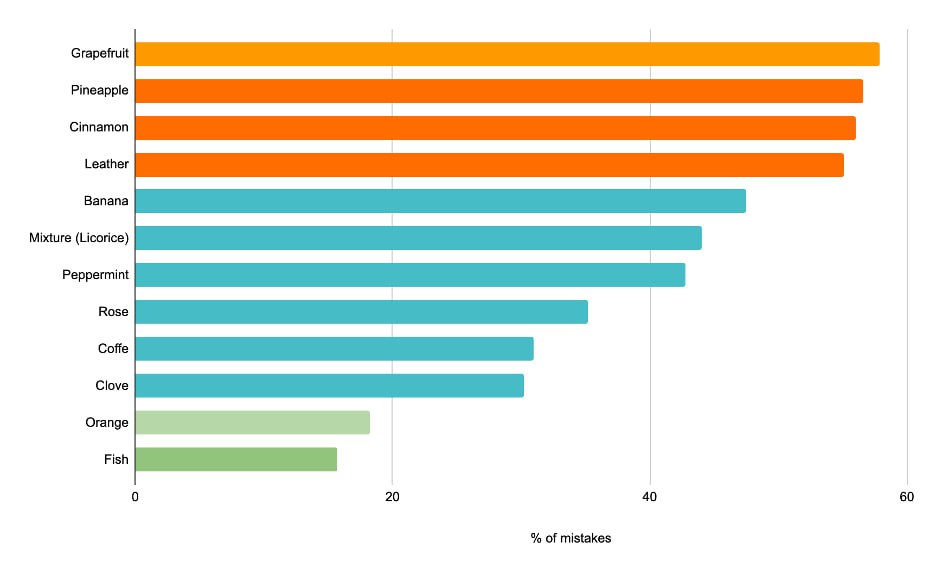
Percentage of wrong odor identification
References: 1. Mitchell E, Mattjie C, Bestwick JP, Barros RC, Schuh AF, Simonet C, et al. Hyposmia in Parkinson’s disease: exploring selective odour loss. npj Parkinsons Dis. 2025;11:67. doi:10.1038/s41531-025-00922-3.
To cite this abstract in AMA style:
D. Larina, E. Bagdasarova, I. Zdorovec, A. Shekhvatova, K. Nazarova, M. Nikolaeva, I. Miliukhina, A. Murtazina, E. Bril, O. Turgunkhujaev. Odor‑specific olfactory dysfunction in early‑onset Parkinson’s disease [abstract]. Mov Disord. 2026; 41 (suppl 1). https://www.mdsabstracts.org/abstract/odor-specific-olfactory-dysfunction-in-early-onset-parkinsons-disease/. Accessed October 1, 2026.« Back to 2026 International Congress
MDS Abstracts - https://www.mdsabstracts.org/abstract/odor-specific-olfactory-dysfunction-in-early-onset-parkinsons-disease/