
Category: Parkinson's Disease: Genetics
Objective: To characterize the patient population enrolled in the ACTIVATE study, a Phase 2 multicenter, randomized, double-blind, placebo-controlled trial assessing the efficacy, safety, tolerability, pharmacodynamics, and pharmacokinetics of BIA 28-6156 in GBA-associated Parkinson’s disease (GBA-PD).
Background: Mutations in the GBA1 gene, which reduce glucocerebrosidase (GCase) enzyme activity, are a well-established genetic risk factor for Parkinson’s disease (PD). Pathogenic GBA1 variants are associated with earlier disease onset, faster progression, and greater cognitive impairment compared to idiopathic PD. Current PD treatments target symptoms but do not address the underlying pathology. BIA 28-6156, an allosteric GCase activator, aims to enhance GCase activity, potentially offering a disease-modifying approach for GBA-PD.
Method: Patients were randomized to receive BIA 28-6156 (10 mg/day or 60 mg/day) or placebo for 78 weeks. Eligible patients were 35–80 years old, had a clinical PD diagnosis (MDS criteria) for 1–7 years, a Hoehn and Yahr score ≤2.5, and a confirmed GBA1 variant. Enrollment required a MoCA score ≥22, absence of moderate motor complications (MDS-UPDRS Part IV subitems ≥3), and stable dopaminergic therapy for at least 30 days prior to screening.
Results: A total of 271 genetically confirmed GBA-PD patients from 11 countries were enrolled (mean age: 58.7 ± 10.0 years; 61.9% male; mean disease duration: 3.7 ± 1.9 years) [table1]. Forty-one GBA1 variants were identified, 33.9% classified as severe [figure1, table2]. At baseline, the mean MDS-UPDRS Part III score was 26.4 ± 11.6, indicating mild motor impairment. Motor fluctuations were present in 50.6% of patients, and dyskinesias in 20.9%, both occurring in less than 50% of waking hours. Cognitive function was largely intact (PD-CRS: 98.1±15.0) [table3]. Levodopa was used by 90% of participants, with a mean daily dose of 479.0 ± 256.8 mg [table4].
Conclusion: The ACTIVATE population consisted at baseline of GBA-PD patients with mild disease severity and a balanced distribution of GBA1 variants. Motor fluctuations and dyskinesias when present were mild. Moderate levodopa and LEED doses further support the early-stage profile. These findings support the feasibility of recruiting this patient population and ensuring a homogeneous sample for evaluating BIA 28-6156’s efficacy in GBA-PD.
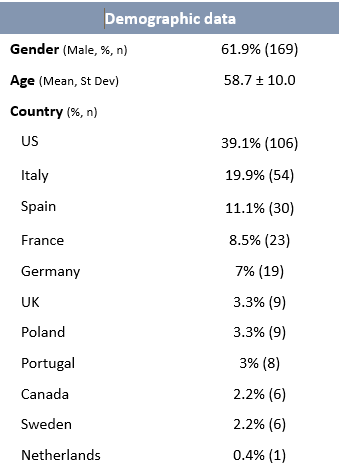
Table 1 Demographic data
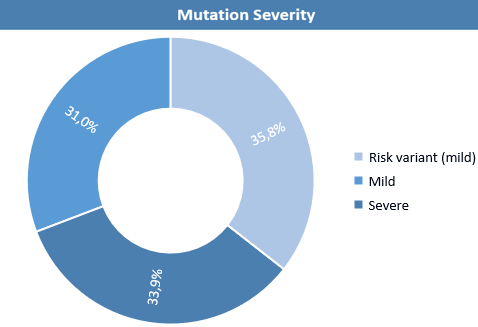
Figure 1 GBA Mutation Severity
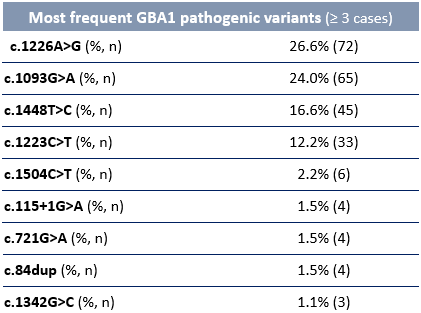
Table 2 GBA variants
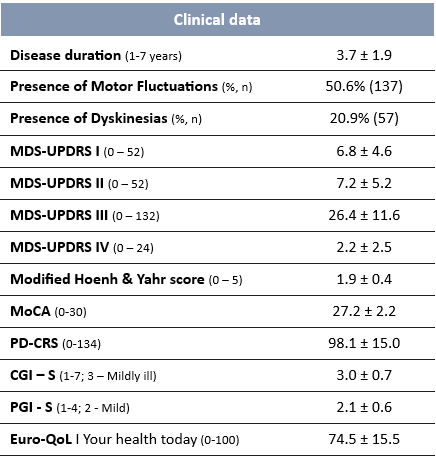
Table 3 clinical data
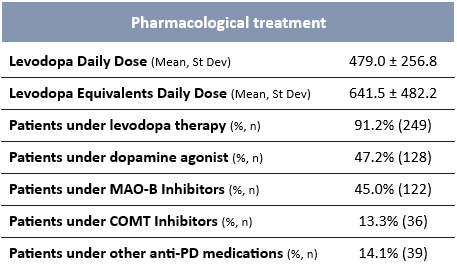
Table 4 Pharmacological treatment
To cite this abstract in AMA style:
JJF. Ferreira, RC. Costa, RBM. Bouça-Machado, FRP. Pereira, GC. Cordeiro, TF. Fonseca, MF. Fonseca, DR. Ramos, AG. Guimarães, JH. Holenz. Clinical and Genetic Profile of the ACTIVATE Population: A Phase 2 Trial of BIA 28-6156 in GBA-PD [abstract]. Mov Disord. 2026; 41 (suppl 1). https://www.mdsabstracts.org/abstract/clinical-and-genetic-profile-of-the-activate-population-a-phase-2-trial-of-bia-28-6156-in-gba-pd/. Accessed October 1, 2026.« Back to 2026 International Congress
MDS Abstracts - https://www.mdsabstracts.org/abstract/clinical-and-genetic-profile-of-the-activate-population-a-phase-2-trial-of-bia-28-6156-in-gba-pd/