
Category: Disparities
Objective: To examine how the built environment influences accessibility of Parkinson’s disease (PD) programs offered by community-based organizations (CBOs).
Background: CBOs offer programs to help fill gaps in PD care by providing support and resources. Although data is limited, existing evidence suggests minority individuals may be underrepresented [1]. Structural factors, including the built environment, may influence access.
Method: This multicenter, cross-sectional study in Houston, TX included participants from academic medical centers and a safety-net county clinic. Participants completed a survey assessing factors influencing participation in PD community programs. Residential addresses were used to calculate distance to local PD programs and to obtain the Area Deprivation Index (ADI) and public transit scores. Program accessibility was evaluated based on participants’ distance and scheduling preferences.
Results: One hundred seventy-one participants completed the survey (median age 71; 57.3% male). Most participants preferred English, but Hispanics were more likely to prefer Spanish (p<0.001). Hispanic and Black participants were more likely to live in more resource-deprived areas (p < 0.001). The median distance to the nearest support group was 10 miles and to the nearest wellness activity was 6.2 miles, with shorter distances for Asians and longer distances for Hispanics [Table 1]. Most participants were interested in attending events but had not previously participated and were unaware of local programs [Figure 1]. Overall, 73% of participants could attend support groups and 73.6% could attend wellness activities based on distance and timing preferences. In logistic regression adjusting for race/ethnicity, ADI, distance to nearest program, transit score, and transportation barriers, language barriers were associated with a lower likelihood of attending support groups (p = 0.023). Correlation analyses showed higher ADI was associated with longer distances to programs (p < 0.001), and greater distances were associated with reduced ability to attend support groups (p = 0.002).
Conclusion: Built environment factors, including neighborhood deprivation and distance to programs, influence accessibility to PD community programs. Strategic, community-integrated program placement and improved accessibility may help promote equitable participation.
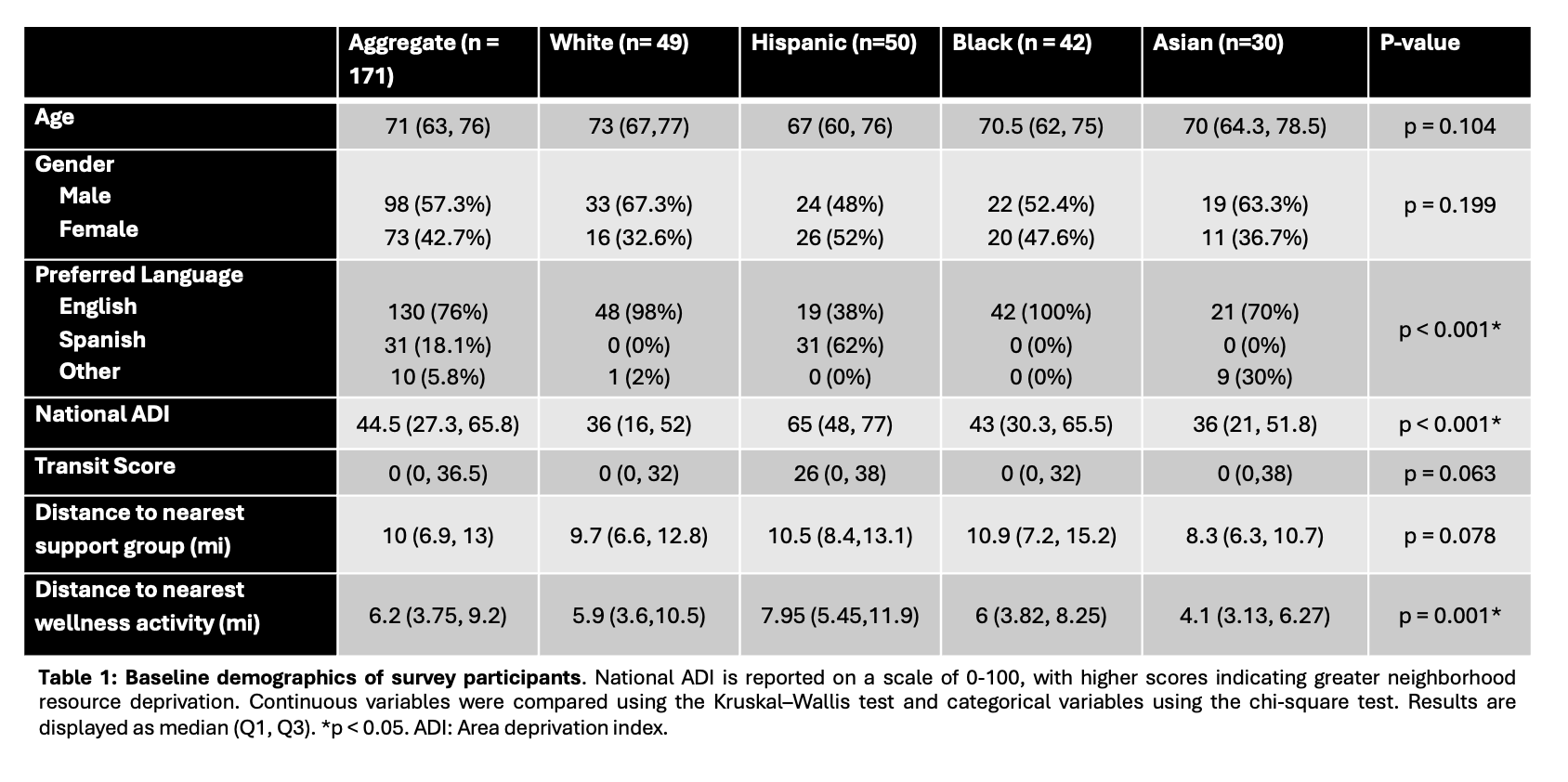
Table 1
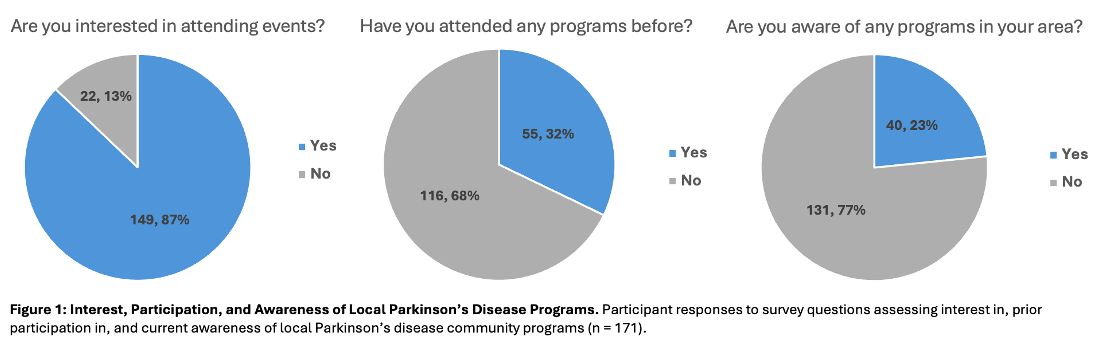
Figure 1
References: [1] Onuigbo C, Branson C. Exploring deep brain stimulation willingness in Black individuals with Parkinson’s disease. Equity Neurosci. 2025 Sep;1(2):100012. doi: 10.1016/j.neuros.2025.100012
To cite this abstract in AMA style:
C. Onuigbo, S. Garcia, C. Tran, J. Martinez-Lemus, S. Chandra, M. Schiess. Built Environment and Accessibility to Parkinson’s Disease Community Programs: A Preliminary Analysis [abstract]. Mov Disord. 2026; 41 (suppl 1). https://www.mdsabstracts.org/abstract/built-environment-and-accessibility-to-parkinsons-disease-community-programs-a-preliminary-analysis/. Accessed October 1, 2026.« Back to 2026 International Congress
MDS Abstracts - https://www.mdsabstracts.org/abstract/built-environment-and-accessibility-to-parkinsons-disease-community-programs-a-preliminary-analysis/