
Category: Parkinson's Disease (Other)
Objective: To examine how adherence and data completeness vary throughout the day in wearable monitoring of people with Parkinson’s disease (PwPD), and whether missing data patterns are associated with disease severity.
Background: Wearable devices provide objective and continuous measures of PD symptoms in real-world settings. However, monitoring is often affected by substantial missing data, arising from physical, cognitive and technological barriers. Understanding missingness is essential to ensure data reliability and avoid systematic biased interpretation.
Method: Wearable data from 79 PwPD and 28 healthy controls (HC) were obtained from the PPMI database [1]. The final dataset included ~28 consecutive days of accelerometer data (sampling rate 100Hz) recorded using the Verily Study Watch. Device wear time was quantified hourly and organized by time-of-day [figure1]. Two-models were used: a mixed-effects logistic model to estimate the probability of wearing the device (adherence), and a mixed-effects Beta regression applied to active observations to model the magnitude of the completeness ratio (CR). This framework was used for analysing: (i) time-of-day differences between PwPD and HC; (ii) within PwPD, the influence of disease severity (MDS-UPDRS Part III and MoCA) on adherence and CR magnitude.
Results: Adherence tested positive both for group and time-of-day: while in the morning (7-11am) HC show a tendency to have slightly lower probability of wearing the device than PwPD (odds ratio [OR]=0.57, p=0.057), as the day progresses, HC are 2 to 3 times more likely to wear the device between 2 and 10pm than PwPD (OR>2, p<0.05) [figure2A]. The Beta regression proves that, once the device is on, PwPD’s CR is very close to that of HC; the only significant difference is between 11am and 5pm when PwPD have moderately lower CR intensity (OR=1.2, p<0.05) [figure2B]. Disease severity analysis shows a significant and positive effect for UPDRS III scores (p<0.05), while MoCA has non-significant negative effects (p=0.31). PwPD with more severe conditions wear the device more consistently.
Conclusion: Remote monitoring in PwPD presents two challenges: adherence and data completeness. Adherence varies across the day compared to HC due to disease-related changes in usage patterns, while data completeness remains stable. These factors should be considered during data imputation and when analysing and interpreting wearable data in PwPD studies.
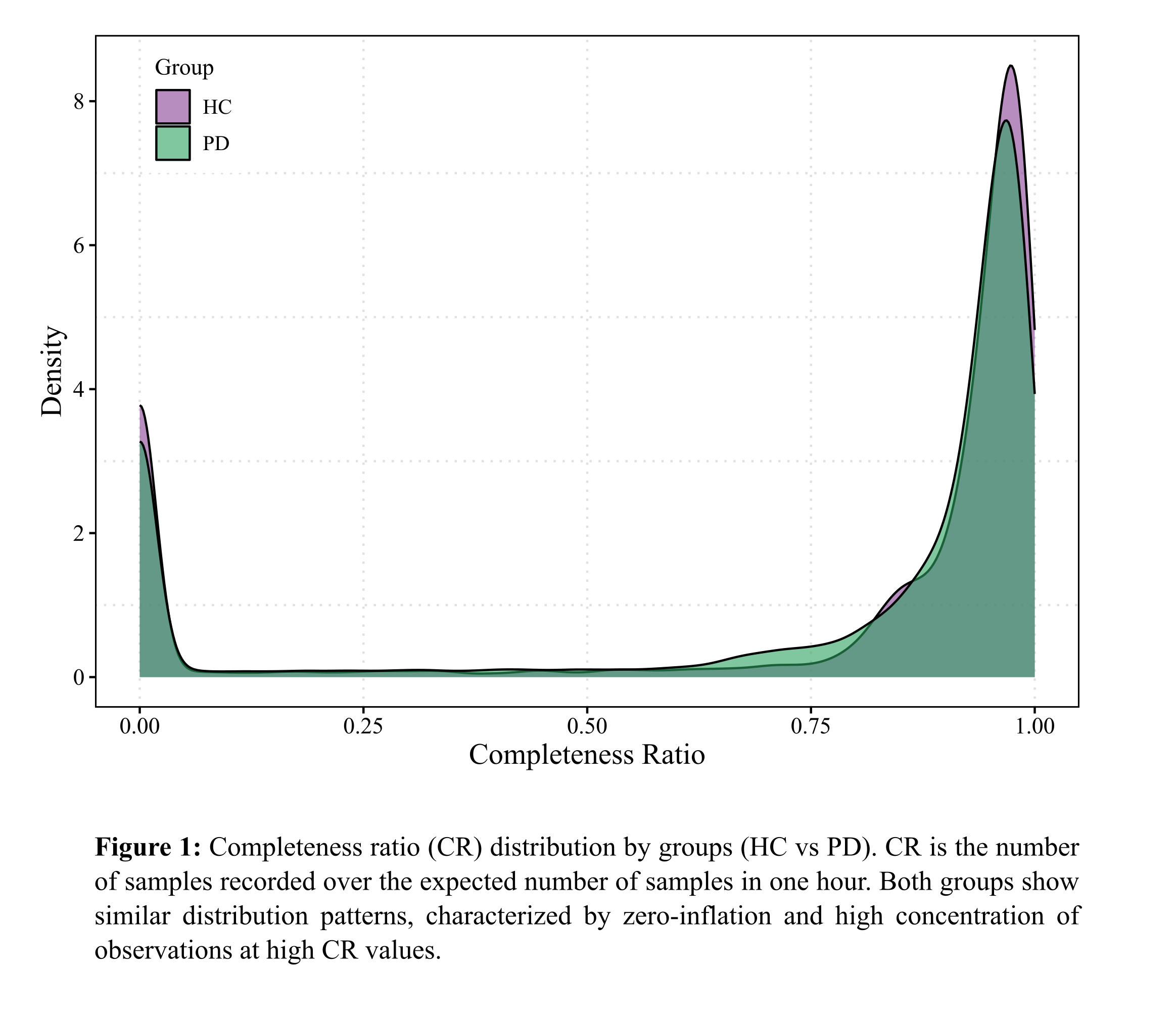
Figure 1
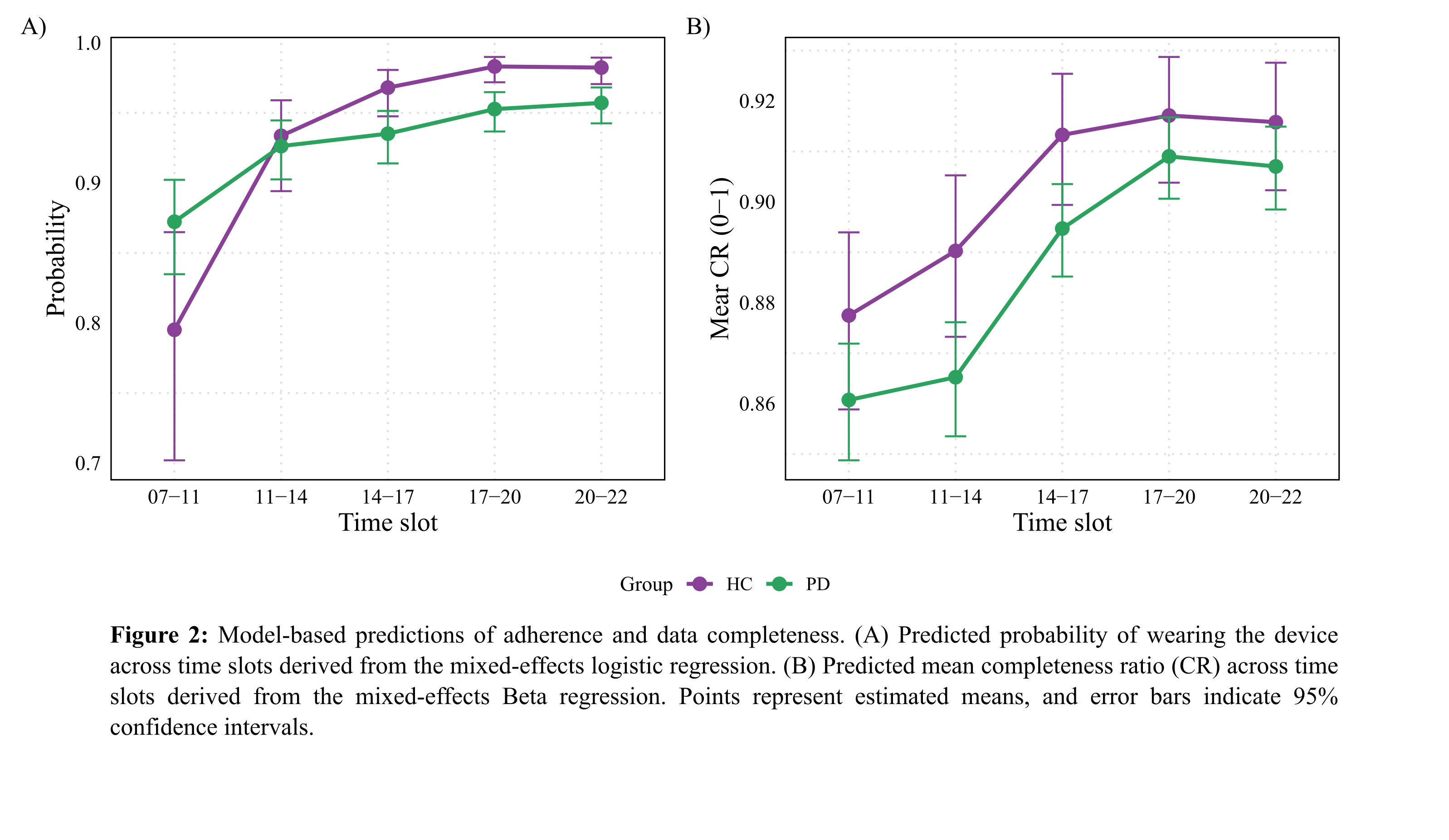
Figure 2
References: [1] https://www.ppmi-info.org
Disclosure:
PPMI – a public-private partnership – is funded by the Michael J. Fox Foundation for Parkinson’s Research
and funding partners, including 4D Pharma, Abbvie, AcureX, Allergan, Amathus Therapeutics, Aligning
Science Across Parkinson’s, AskBio, Avid Radiopharmaceuticals, BIAL, BioArctic, Biogen, Biohaven,
BioLegend, BlueRock Therapeutics, Bristol-Myers Squibb, Calico Labs, Capsida Biotherapeutics, Celgene,
Cerevel Therapeutics, Coave Therapeutics, DaCapo Brainscience, Denali, Edmond J. Safra Foundation, Eli
Lilly, Gain Therapeutics, GE HealthCare, Genentech, GSK, Golub Capital, Handl Therapeutics, Insitro, Jazz
Pharmaceuticals, Johnson & Johnson Innovative Medicine, Lundbeck, Merck, Meso Scale Discovery, Mission
Therapeutics, Neurocrine Biosciences, Neuron23, Neuropore, Pfizer, Piramal, Prevail Therapeutics, Roche,
Sanofi, Servier, Sun Pharma Advanced Research Company, Takeda, Teva, UCB, Vanqua Bio, Verily, Voyager
Therapeutics, the Weston Family Foundation and Yumanity Therapeutics.
To cite this abstract in AMA style:
E. Roveroni, M. Moretto, A. Giupponi, M. Castellaro, T. Gandolfi, M. Veronese. About Data Missingness in Wearable Monitoring of Parkinson’s Disease [abstract]. Mov Disord. 2026; 41 (suppl 1). https://www.mdsabstracts.org/abstract/about-data-missingness-in-wearable-monitoring-of-parkinsons-disease/. Accessed October 1, 2026.« Back to 2026 International Congress
MDS Abstracts - https://www.mdsabstracts.org/abstract/about-data-missingness-in-wearable-monitoring-of-parkinsons-disease/