
Objective: To provide an updated synthesis of existing evidence and critically appraise previous methodological approaches, we conducted a systematic review and meta-analysis of observational studies assessing the association between endogenous reproductive factors and risk of Parkinson’s disease in women.
Background: Parkinson’s disease (PD) is the second most common neurodegenerative disease worldwide and shows notable sex differences in incidence, clinical presentation, and progression. The reasons for these differences remain unclear. Endogenous reproductive and hormonal factors, which influence levels of endogenous oestrogen across the life course, have therefore been investigated as potential contributors to PD risk. However, epidemiological studies examining reproductive history in relation to PD risk have reported inconsistent findings.
Method: We searched Medline and Web of Science for observational studies assessing endogenous reproductive factors, including age at menopause, age at menarche, fertile lifespan and parity, and their association with PD risk in women. Case-control and cohort studies reporting multivariable-adjusted hazard ratios or odds ratios were eligible. Study quality was appraised using the Newcastle–Ottawa Scale. Pooled estimates were derived using random-effects models. Heterogeneity was assessed with τ² and I², prediction intervals were computed, and publication bias was assessed using contour-enhanced funnel plots, Egger’s test and trim-and-fill methods.
Results: Thirteen observational studies including over 5 million women and 17,000 PD cases were eligible. Later age at menarche was associated with a modestly increased PD risk (pooled HR/OR 1.10, 95% CI 1.02–1.20). Each additional year of menopausal age was associated with a 1.2% lower PD risk (pooled HR/OR 0.99, 95% CI 0.98–1.00; p=0.014), corresponding to an estimated 6% lower risk for menopause occurring five years later. Fertile lifespan and parity were not significantly associated with PD risk.
Conclusion: These findings suggest that cumulative oestrogen exposure may have a modest influence on PD susceptibility in women. More consistent definitions of reproductive markers and systematic collection of hormonal therapy data are needed to strengthen future research.
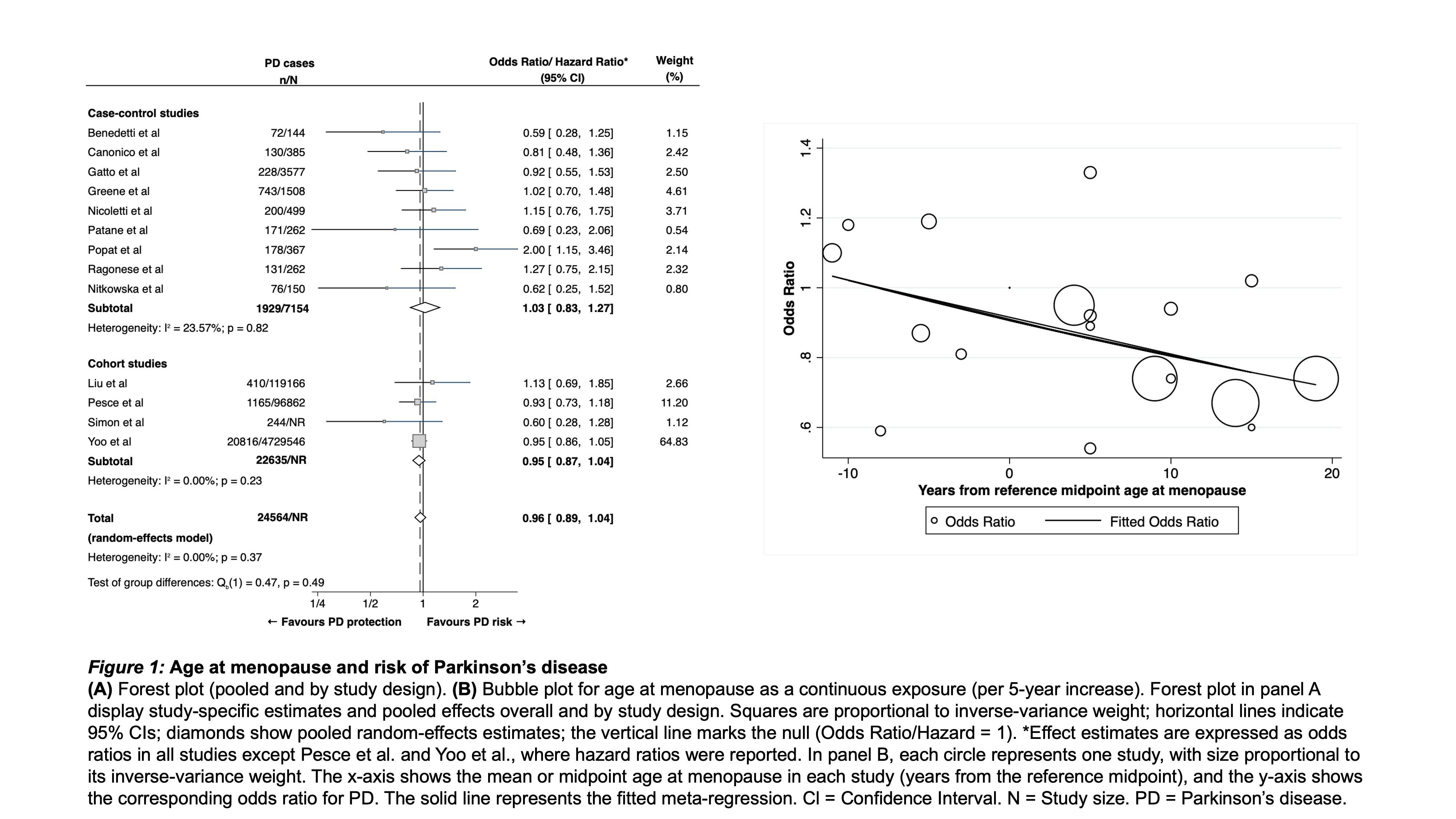
Figure 1
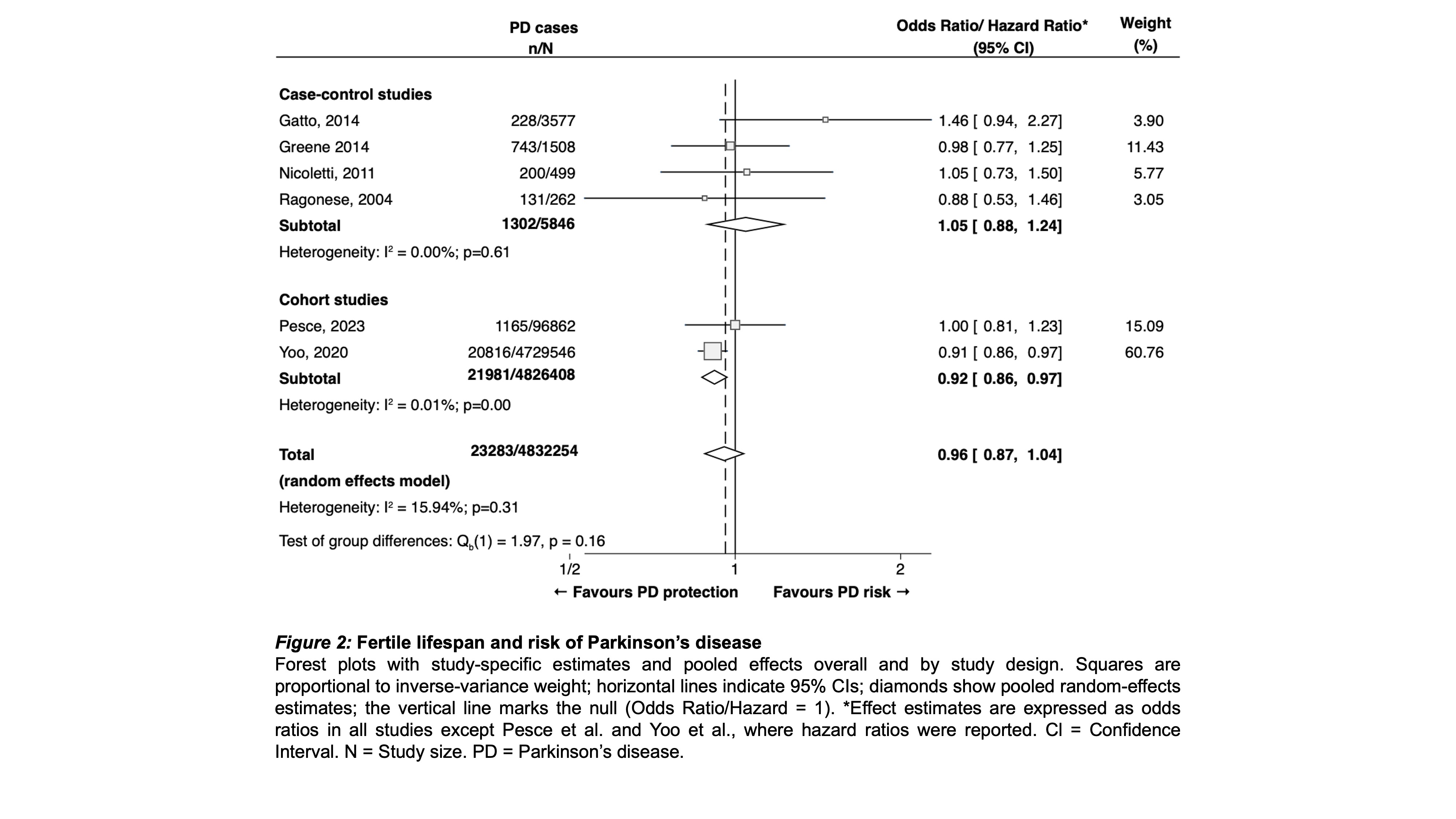
Figure 2
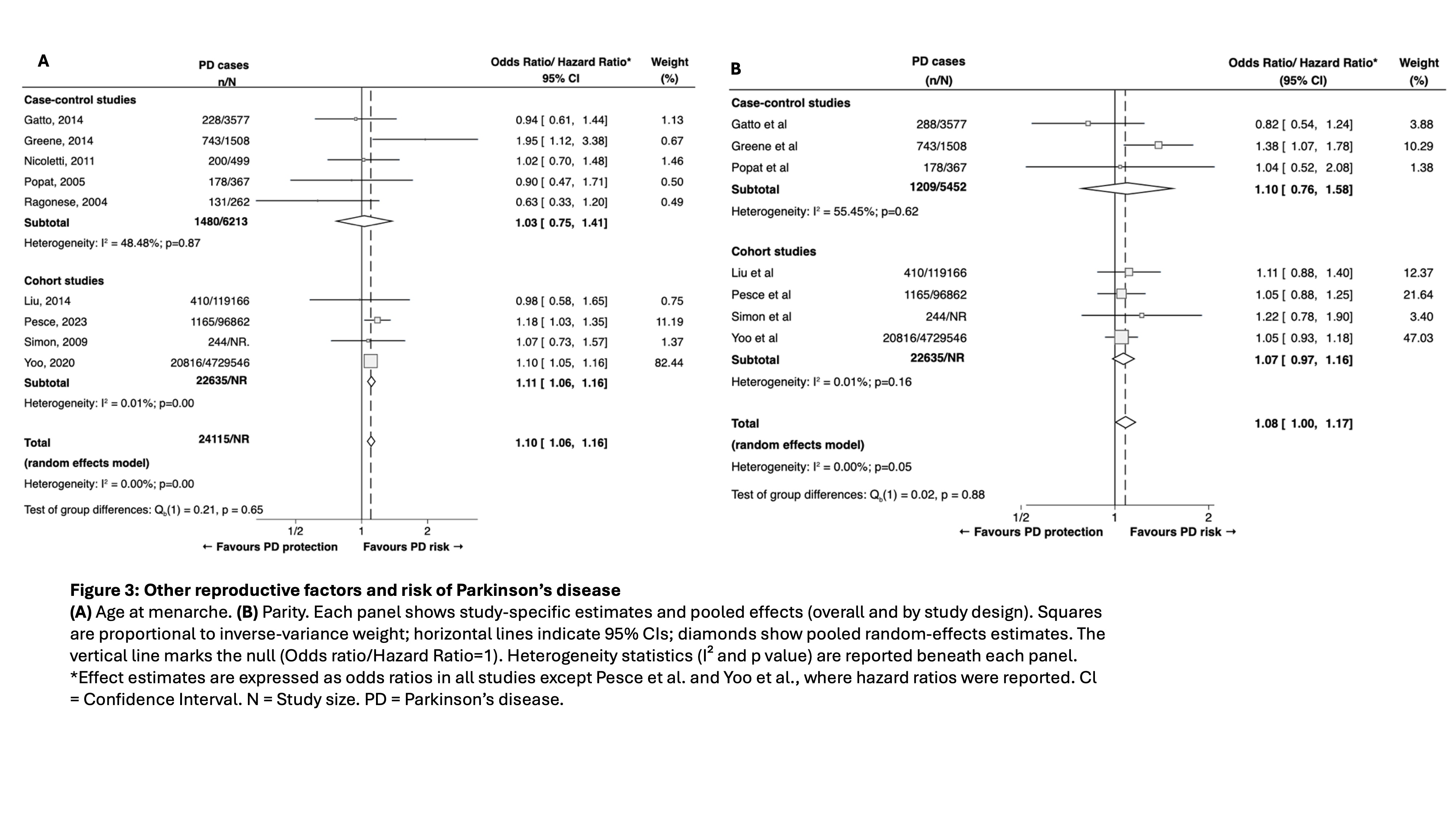
Figure 3
To cite this abstract in AMA style:
T. Ntetsika, E. Papathoma, T. Soumala, I. Markaki. Endogenous reproductive factors and risk of Parkinson’s disease in women: a systematic review and meta-analysis of observational studies [abstract]. Mov Disord. 2026; 41 (suppl 1). https://www.mdsabstracts.org/abstract/endogenous-reproductive-factors-and-risk-of-parkinsons-disease-in-women-a-systematic-review-and-meta-analysis-of-observational-studies/. Accessed October 1, 2026.« Back to 2026 International Congress
MDS Abstracts - https://www.mdsabstracts.org/abstract/endogenous-reproductive-factors-and-risk-of-parkinsons-disease-in-women-a-systematic-review-and-meta-analysis-of-observational-studies/