
Category: Choreas (Non-Huntington's Disease)
Objective: To clarify the causality between neuronal activity in globus pallidus external segment (GPe) and levodopa-induced dyskinesia (LID), and further ascertain the specificity of this activated neuronal subpopulation.
Background: LID is an troublesome complication arising in patients with Parkinson’s disease after administration of levodopa. The underlying mechanism is not fully elucidated. As a critical node within the basal ganglia indirect pathway, the response of GPe along with its function in dyskinesia remains largely unexplored.
Method: The activity-dependent labeling tool Fos-creER mice combined with cre-dependent tracing strategy, fiber photometry and optogenetic/ chemogenetic manipulation were used to label, record and intervene the neuronal ensemble activated in mice presenting dyskinesia. The PV-cre mice was further employed to explore the role of PV-positive neurons.
Results: In dyskinetic mice, we observed an increased number of activated neurons in GPe (GPeactivated in LID), the response of which was correlated with the severity of dyskinesia (R=0.95, p<0.05). Inhibition of GPeactivated in LID significantly ameliorated abnormal involuntary dystonia and hyperkinetic movements (p<0.05), while activation of them induced dyskinesia-like behaviour even in the absence of levodopa (p<0.05) [Figure1]. This neuronal subpopulation activated in LID exhibited no clear spatial organization, instead, showed specific Nkx2.1 expression along with descending projections direct toward subthalamic nucleus and globus pallidus internal segment. However, manipulation of the PV+ subsets in Nkx2.1-positive neurons exerted no discernible effect on dyskinesia [Figure2].
Conclusion: The pathogenesis of dyskinesia is mediated by a specific neuronal subset in GPe, indicating a potential precise target for management of dyskinesia.
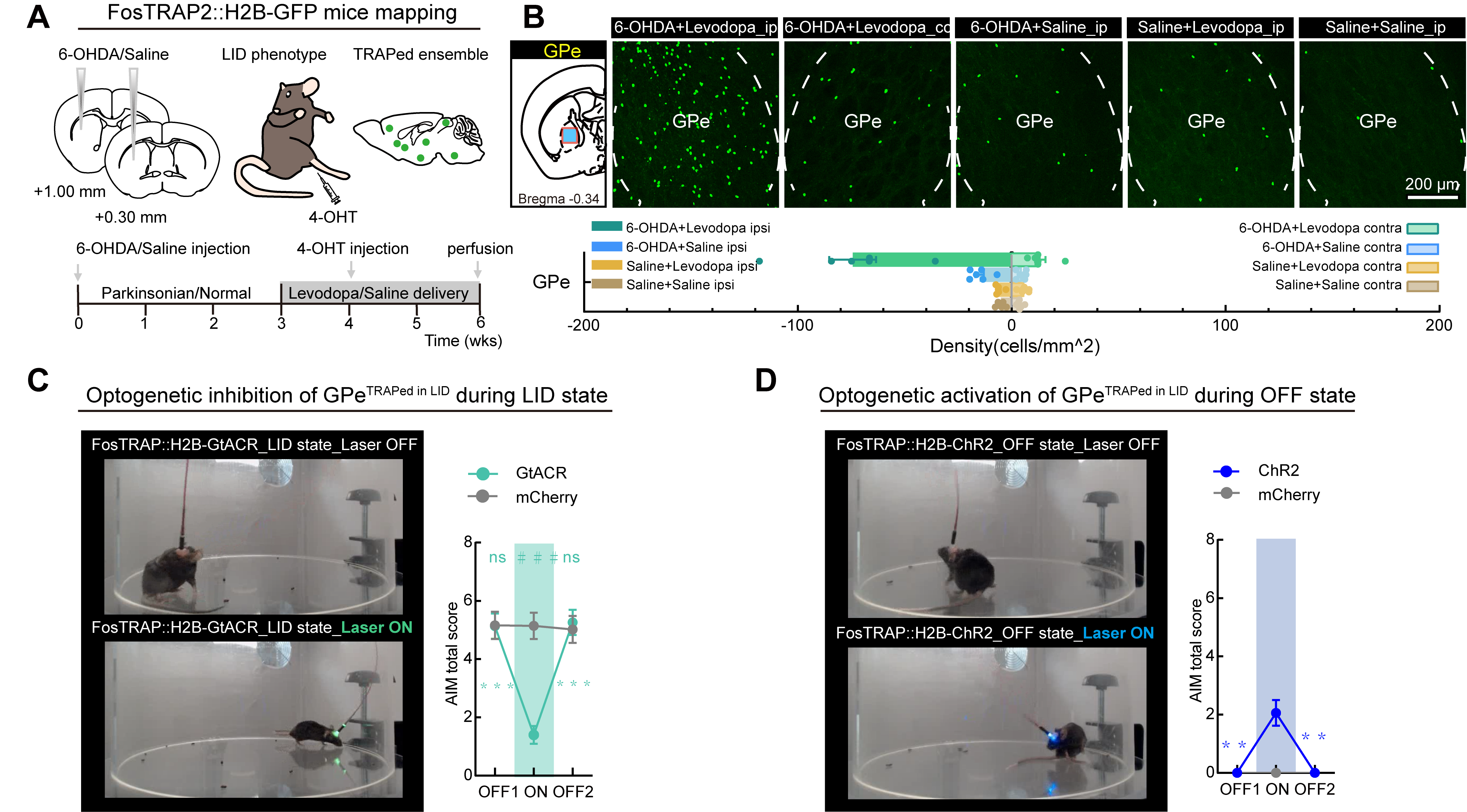
Figure1
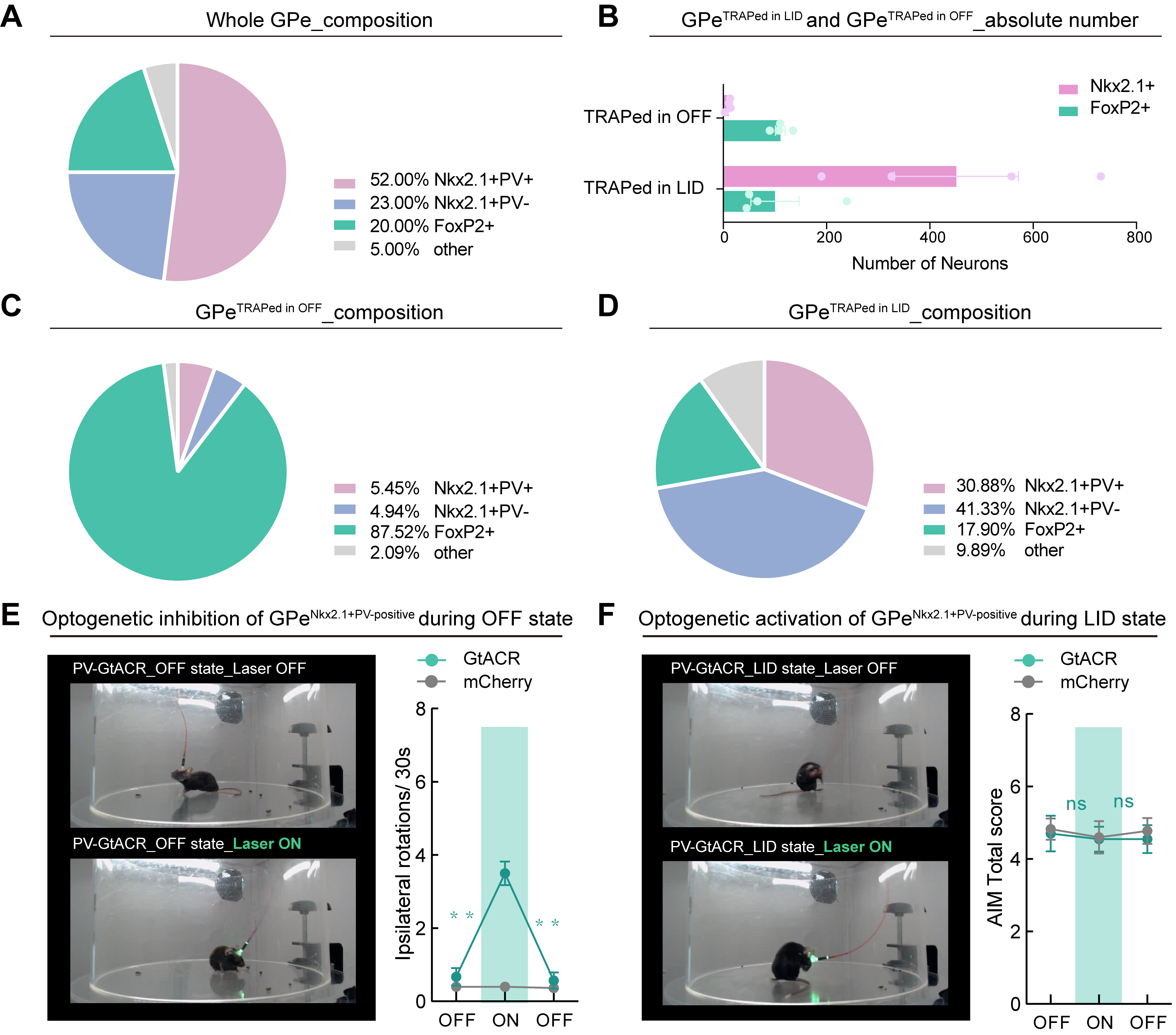
Figure2
To cite this abstract in AMA style:
C. Shen. A Specific Neuronal Subpopulation in Globus Pallidus External Segment Mediates the Pathogenesis of Dyskinesia in Parkinson’s Disease [abstract]. Mov Disord. 2026; 41 (suppl 1). https://www.mdsabstracts.org/abstract/a-specific-neuronal-subpopulation-in-globus-pallidus-external-segment-mediates-the-pathogenesis-of-dyskinesia-in-parkinsons-disease/. Accessed October 1, 2026.« Back to 2026 International Congress
MDS Abstracts - https://www.mdsabstracts.org/abstract/a-specific-neuronal-subpopulation-in-globus-pallidus-external-segment-mediates-the-pathogenesis-of-dyskinesia-in-parkinsons-disease/