
Category: Parkinson’s Disease: Clinical Trials
Objective: To investigate whether bright light therapy (BLT) improves sleep-related symptoms and to explore the potential functional brain network mechanisms underlying BLT in Parkinson’s disease (PD).
Background: Sleep disturbances are common non-motor symptoms in PD, but current pharmacological treatments demonstrate limited efficacy and may be associated with adverse effects. BLT has emerged as a promising therapeutic approach. However, its effects on functional brain networks remain unclear.
Method: In this randomized crossover study, 33 PD patients received 30 days of BLT (10,000 lux) and 30 days of dim light therapy (DLT, 200 lux) in reverse order, separated by a 30-day washout. LT was administered twice daily, for 1 hour each in the morning and evening. Clinical scales and 64-channel resting-state electroencephalography (EEG) were assessed before and after each treatment period. To analyze the crossover design, linear mixed-effects models (LMMs) were applied, with post-intervention outcomes as the dependent variables and intervention type (BLT/DLT) as the main fixed effect. Pre-intervention outcomes, treatment sequence, intervention period, age, sex, H&Y stage, levodopa equivalent daily dose, and disease duration were included as covariates, and participant ID was modeled as a random effect. Functional connectivity was measured using phase locking value (PLV), and graph theoretical metrics were calculated across the delta, theta, alpha, and beta bands. Multiple comparisons were corrected using the false discovery rate (FDR) method.
Results: Compared with DLT, BLT showed a greater reduction in Epworth Sleepiness Scale (ESS) scores (P=0.009). EEG analysis showed that BLT significantly increased the PLV between the frontal and temporal lobes (P=0.024). BLT also increased global efficiency in the delta (P=0.029), alpha (P=0.034), and beta bands (P=0.046) and reduced characteristic path length in the alpha (P=0.034) and beta bands (P=0.025), indicating improved information transfer and integration efficiency in functional brain networks.
Conclusion: BLT significantly improved daytime sleepiness in patients with PD. One potential mechanism is that BLT enhances the flexibility and information transfer efficiency of functional brain networks.
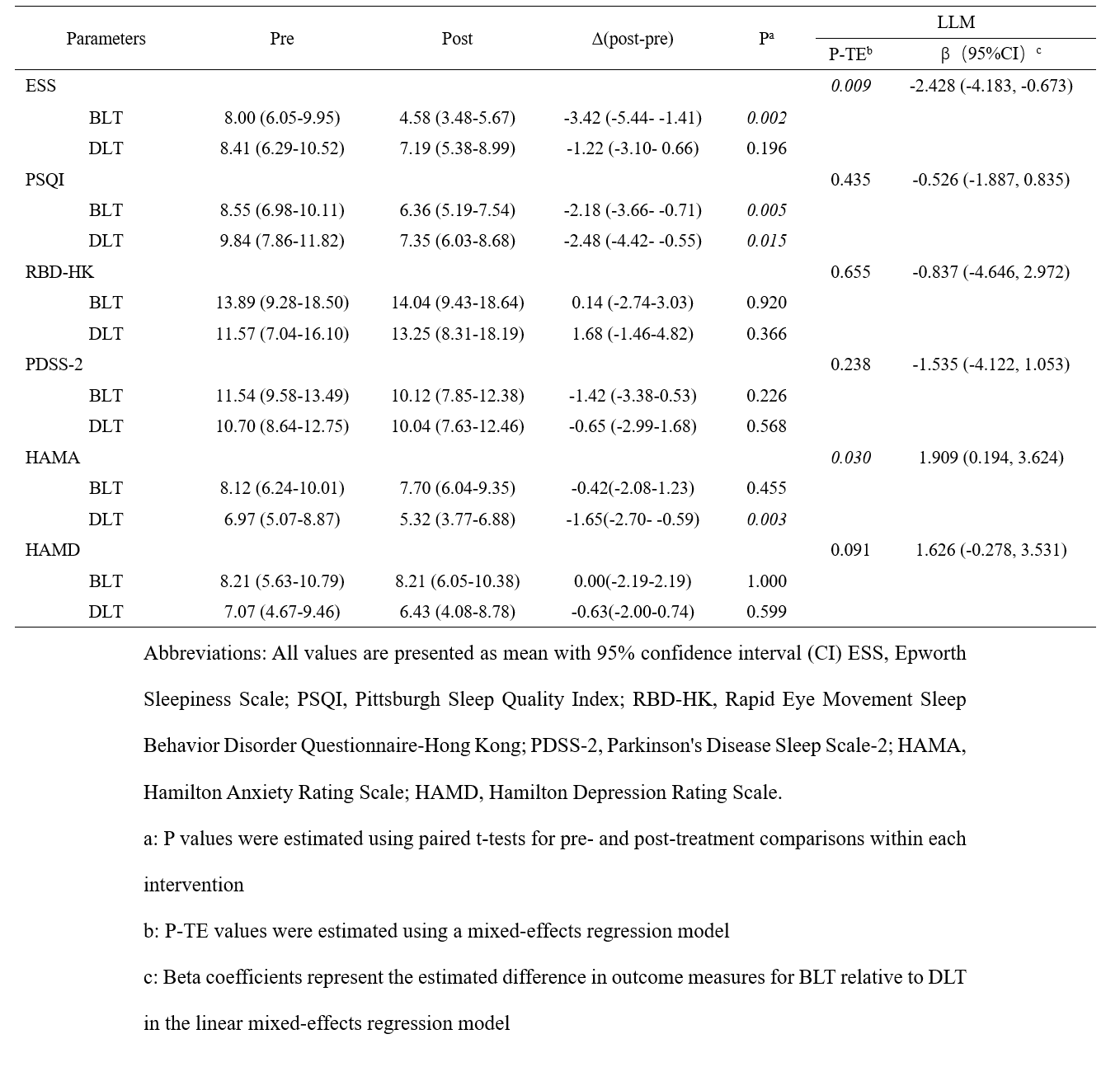
Effect of BLT on clinical scales
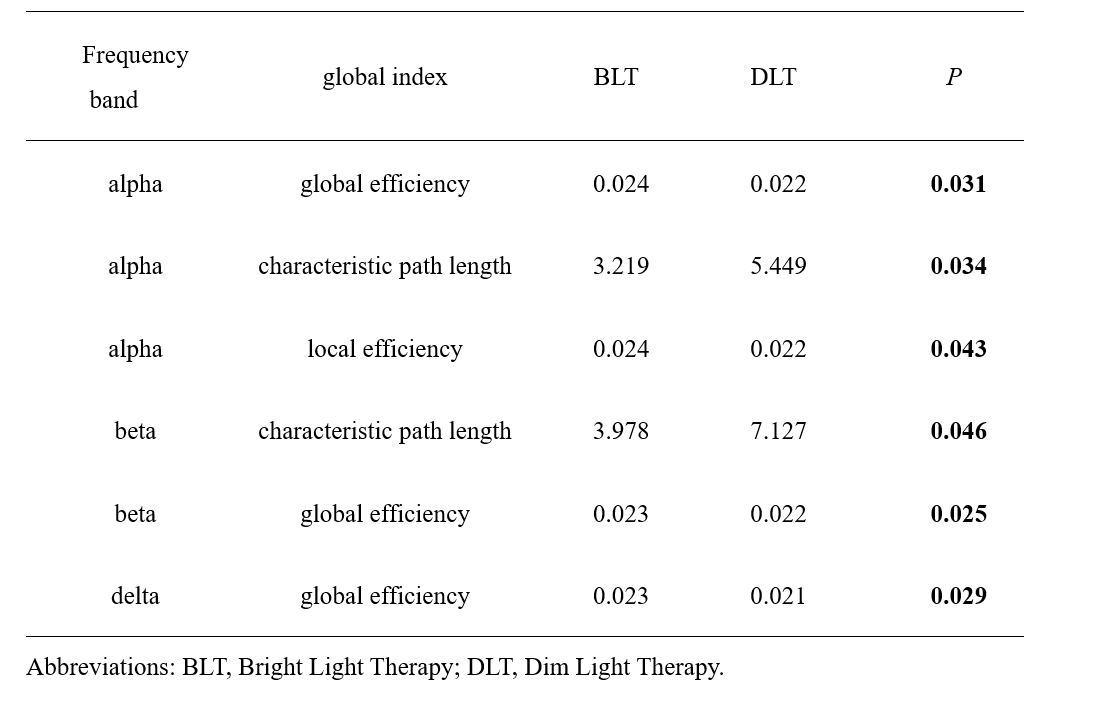
Effect of BLT on EEG global indexes
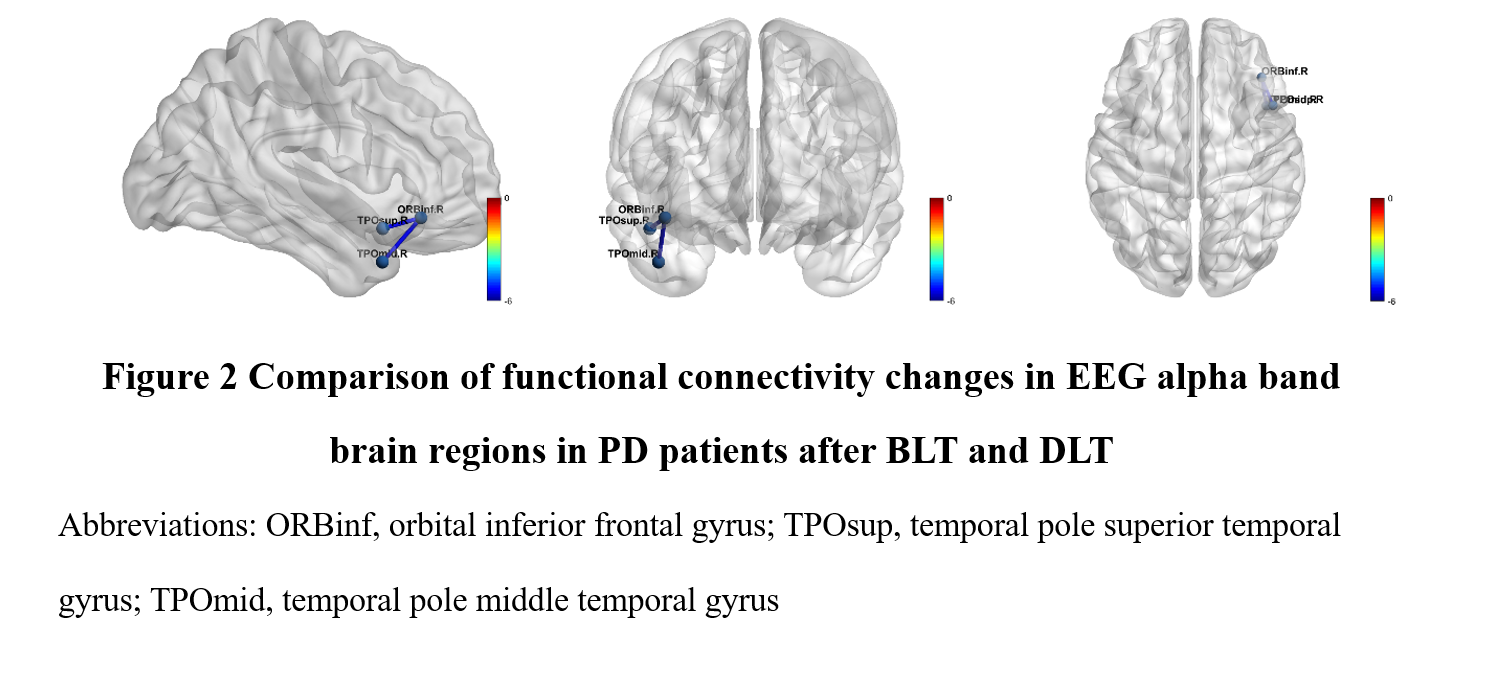
Effect of BLT on regional brain FC
To cite this abstract in AMA style:
H. Li, Y. Shen, C. Liu. Effects of Bright Light Therapy On Sleep And Functional Brain Networks In Parkinson’s Disease-A Pilot Trial [abstract]. Mov Disord. 2026; 41 (suppl 1). https://www.mdsabstracts.org/abstract/effects-of-bright-light-therapy-on-sleep-and-functional-brain-networks-in-parkinsons-disease-a-pilot-trial/. Accessed October 1, 2026.« Back to 2026 International Congress
MDS Abstracts - https://www.mdsabstracts.org/abstract/effects-of-bright-light-therapy-on-sleep-and-functional-brain-networks-in-parkinsons-disease-a-pilot-trial/