
Category: Parkinson’s Disease: Clinical Trials
Objective: Three independent, open-label, clinical drug-drug interaction (DDI) studies were conducted to characterise the clinical DDI profile of BIA 28-6156.
Background: BIA 28-6156 (paricerat) is a first-in-class, small molecule for once-daily oral administration, novel allosteric activator of the beta-glucocerebrosidase enzyme in development for the treatment of Parkinson’s disease. In vitro data suggest that CYP3A4 is the major metabolising enzyme of BIA 28-6156 and that BIA 28-6156 may induce/inhibit the activity of CYP3A4 and inhibit BCRP-, MATE1- and P-gp-mediated drug transport.
Method: Interactions between BIA 28-6156 and mechanistically relevant drugs, namely strong CYP3A4 modulators (carbamazepine and clarithromycin), index CYP3A4 substrate (midazolam), and BCRP-, MATE1- and P-gp substrates (rosuvastatin, metformin, and dabigatran etexilate, respectively), were evaluated in healthy subjects [Figure 1]. Pharmacokinetic (PK) parameters were derived using non-compartmental methods on a per-study basis, and DDI effects were assessed using a mixed-effects model on log-transformed data estimating geometric mean ratios (GMR) and 90% confidence intervals (CI). Safety/tolerability was evaluated throughout each study.
Results: Exposure of BIA 28-6156 was reduced when co-administered with carbamazepine whilst increased with clarithromycin. BIA 28-6156 increases plasma exposure of rosuvastatin and dabigatran. These effects are outside the no-effect boundary of 0.80–1.25 [Table 1]. No relevant and/or serious adverse events were reported [Table 2].
Conclusion: As a substrate, strong CYP3A4 modulators impact the exposure of BIA 28-6156. As a precipitant, BIA 28-6156 has no effect on CYP3A4 activity. BIA 28-6156 may inhibit BCRP and P-gp-mediated drug transport. All treatments were generally well-tolerated. These findings will support design of further clinical studies with BIA 28-6156.

Overview of Safety Results per DDI study.

Overview of PK Results per DDI study.
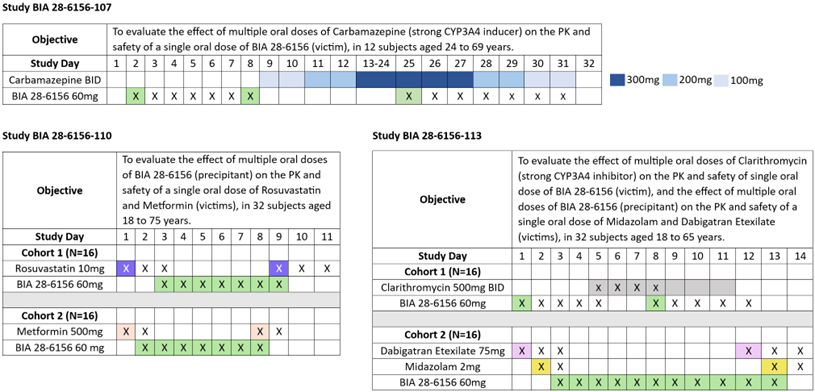
Objectives and designs of each DDI study.
To cite this abstract in AMA style:
TF. Fonseca, AR. Ronaghinia, JR. Reis, DR. Rodrigues, AN. Neves, GC. Cordeiro, RC. Costa, FR. Rocha, DM. Magalhães, AG. Guimarães, JH. Holenz. Clinical Drug-Drug Interaction Profile Of BIA 28-6156: Results From Three Independent Phase I Studies [abstract]. Mov Disord. 2026; 41 (suppl 1). https://www.mdsabstracts.org/abstract/clinical-drug-drug-interaction-profile-of-bia-28-6156-results-from-three-independent-phase-i-studies/. Accessed October 1, 2026.« Back to 2026 International Congress
MDS Abstracts - https://www.mdsabstracts.org/abstract/clinical-drug-drug-interaction-profile-of-bia-28-6156-results-from-three-independent-phase-i-studies/