
Category: Parkinson's Disease (Other)
Objective: To compare the baseline characteristics of fallers versus non-fallers in a remote, decentralized study of Parkinson’s disease (PD) participants.
Background: Falls are common in PD and are associated with injury, hospitalization, and lower quality of life. Digital health technologies may provide new insights into the relationship among PD symptom severity, cognitive abilities, physical activity, and falls.
Method: AT-HOME PD2 is a remote, decentralized observational study that includes participants from two phase III clinical trials of potential disease-modifying therapeutics (STEADY-PD III, SURE-PD3) and a genetic registry study (PD GENEration). Participants complete annual video visits, quarterly mPower 2.0 digital motor tasks, quarterly online questionnaires, and monthly seven-day periods wearing a wrist-worn CentrePoint Insight Watch and a Fitbit Charge 5. At baseline, participants were categorized as fallers or non-fallers based on self-report via interview of a fall in the previous 12 months. We compared baseline characteristics, number of timed finger taps from the first period of mPower 2.0 use, and activity metrics from the first three months of Fitbit wear between fallers and non-fallers using T-tests, chi-square, and Fisher’s exact tests.
Results: Two hundred participants (mean (SD) age 69.0 (8.5) years, 113 (56.5%) male, 194 (97%) White, years since diagnosis 8.8 (1.5)) enrolled in AT-HOME PD2. Fallers (n = 106) and non-fallers (n = 94) did not differ in demographics, modified MDS-UPDRS Part 3 motor score (26.3 (9.8) vs. 24.8 (9.7), p=0.27), steps/day (4978 (3766) vs. 5270 (3197), p=0.57), or minutes of moderate-vigorous physical activity/day (22.9 (24.0) vs. 25.0 (24.5), p=0.41) [table1]. Fallers had greater disability on the Schwab & England (87.3 (9.0) vs. 89.6 (5.1), p=0.02), worse MDS-UPDRS Part 1a (2.1 (2.1) vs. 1.1 (1.3), p<0.001) and Part 1b non-motor scores (8.8 (3.9) vs. 7.2 (3.7), p=0.004), lower MoCA scores (26.9 (2.5) vs. 27.7 (2.5), p=0.02) and worse MDS-UPDRS Part 2 motor scores (12.2 (6.5) vs. 9.2 (6.0), p=0.001).
Conclusion: 53% of PD participants reported a fall in the previous year. Compared with non-fallers, fallers had worse non-motor and motor symptoms, worse cognitive performance, and greater disability. Digitally-estimated step count and physical activity levels were similar suggesting that fallers are not less active than non-fallers.
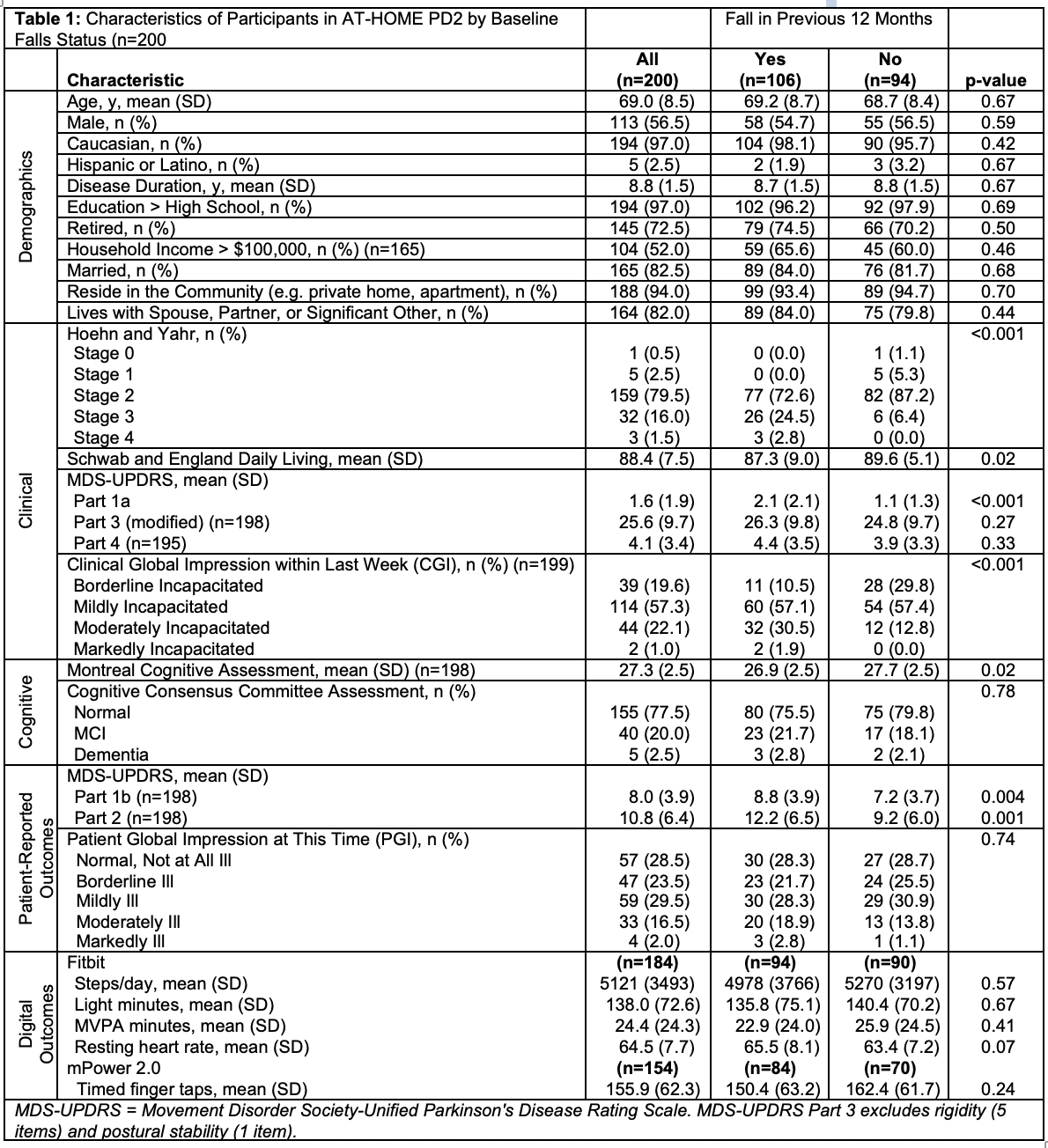
Table 1
To cite this abstract in AMA style:
P. Auinger, R. Wilson, C. Roe, A. Ascherio, J. Beck, S. Benvengo, K. Biglan, E. Dorsey, A. Espay, E. Macklin, M. Monje, E. Neto, D. Novak, M. Schwarzschild, S. Sieberts, T. Simuni, C. Tanner, D. Weintraub, R. Schneider. Baseline characteristics of fallers versus non-fallers in a remote, decentralized study of Parkinson’s disease [abstract]. Mov Disord. 2026; 41 (suppl 1). https://www.mdsabstracts.org/abstract/baseline-characteristics-of-fallers-versus-non-fallers-in-a-remote-decentralized-study-of-parkinsons-disease/. Accessed October 1, 2026.« Back to 2026 International Congress
MDS Abstracts - https://www.mdsabstracts.org/abstract/baseline-characteristics-of-fallers-versus-non-fallers-in-a-remote-decentralized-study-of-parkinsons-disease/