
Category: Parkinson's Disease: Surgical Therapy
Objective: To compare speech performance following unilateral MR-guided focused ultrasound (MRgFUS) targeting the ventral intermediate nucleus (VIM) of the thalamus in Parkinson’s disease (PD) and essential tremor (ET) using quantitative acoustic speech analysis.
Background: MRgFUS VIM thalamotomy is an established treatment for medication-refractory tremor in both PD and ET. However, its impact on speech may differ depending on the underlying pathology. Quantitative acoustic measures may help characterize disease-specific speech outcomes following treatment.
Method: In this prospective study, 9 PD patients (8 left, 1 right) and 19 ET patients (15 left, 4 right) underwent unilateral thalamotomy. Twenty-one healthy controls were also included to provide reference baseline speech metrics. Speech recordings were obtained using a standardized microphone setup and computer-based acoustic analysis before treatment and at 6-month follow-up. Tasks included sustained phonation, diadochokinetic (DDK) syllable repetition, text reading, and spontaneous monologue. Paired t-tests assessed within-group changes. Between-disease comparisons of change at both timepoints were evaluated using ANCOVA adjusting for age and sex.
Results: In ET patients, treatment was associated with reduced pitch variability (F0sd, p=0.030) during phonation tasks and diadochokinetic irregularity (DDKI, p=0.031) during DDK tasks, as well as increased loudness modulation (stdPWR, p=0.012) during reading. Conversely, PD patients showed decreased pitch variability (F0sd, p=0.013) and loudness modulation (stdPWR, p=0.042) during reading.[figure1]
Comparisons between pathologies demonstrated differences in speech parameters. ET patients exhibited an improvement in pitch variability (F0sd, p=0.029) during phonation tasks, syllable repetition rate (DDKR, p=0.044) during DDK tasks, and loudness modulation (stdPWR, p=0.002) during reading.[figure2]
Conclusion: Speech outcomes following VIM MRgFUS lesions differ according to the underlying pathology. In ET, thalamotomy appears to improve tremor-related speech instability and articulatory timing, whereas the worsening observed in PD may be associated with progression of hypokinetic speech features. These findings suggest that VIM lesioning interacts with disease-specific speech pathophysiology and highlight the importance of quantitative acoustic analysis for detecting treatment-related speech changes.
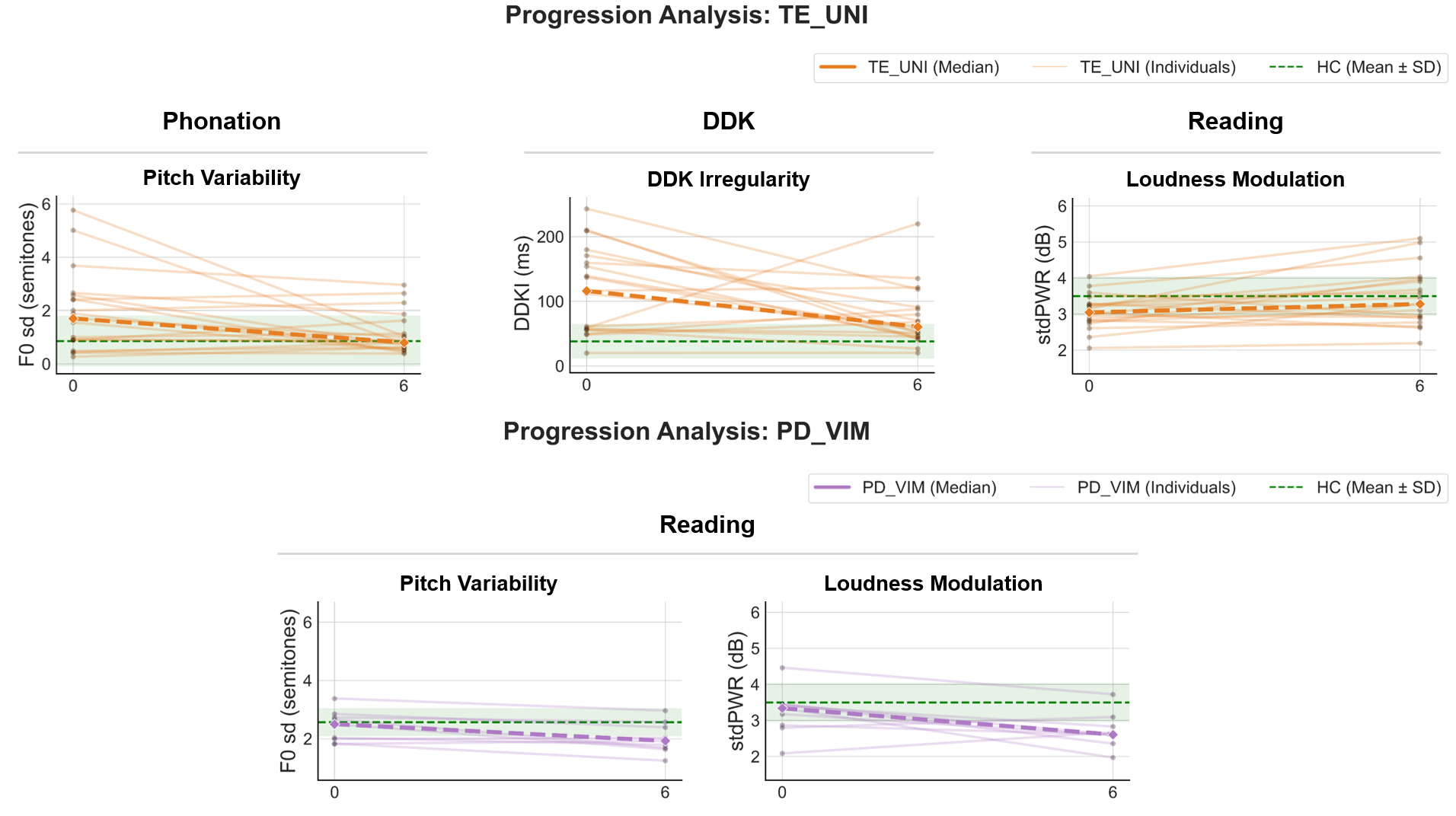
Progression analysis ET and PD
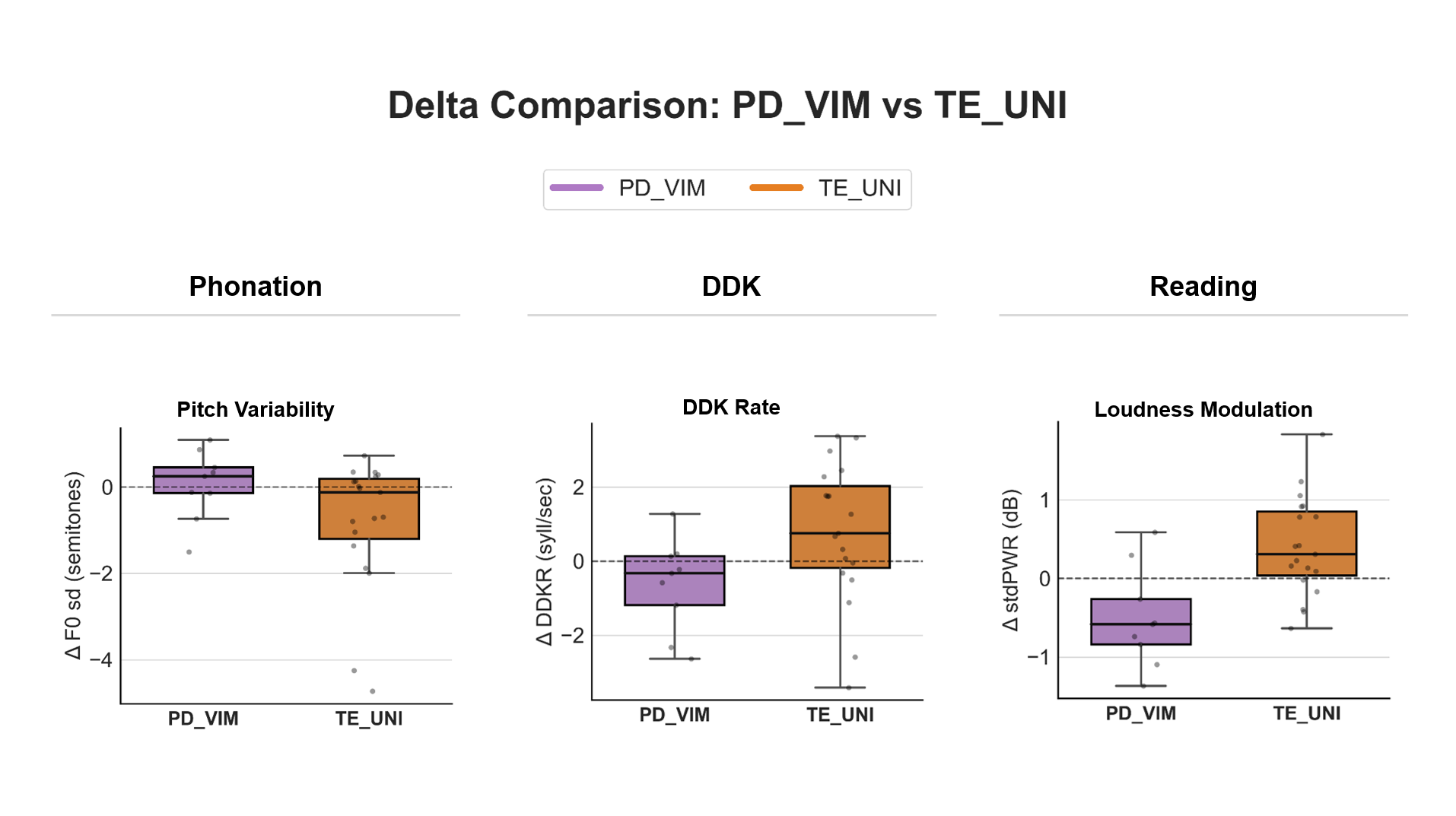
Between-group comparison ET and PD
To cite this abstract in AMA style:
P. Cortadi La-Villa, G. Diaz-Taveras, E. Salinas Jaime, M. šimek, E. Natera-Villalba, A. Martin-Bastida, L. Gonzalez-Quarante, A. Arcadi Da-Silva, C. Sanchez-Catasus, J. Rusz, M. Rodriguez-Oroz. Quantitative Changes in Speech After Focused Ultrasound Thalamotomy in Parkinson’s Disease and Essential Tremor [abstract]. Mov Disord. 2026; 41 (suppl 1). https://www.mdsabstracts.org/abstract/quantitative-changes-in-speech-after-focused-ultrasound-thalamotomy-in-parkinsons-disease-and-essential-tremor/. Accessed October 1, 2026.« Back to 2026 International Congress
MDS Abstracts - https://www.mdsabstracts.org/abstract/quantitative-changes-in-speech-after-focused-ultrasound-thalamotomy-in-parkinsons-disease-and-essential-tremor/