
Category: Disparities
Objective: BIND-MD aims to identify barriers that hinder participation of ethnic minorities in movement disorders research, examine sources of mistrust and develop strategies to overcome barriers to research participation.
Background: Movement disorders, particularly Parkinson’s, may present and progress differently across ethnic groups. Lack of ethnic representation raises concerns about the applicability of movement disorders research, particularly when researching potential treatments.
Method: We analysed participants’ opinions on research and barriers to participation in three phases: 1) Two focus groups were held with 18 participants. Participants completed a questionnaire collecting demographics, perceptions of research, and likelihood of participating in a clinical trial. Discussions were held on perceptions of research, barriers and enablers to participation. 2) Reflexive thematic analysis was conducted and feedback obtained from participants. 3) A focus group of six researchers discussed experiences and challenges recruiting ethnic minority participants.
Results: Six themes were identified: fear, mistrust, logistical challenges, stigma, researcher bias, and poor communication. Top concerns included fear of side effects, concerns about historical mistreatment of ethnic minorities, and logistical barriers (e.g. mobility, length of or ability to travel). There was a decline in logistical and informational barriers post focus group, but systemic barriers (e.g. mistrust, historical mistreatment) remained. Logistical barriers are modifiable by providing flexible visits, local access, and fair renumeration. Communication should be accessible, multilingual, and continuous. Information must be honest and specific. Safety nets (e.g. contacts, support lines) should be clearly visible. Trust can be built through visible, approachable, and diverse study teams. Stigma can be reduced through use of community champions and community-led awareness, and researcher bias addressed through increased exposure to diverse patient groups.
Conclusion: BIND-MD illustrates how underrepresentation of ethnic minorities in movement disorders research is driven by systemic, informational, and trust-based barriers. Many barriers can be modified or overcome through culturally inclusive communication, flexible visits, fair renumeration, clear information about safety and support, community engagement, and culturally competent research teams.
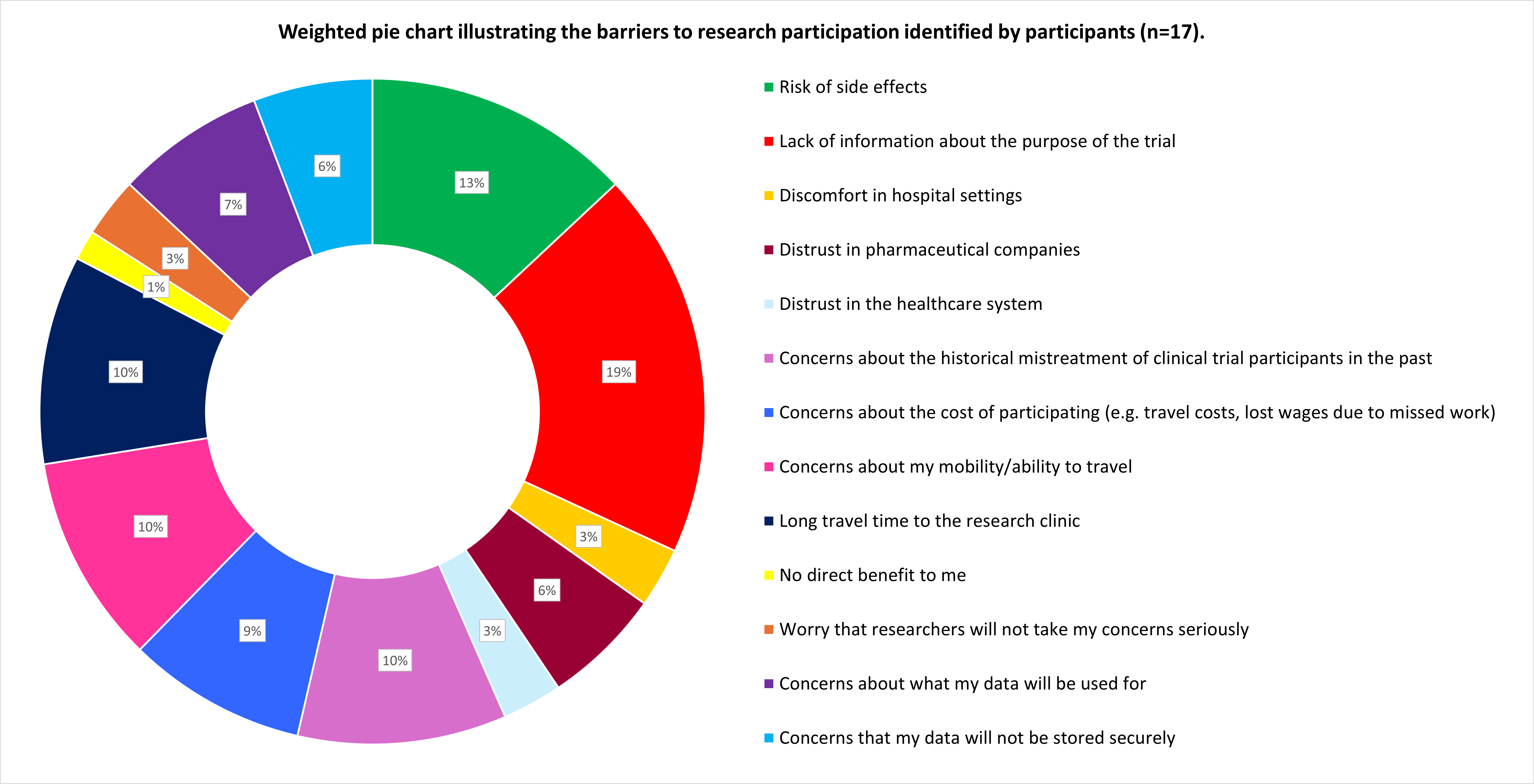
Participant-identified research barriers
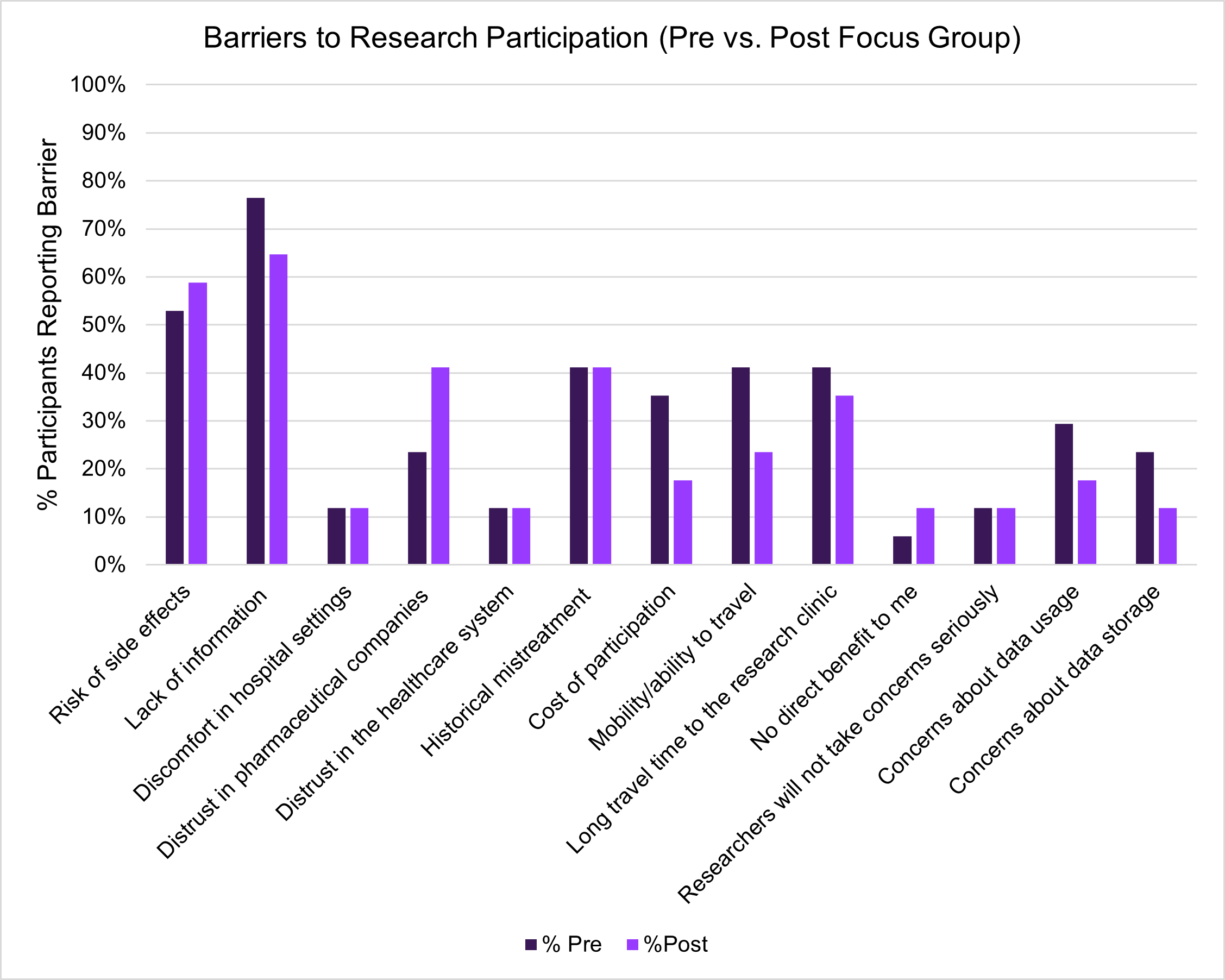
Barriers pre vs. post focus group
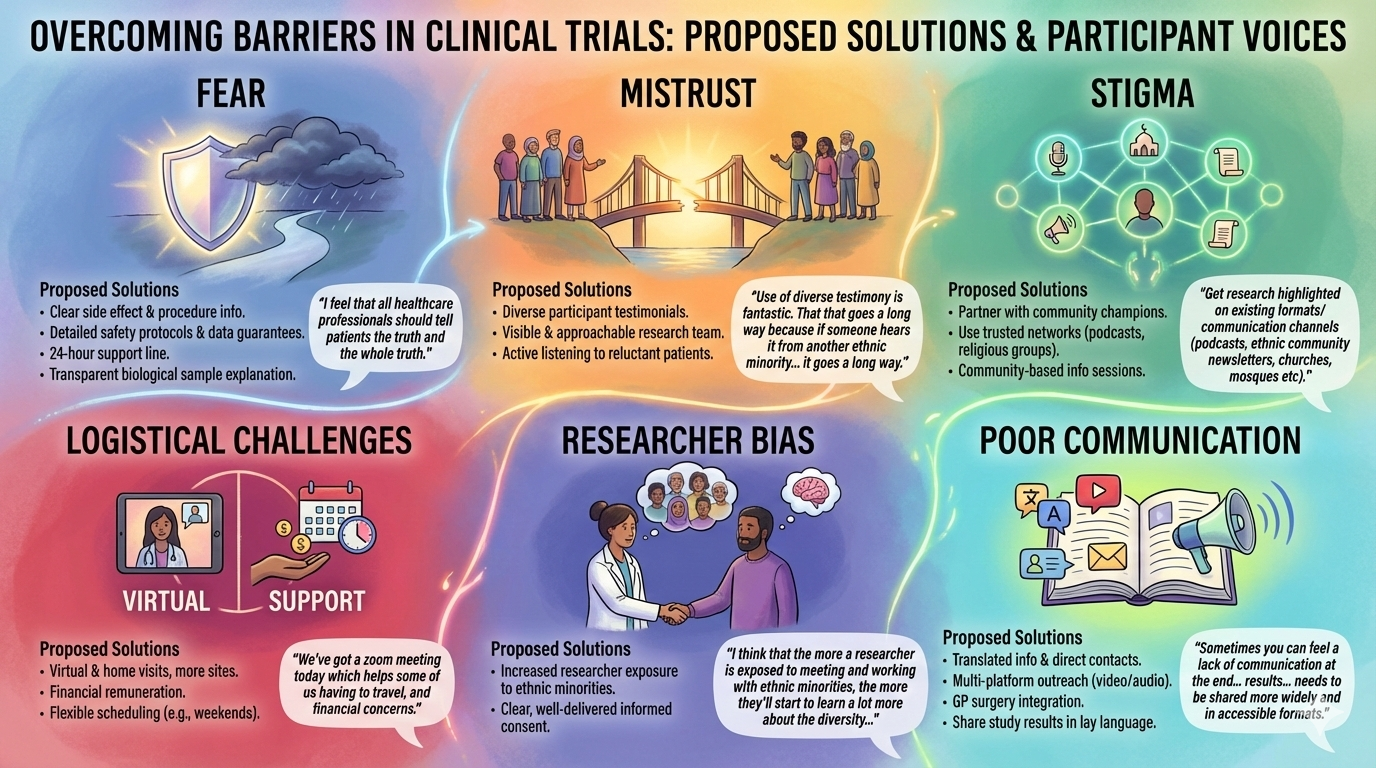
Enablers to research participation
References: [1] Ben-Joseph, A., Marshall, C. R., Lees, A. J., & Noyce, A. J. (2020). Ethnic Variation in the Manifestation of Parkinson’s Disease: A Narrative Review. J Parkinsons Dis, 10(1), 31–45. https://doi.org/10.3233/jpd-191763
[2] Braun, V., & Clarke, V. (2012). Thematic analysis. In (pp. 57–71).
[3] Duarte Folle, A., Flores, Marie E S., Kusters, C., Paul, Kimberly C., Del Rosario, I., Zhang, K., Ruiz, C., Castro, E., Bronstein, J., Ritz, B., & Keener, Adrienne M. (2023). Ethnicity and Parkinson’s Disease: Motor and Nonmotor Features and Disease Progression in Latino Patients Living in Rural California. The Journals of Gerontology: Series A, 78(7), 1258–1268. https://doi.org/10.1093/gerona/glad016
[4] Zirra, A., Dey, K. C., Camboe, E., Waters, S., Haque, T., Huxford, B., Chohan, H., Donkor, N., Kahan, J., Ben-Joseph, A., Gallagher, D. A., Budu, C., Boyle, T., Simonet, C., Lees, A. J., Marshall, C. R., & Noyce, A. J. (2025). The East London Parkinson’s disease project – a case-control study of Parkinson’s Disease in a diverse population. npj Parkinson’s Disease, 11(1), 172. https://doi.org/10.1038/s41531-025-01031-x
To cite this abstract in AMA style:
H. Collins, E. Manoharan, S. Gandhi, A. Zarkali, A. Batla. Barriers and Enablers to Diversity and Inclusion in Movement Disorders Research (BIND-MD) [abstract]. Mov Disord. 2026; 41 (suppl 1). https://www.mdsabstracts.org/abstract/barriers-and-enablers-to-diversity-and-inclusion-in-movement-disorders-research-bind-md/. Accessed October 1, 2026.« Back to 2026 International Congress
MDS Abstracts - https://www.mdsabstracts.org/abstract/barriers-and-enablers-to-diversity-and-inclusion-in-movement-disorders-research-bind-md/