
Objective: To identify and characterize sporadic dystonia-related network (SDRN) using resting-state fMRI (rs-fMRI) and machine learning.
Background: Sporadic dystonia is a hyperkinetic movement disorder characterized by involuntary muscle contractions and abnormal postures, with highly variable clinical presentations. Its pathophysiology involves distributed brain networks [1]. Machine learning combined with explainable AI offers a promising approach to detect subtle multivariate whole-brain functional alterations that may not be captured by traditional analyses.
Method: We studied 20 patients with SD (F/M: 15/5; age: 53.4±14.2) and 29 healthy controls (HC, F/M: 20/9; age: 55.8±10.8) recruited from the Center for Neurosciences, Northwell Health. All participants underwent rs-fMRI following a 12-hour washout of other movement disorder medications. Data were preprocessed using FSL [2-3] and ICA-AROMA [4], and group independent component analysis (ICA) was performed with the GIFT toolbox [5], yielding 28 ICs. Network expression scores were computed for each subject and used as features to train and validate a K-nearest neighbor (KNN) classifier in MATLAB. Local Interpretable Model-agnostic Explanations (LIME) [6] was applied to identify the ICs most relevant to the classification of SD, and model performance was evaluated using 5-fold cross-validation.
Results: There were no significant differences in age, sex, or head motion displacement between SD and HC groups (p>0.43). The KNN classifier demonstrated very good performance in distinguishing SD from HC subjects, achieving an accuracy of 85.7%, with a sensitivity of 80% and specificity of 89.7%. The model also yielded an F1 score of 82%, indicating a good balance between precision and recall in identifying SD cases. Using explainable AI, the SDRN [Fig. 1] was identified, primarily comprising three key ICs: IC7 (default mode network), IC10 (sensorimotor network), and IC20 (attention network), which contributed most strongly to distinguishing SD from HC.
Conclusion: Machine learning applied to rs-fMRI identified an SDRN involving the default mode, sensorimotor, and attention networks. These findings support dystonia as a disorder of distributed brain networks and highlight the potential of explainable AI for identifying neuroimaging biomarkers.
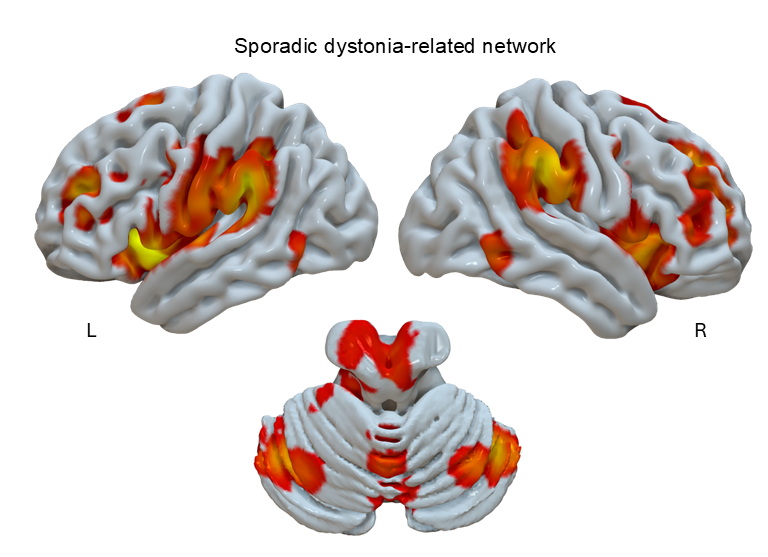
Sporadic Dystonia Related Network
References: References:
1. An Vo, Nha Nguyen, Koji Fujita, Katharina A Schindlbeck, Andrea Rommal, Susan B Bressman, Martin Niethammer, David Eidelberg, Disordered network structure and function in dystonia: pathological connectivity vs. adaptive responses, Cerebral Cortex, Volume 33, Issue 11, 1 June 2023, Pages 6943–6958,
2. S.M. Smith, M. Jenkinson, M.W. Woolrich, C.F. Beckmann, T.E.J. Behrens, H. Johansen-Berg, P.R. Bannister, M. De Luca, I. Drobnjak, D.E. Flitney, R. Niazy, J. Saunders, J. Vickers, Y. Zhang, N. De Stefano, J.M. Brady, and P.M. Matthews. Advances in functional and structural MR image analysis and implementation as FSL. NeuroImage, 23(S1):208-19, 2004
3. Mark W. Woolrich, Saad Jbabdi, Brian Patenaude, Michael Chappell, Salima Makni, Timothy Behrens, Christian Beckmann, Mark Jenkinson, Stephen M. Smith, Bayesian analysis of neuroimaging data in FSL, NeuroImage,Volume 45, Issue 1, Supplement 1,2009,Pages S173-S186,ISSN 1053-8119,nhttps://doi.org/10.1016/j.neuroimage.2008.10.055.
4. Pruim, R. H. R., Mennes, M., van Rooij, D., Llera, A., Buitelaar, J. K., & Beckmann, C. F. (2015). ICA-AROMA: A robust ICA-based strategy for removing motion artifacts from fMRI data. NeuroImage, 112, 267–277. https://doi.org/10.1016/j.neuroimage.2015.02.064
5. Calhoun VD, Liu J, Adali T. A review of group ICA for fMRI data and ICA for joint inference of imaging, genetic, and ERP data. Neuroimage. 2009 Mar;45(1 Suppl):S163-72. doi: 10.1016/j.neuroimage.2008.10.057. Epub 2008 Nov 13. PMID: 19059344; PMCID: PMC2651152.
6. Marco Tulio Ribeiro, Sameer Singh, and Carlos Guestrin. ” why should i trust you?” explaining the predictions of any classifier. In Proceedings of the 22nd ACM SIGKDD international conference on knowledge discovery and data mining, 1135–1144. 2016.
Acknowledgments: This work was funded by the Dystonia Medical Research Foundation (DMRF) and the Career Enhancement Award (CEA) to AV. We are grateful to all study
participants and research staff who contributed to data collection.
To cite this abstract in AMA style:
O. Omilabu, D. Truong, K. Nguyen, S. Vacca, T. Fitzpatrick, A. Oh, M. Neithammer, N. Nguyen, D. Eidelberg, A. Vo. Identification of a sporadic dystonia-related brain network using resting-state fMRI and machine learning [abstract]. Mov Disord. 2026; 41 (suppl 1). https://www.mdsabstracts.org/abstract/identification-of-a-sporadic-dystonia-related-brain-network-using-resting-state-fmri-and-machine-learning/. Accessed October 1, 2026.« Back to 2026 International Congress
MDS Abstracts - https://www.mdsabstracts.org/abstract/identification-of-a-sporadic-dystonia-related-brain-network-using-resting-state-fmri-and-machine-learning/