
Objective: To determine if combining microRNA-7-5p (miR-7-5p) and neuron-derived extracellular vesicle (NDEV) α-synuclein (α-syn) would enrich prodromal Parkinson’s disease (PD) subjects for those more likely to phenoconvert.
Background: Studies have found blood NDEV miR-7-5p and NDEV α-syn were markers for PD phenoconversion. No study has looked at the combined effect of these two markers.
Method: Baseline whole blood miR-7-5p, baseline NDEV α-syn, time to phenoconversion, baseline age, and gender data were obtained on 313 prodromal PD patients from the Parkinson Progression Marker Initiative (PPMI) (Table 1). Log-rank analysis was used to find cutpoints. Cox regression analysis was used to calculate hazard ratios. Missing miR-7-5p values were imputed using the classification and regression tree (CART) method. Kaplan–Meier survival curves were used to evaluate differences in time to PD phenoconversion.
Results: The cutpoints for miR-7-5p and NDEV α-syn were 3.31 (p=0.008) and 2.91 (p=0.09), respectively. In separate models, using miR-7-5p and NDEV α-syn cutpoints, higher miR-7-5p (hazard ratio [HR] 2.26, 95% confidence interval [CI] 1.43-3.56, p<0.001) and NDEV α-syn (HR 4.39, 95% CI 1.26-15.3, p=0.020) were associated with increased phenoconversion (Tables 2 and 3). In a single model combining miR-7-5p and NDEV α-syn cutpoints, higher combined miR-7-5p and NDEV α-syn were associated with higher phenoconversion (HR 2.68, 95% CI 1.05-6.86, p=0.04, Table 4). In a model with baseline miR-7-5p, baseline age, and gender, higher baseline miR-7-5p (HR 1.54, 95% CI 1.15-2.06, p=0.004) and baseline age (HR 1.05, 95% CI 1.02-1.09, p=0.002) were associated with increased phenoconversion (Table 2). In a model with baseline NDEV α-syn, baseline age, and gender, baseline age (HR 1.07, 95% CI 1.00-1.14, p=0.04) but not higher baseline NDEV α-syn (HR 1.42, 95% CI 0.84-2.40, p=0.2) was associated with increased phenoconversion (Table 3). Kaplan–Meier analysis demonstrated increased PD phenoconversion among participants with elevated NDEV α-syn (Fig 1A), miR-7-5p (Fig 1B), or both biomarkers (Fig 1C), or either biomarker (Fig 1D).
Conclusion: MiR-7-5p and NDEV α-syn could be used together to enrich prodromal patients likely to develop PD earlier in disease-modifying clinical trials.
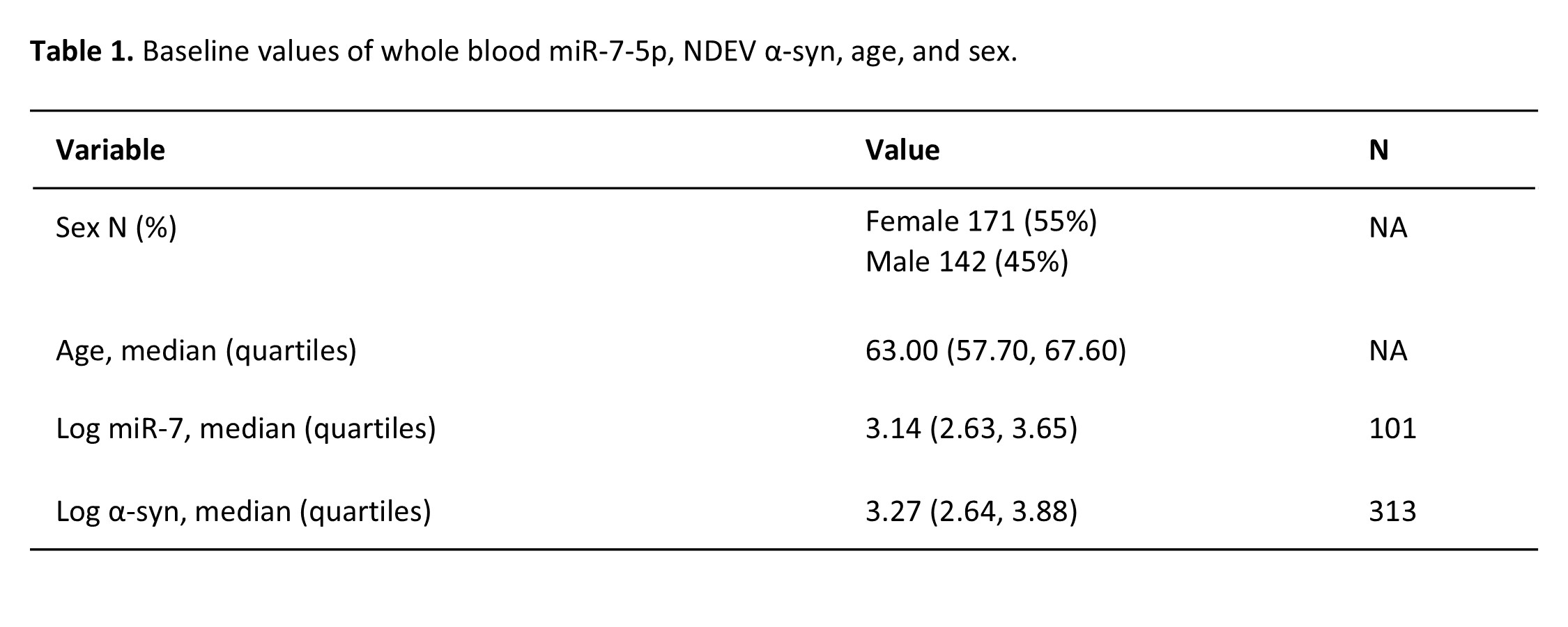
Table 1
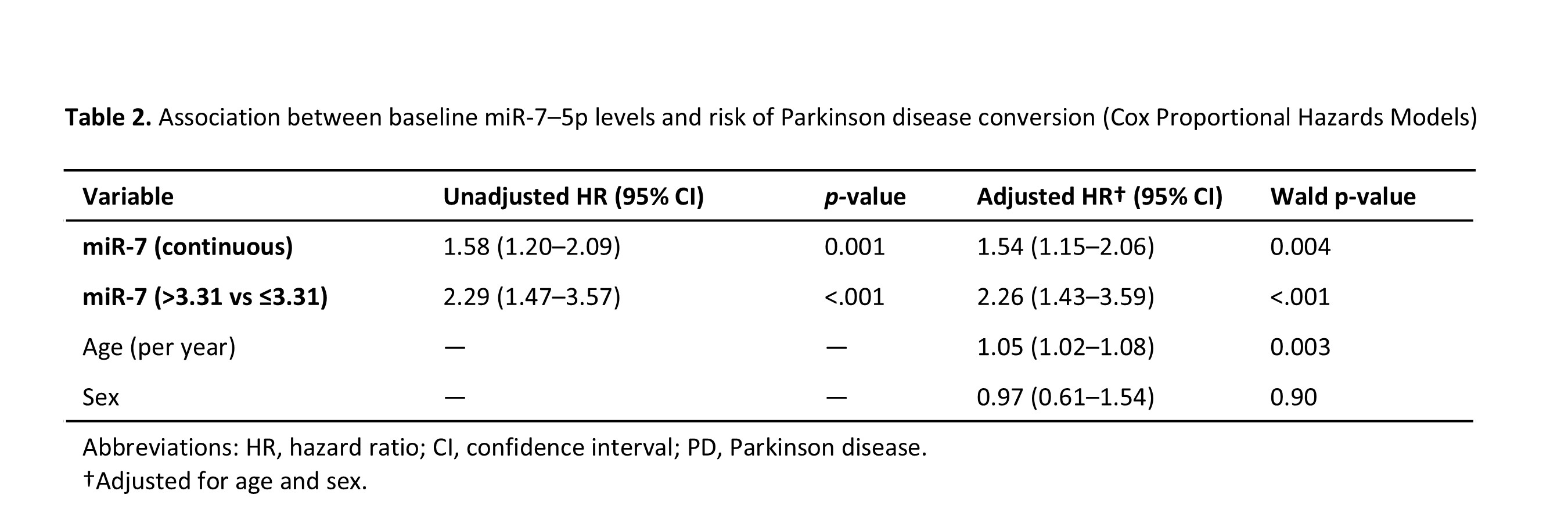
Table 2
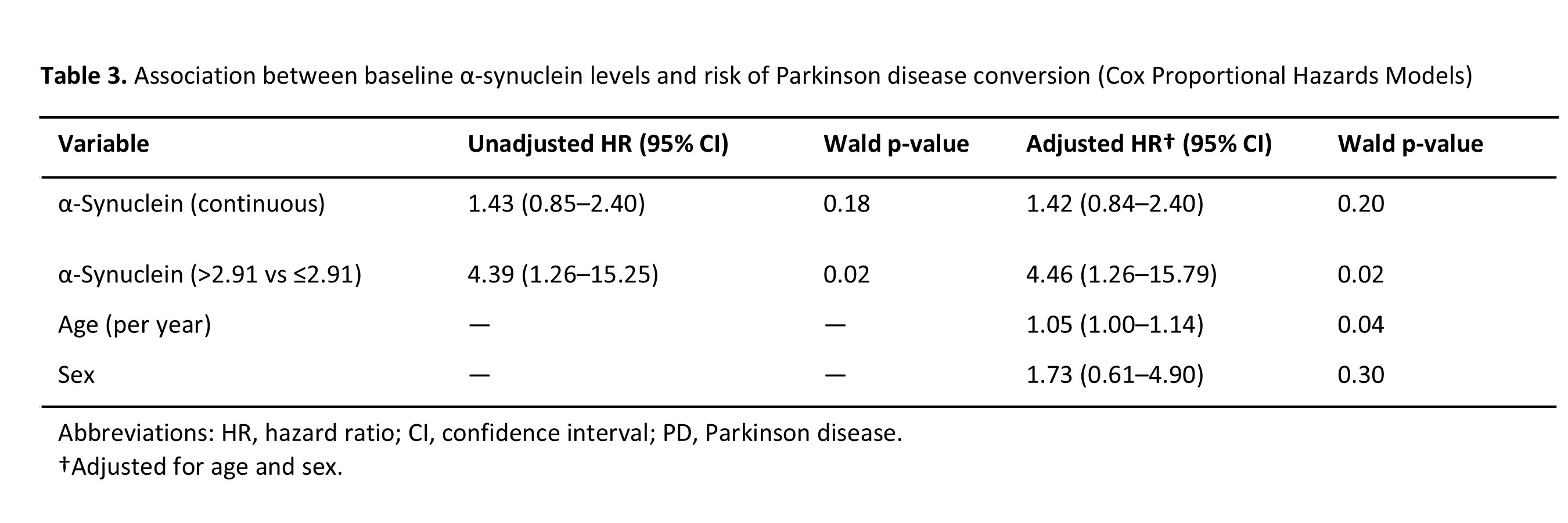
Table 3
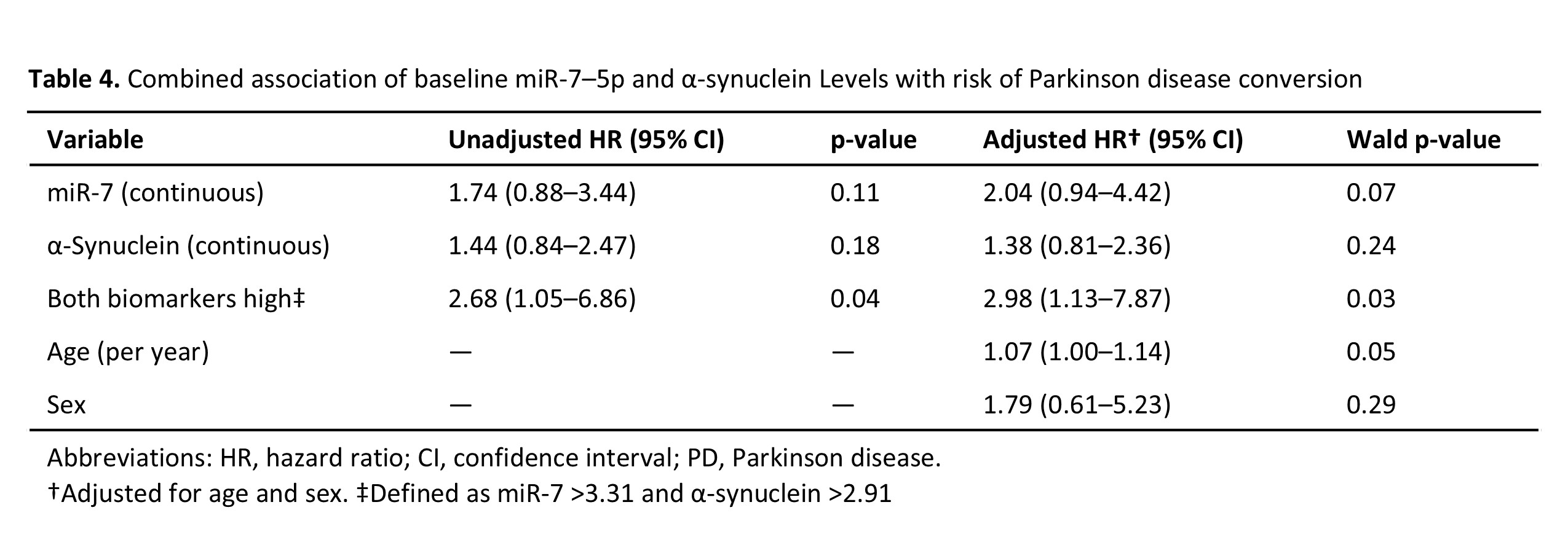
Table 4
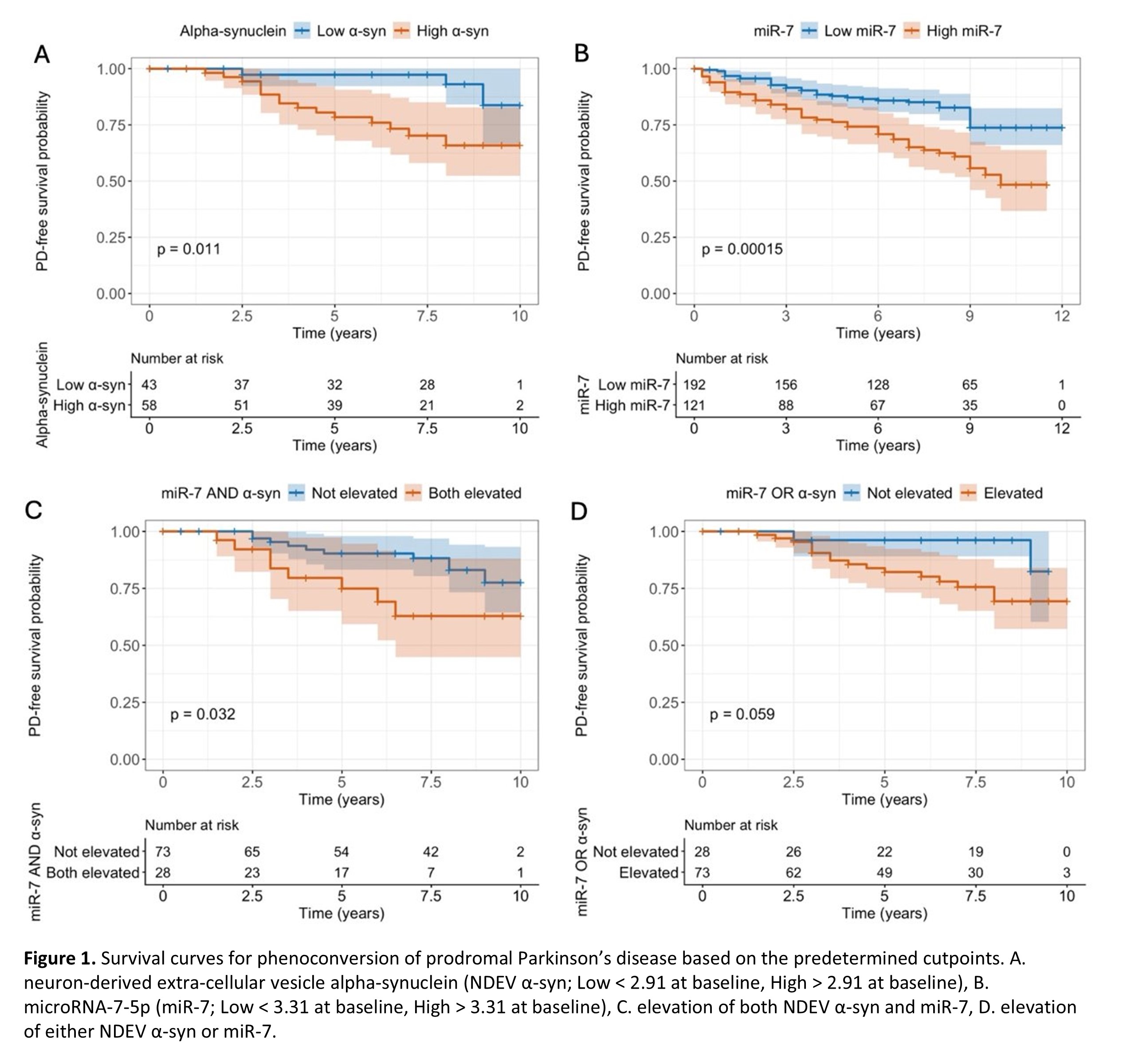
Figure 1
To cite this abstract in AMA style:
C. Adams, S. Zadegan, K. Muthiah, P. Velammal, M. Jatty. Retrospective Evaluation of microRNA-7-5p and Neuron-Derived α-Synuclein in Prodromal Parkinson’s Disease as Phenoconversion Biomarkers [abstract]. Mov Disord. 2026; 41 (suppl 1). https://www.mdsabstracts.org/abstract/retrospective-evaluation-of-microrna-7-5p-and-neuron-derived-%ce%b1-synuclein-in-prodromal-parkinsons-disease-as-phenoconversion-biomarkers/. Accessed October 1, 2026.« Back to 2026 International Congress
MDS Abstracts - https://www.mdsabstracts.org/abstract/retrospective-evaluation-of-microrna-7-5p-and-neuron-derived-%ce%b1-synuclein-in-prodromal-parkinsons-disease-as-phenoconversion-biomarkers/