
Category: Dystonia: Clinical Trials
Objective: To describe a series of patients with tardive dystonia and a single case with choreoathethosic movements, with cocaine consumption and without an identified secondary cause.
Background: Cocaine is an inhibitor of the dopamine transporter (DAT). While acute dystonic reactions are well-documented, tardive syndromes are rarely reported. In Chile, annual active cocaine use prevalence is estimated to be 1%, and 5.9% have ever tried cocaine at least once in their lifetime; identifying these secondary movement disorders is essential for accurate diagnosis and management.
Method: A retrospective study was conducted at a specialized movement disorder clinic in Santiago, Chile, including patients from 2014 to 2019. We screened for the word “Cocaine” in the clinic electronic database. 23 cases were identified, from which 17 were excluded due to confounding factors or acute dystonia diagnosis. Five patients were included for tardive dystonia case series, and one patient for choreoathethosis case report.
Results: The tardive dystonia cohort included 5 patients (3 male, 2 female) with a median age of 34 years (range: 22–40). 100% presented with cervical dystonia; 1 (20%) had concomitant oromandibular involvement. Median time from consumption onset to dystonia was 3 months (range: 1 week to 12 years). Median dystonia duration at evaluation was 2 years (range: 1–5 years). 4 patients ceased consumption. All patients were treated with Botulinum Toxin, achieving symptomatic improvement. Oral adjuncts included Clonazepam (n=3) and Trihexyphenidyl (n=1).
Choreoathethosic patient was male, 53 years old, has a consumption onset to symptom of 6 years, choreoathethosis presented on both upper limbs, was symmetrical and compatible with “crack dancing”. Patient ceased consumption and was treated with tetrabenazin and symptom lasted for 2 years.
Conclusion: Chronic cocaine use can be a trigger for tardive dystonia. This pathology is potentially underdiagnosed. Our finding emphasizes the necessity of a detailed toxicological history in adult-onset dystonias.
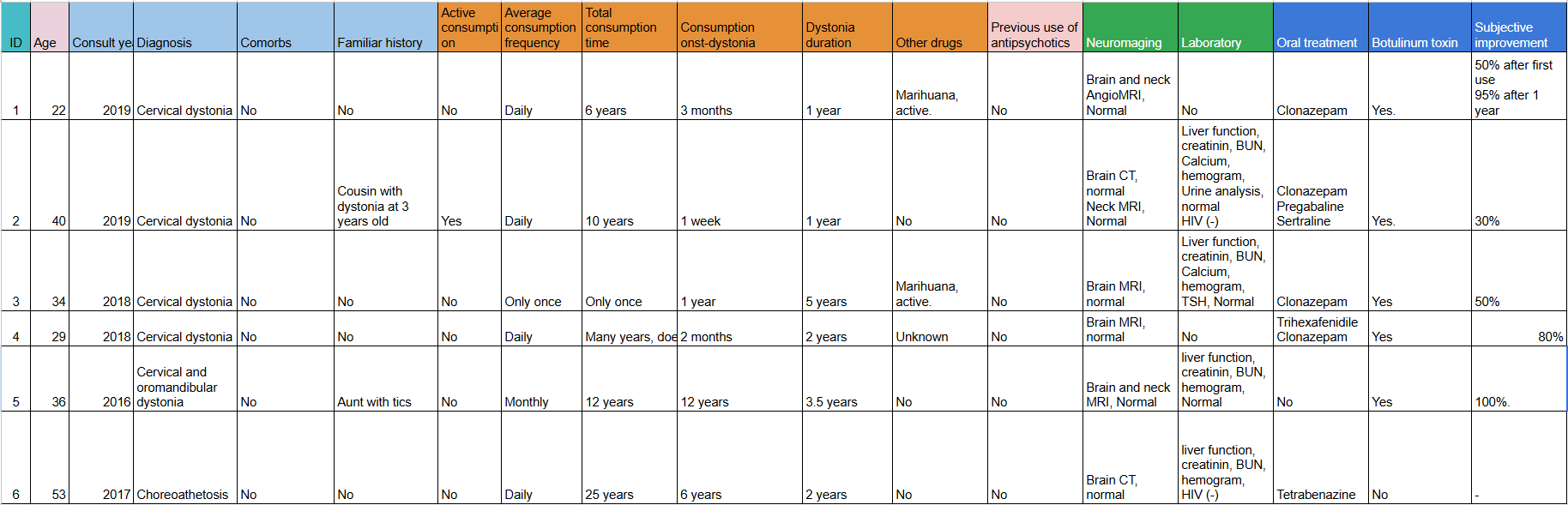
Patient resume table
References: Estudio Nacional de Drogas en Población General, SENDA 2018
Deik A, Saunders-Pullman R, San Luciano M. Substances of abuse and movement disorders: complex interactions and comorbidities. Curr Drug Abuse Rev. 2012 September ; 5(3): 243–253
Brust JC. Neurologic Complications of Illicit Drug Abuse. Continuum (Minneap Minn) 2014;20(3):642–656
Pinto JM, Babu K, Jenny C. Cocaine-induced dystonic reaction. Pediatr Emer Care 2013;29: 1006-1008
Catalano G, Catalano MC, Rodriguez R. Dystonia associated with crack cocaine use. South Med J. 1997;90(10):1050-1052
Fines RE, Brady WJ, Debehnke DJ. Cocaine-associated dystonic reaction. Am J Emerg Med. 1997; 15(5):513–515
Vinkers DJ, van Harten PN, Schols D. Letter to the Editor (Case report): Long-term use of cocaine and late-onset torticollis. Progress in Neuro-Psychopharmacology & Biological Psychiatry 2010;34:425–426; una mujer de 34 años con movimientos coreo-distónicos de tronco que persisten tras 20 meses de abstinencia (5), y un hombre de 45 años con distonía cervical que persiste luego de 15 años de abstinencia (7).
Weiner WJ, Rabinstein A, Levin B, Weiner C, Shulman LM. Cocaine-induced persistent dyskinesias. Neurology 2001;56:964–965
Brust JC. Substance abuse and movement disorders. Mov Disord. 2010; 25(13):2010–2020
Duodécimo estudio nacional de drogas en población general de Chile, 2018. SENDA.
Van Harten PN, van Trier JC, Horwitz EH, Matroos GE and Hoek HW. Cocaine as a risk factor for neuroleptic-induced acute dystonia. The Journal of Clinical Psychiatry. 1998
Hegarty AM, Lipton RB, Merriam AE, et al. Cocaine as a risk factor for acute dystonic reactions. Neurology. 1991;41:1670Y1672
To cite this abstract in AMA style:
M. Niedbalski, M. Canals, F. Urbina, V. Besa. Tardive Dystonia Case Ceries and Choreathethosis Case Report Secondary to Cocaine Use From a Specialized Movement Disorder Center in Santiago, Chile. [abstract]. Mov Disord. 2026; 41 (suppl 1). https://www.mdsabstracts.org/abstract/tardive-dystonia-case-ceries-and-choreathethosis-case-report-secondary-to-cocaine-use-from-a-specialized-movement-disorder-center-in-santiago-chile/. Accessed October 1, 2026.« Back to 2026 International Congress
MDS Abstracts - https://www.mdsabstracts.org/abstract/tardive-dystonia-case-ceries-and-choreathethosis-case-report-secondary-to-cocaine-use-from-a-specialized-movement-disorder-center-in-santiago-chile/