
Category: Parkinson’s Disease: Clinical Trials
Objective: To investigate if coordinated rehabilitation after starting Device Assisted Treatment (DAT) improves daily activity performance/skills, participation, and disease specific quality of life.
Background: DATs reduce motor fluctuations and improve quality of life in advanced Parkinson’s disease (PD). However, patients often abandon some everyday activities before starting DAT due to severe symptoms. Personalized rehabilitation following DAT initiation may help patients resume these activities and enhance functional gains.
Method: This was a single center, randomized controlled open study, where PD patients starting deep brain stimulation, intestinal levodopa infusion, or subcutaneous apomorphine infusion were randomized to standard care (SC) or standard care plus a three-month rehabilitation period (SC+R) starting one month after DAT initiation. The primary outcome was the Assessment of Motor and Process Skills (AMPS) at one, six and twelve months after DAT-initiation [figure 1]. Rehabilitation was primary-care-based and executed after an initial specialist Parkinson rehabilitation team assessment. Secondary outcomes included MDS-UPDRS, MoCA, accelerometry, and patient-reported outcome measures (PROMs).
Results: Of 54 patients randomized over 5.5 years, 45 completed the study (SC+R. n=22; SC, n=23). The groups were well balanced regarding DAT modalities and clinical characteristics. The primary outcome variable did not indicate that rehabilitation improved patient daily activity skills. There was however a significant group difference in AMPS motor skills that favored the rehabilitated SC+R group, although without significant interaction with time. Motor skills were significantly better maintained in the rehabilitation group with meaningful effect sizes at six and twelve months [figure 2]. Many measures improved across both groups due to DAT, and the SC+R group showed significantly better cognitive performance than SC at twelve months.
Conclusion: While the primary efficacy outcome was not fully met, tailored primary care rehabilitation improved the maintenance of motor skills after DAT initiation. Most other measures showed DAT was effective regardless of rehabilitation. The observed positive effect of rehabilitation on cognition in the first year after introducing DAT requires further confirmation.
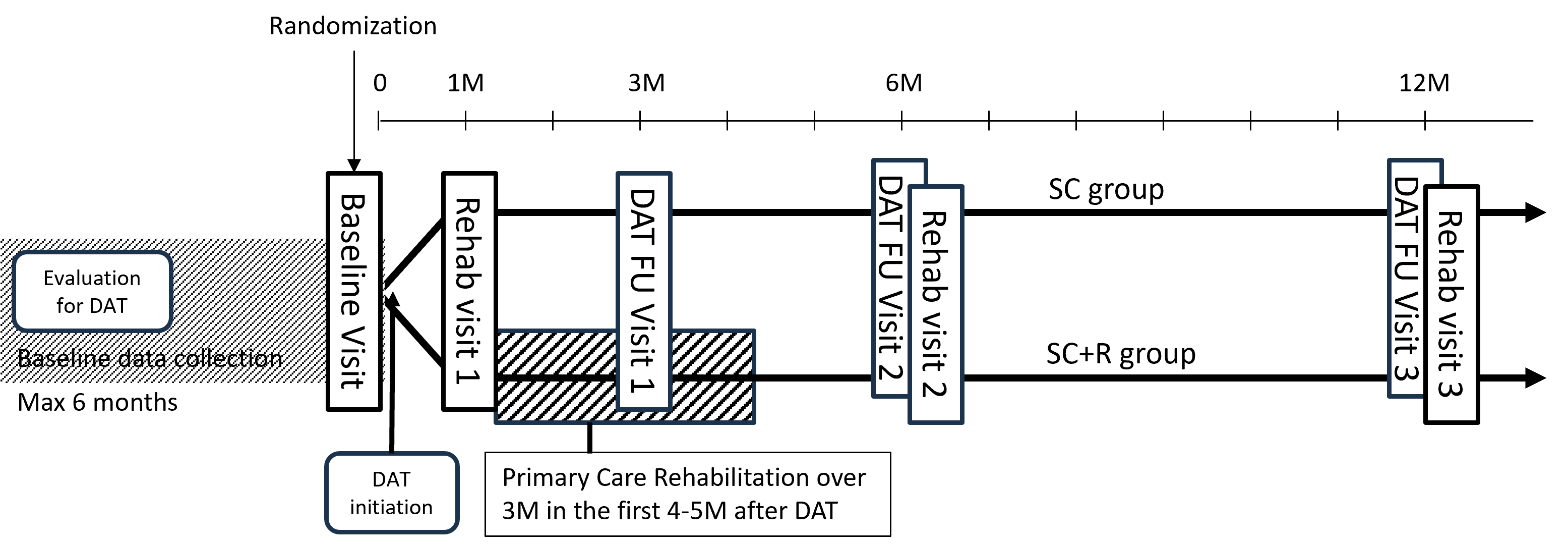
Figure 1: Overview study design

Figure 2: AMPS motor (A) and Process (B) skills.
To cite this abstract in AMA style:
A. Björkdahl, A. Khalif, M. Gustafsson, A. Lindström, F. Bergquist. Rehabilitation Following Initiation of Device Assisted Treatment in Parkinson’s Disease – a Randomized Controlled Trial [abstract]. Mov Disord. 2026; 41 (suppl 1). https://www.mdsabstracts.org/abstract/rehabilitation-following-initiation-of-device-assisted-treatment-in-parkinsons-disease-a-randomized-controlled-trial/. Accessed October 1, 2026.« Back to 2026 International Congress
MDS Abstracts - https://www.mdsabstracts.org/abstract/rehabilitation-following-initiation-of-device-assisted-treatment-in-parkinsons-disease-a-randomized-controlled-trial/