
Objective: To support the development of a smart textile with facial sensors and present a novel continuous monitoring approach, we derived and rendered digital twins from a large existing dataset with associated clinical assessments. This method allows for the realistic variation of physical appearances while keeping the original facial movement trajectories intact.
Background: Hypomimia is a hallmark motor symptom of Parkinson’s disease (PD) [1]. Machine learning (ML) models might offer automated hypomimia assessment, for example, for the detection of symptom fluctuations [2]. However, real-world video data collections often lack demographic diversity, which may lead to algorithmic bias.
Method: We extracted facial keypoints from a clinical database comprising over 33,696 videos of 295 patients from routine examinations at our university medical center. Using computer vision techniques, these markers allowed to derive the kinematic trajectories of the facial movements. We then applied facial motion retargeting to transfer the exact pathological and normal expressions onto a diverse panel of highly realistic 3D artificial human avatars. The avatars were systematically generated to represent a balanced distribution of age, skin tone, and biological sex.
Results: We demonstrated that modern, off-the-shelf 3D game engines can generate realistic faces displaying pathological facial movements. Manual validation confirmed that the artificial avatars preserved the spatiotemporal dynamics of the original hypomimia phenotypes while completely masking the original patients’ identities. Consequently, the demographic variance of the training set was successfully normalized to reference populations to avoid sampling bias in further analyses.
Conclusion: Translating clinical facial keypoints onto artificial 3D avatars provides a robust methodology for generating bias-mitigated, privacy-preserving synthetic datasets. This approach effectively normalizes demographic variables while retaining critical pathological kinematics, facilitating the equitable development of wearable smart textiles for continuous hypomimia monitoring in PD. In the future, extending this technology could significantly simplify case sharing and teaching while ensuring complete patient privacy.
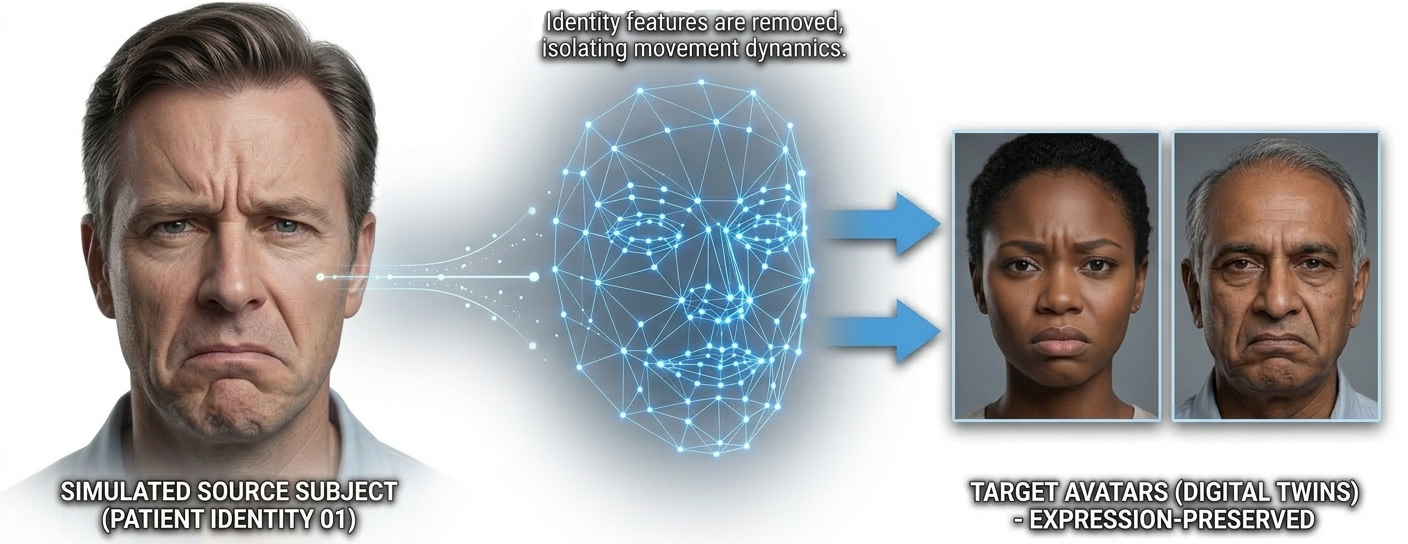
Paradigm for transferring facial movements.
References: [1] Bianchini E, Rinaldi D, Alborghetti M, et al. The Story behind the Mask: A Narrative Review on Hypomimia in Parkinson’s Disease. Brain Sciences. 2024;14(1):109.
[2] Novotny M, Tykalova T, Ruzickova H, et al. Automated video-based assessment of facial bradykinesia in de-novo Parkinson’s disease. npj Digit Med. 2022;5(1):1–8.
To cite this abstract in AMA style:
C. Gundler, A. Wiederhold, M. Pötter-Nerger. Translating Real-World Parkinsonian Facial Kinematics onto Diverse Digital Avatars [abstract]. Mov Disord. 2026; 41 (suppl 1). https://www.mdsabstracts.org/abstract/translating-real-world-parkinsonian-facial-kinematics-onto-diverse-digital-avatars/. Accessed October 1, 2026.« Back to 2026 International Congress
MDS Abstracts - https://www.mdsabstracts.org/abstract/translating-real-world-parkinsonian-facial-kinematics-onto-diverse-digital-avatars/