
Objective: To investigate disease characteristics and common drug treatment of late-stage Parkinsons’ disease (LSPD).
Background: LSPD presents with disabling motor and non-motor symptoms, the latter becoming dominant in the late stage1. There are few previous data on medication use in LSPD patients.
Method: Our study was an observational, multinational, cross-sectional study among physicians. In 2025, a 46-question online survey was distributed to outpatient and inpatient specialized palliative care services in Austria, Germany and the German speaking part of Switzerland. The results were analyzed by a two round Delphi study involving movement disorder specialists. Consensus was defined as ≥75% agreement.
Results: A total of 118 participants completed the survey (response rate: 9.4%). In the Delphi process, eight experts out of 19 participated. Final consensus was reached on 62 out of 140 items.
The most frequently reported symptoms were dysphagia (94%), rigidity (78%), speech disorder (70%), dementia (74%) and constipation (64%) aligning with the Delphi consensus [figure1].
Top drugs for motor symptom control at admission to and end of palliative care were levodopa+benserazide/carbidopa (96% vs. 64%) and rotigotine (48% vs. 49%). Similarly, the Delphi experts agreed on the importance of levodopa+benserazide/carbidopa and rotigotine for palliative care. Notably, the Delphi panel also endorsed intestinal levodopa. There was strong consensus that levodopa therapy should be maintained until death.
For non-motor symptom control [table1], laxatives were the most favored drug class at both admission to and end of palliative care (75% vs. 73%), which was consistent with the Delphi findings. The most preferred agents were macrogol (70%) and sodium picosulfate (71%).
The Delphi experts emphasized the use of antipsychotics and medications for hypersalivation throughout palliative and end-of-life care. Quetiapine was the most frequently used medication for managing psychosis (76%) and delirium (59%). Delphi panelists reached consensus on botulinum toxin injections for managing hypersalivation.
Conclusion: Our explorative findings provide valuable insights into pharmacological management of LSPD, underscoring the need for a targeted drug therapy to reduce symptom burden.
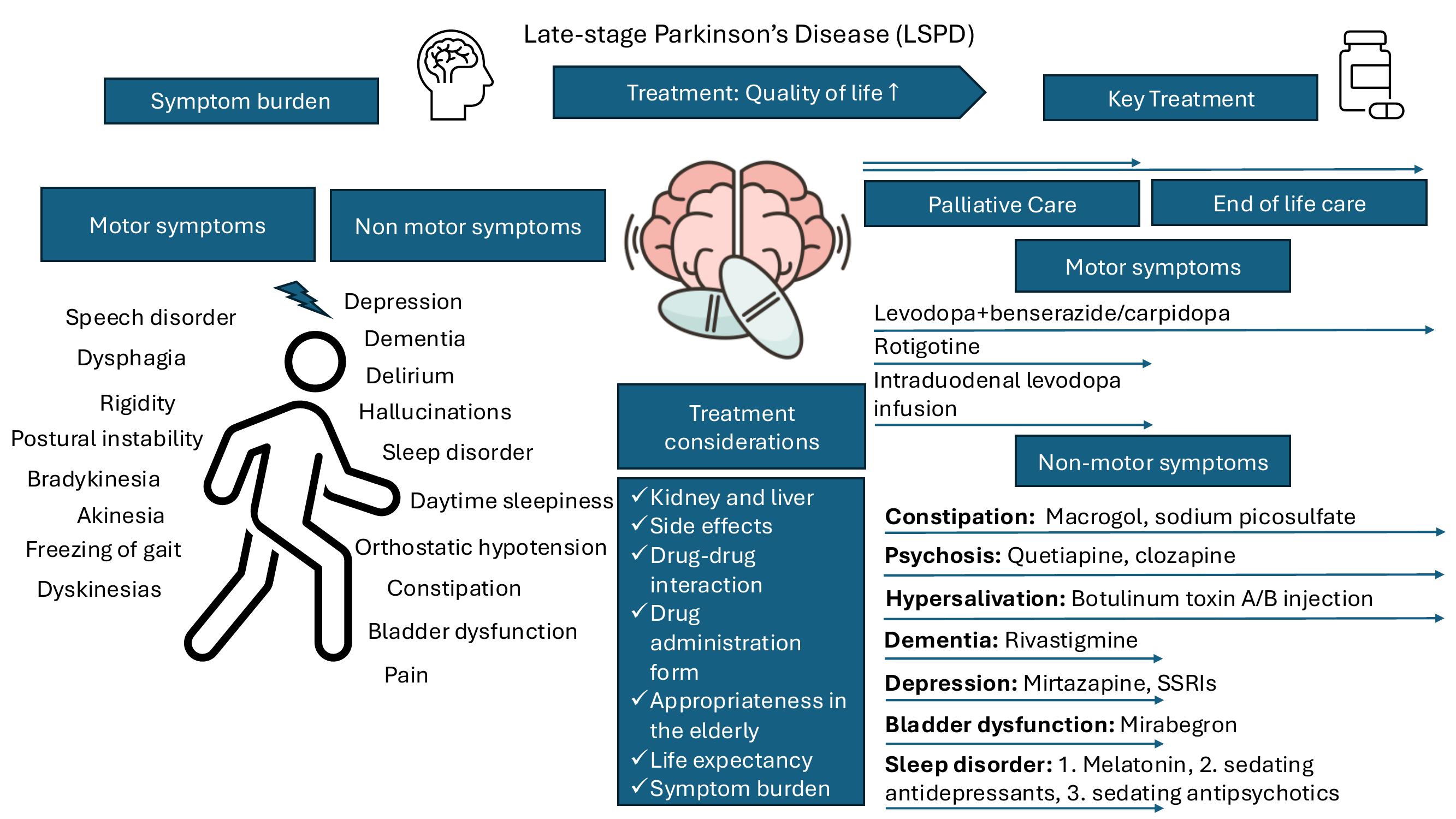
LSPD characteristics and key drug treatment
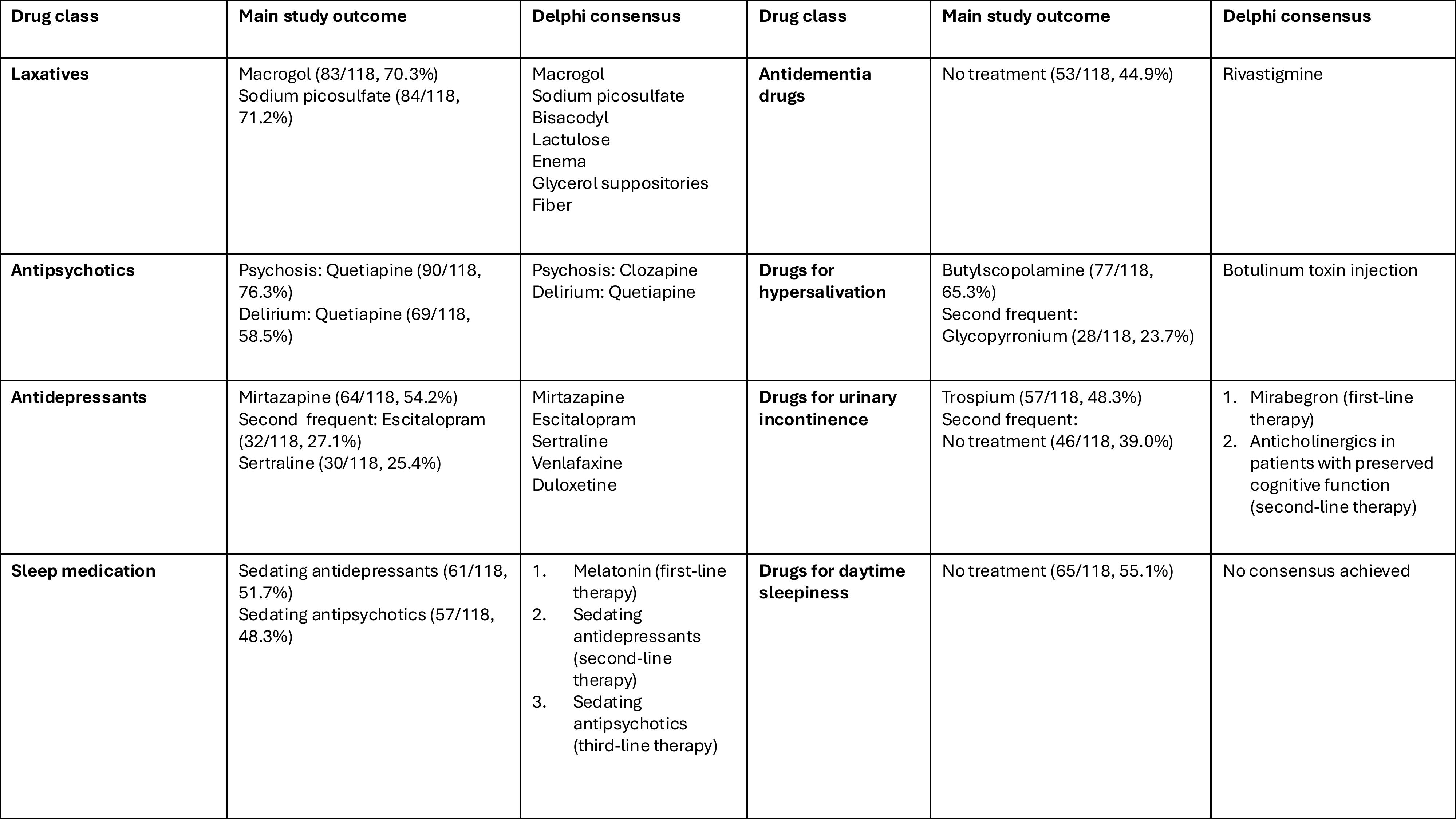
Drug treatment of non-motor symptoms
References: 1. Schrag A, Hommel A, Lorenzl S, et al. The late stage of Parkinson’s -results of a large multinational study on motor and non-motor complications. Parkinsonism Relat Disord 2020;75:91-96.
To cite this abstract in AMA style:
C. Pallauf, C. Weck, C. Brandl, S. Lorenzl. Medical Management of Late-stage Parkinson’s Disease – a Cross-sectional, Multinational Survey [abstract]. Mov Disord. 2026; 41 (suppl 1). https://www.mdsabstracts.org/abstract/medical-management-of-late-stage-parkinsons-disease-a-cross-sectional-multinational-survey/. Accessed October 1, 2026.« Back to 2026 International Congress
MDS Abstracts - https://www.mdsabstracts.org/abstract/medical-management-of-late-stage-parkinsons-disease-a-cross-sectional-multinational-survey/