
Objective: To systematically investigate the efficacy of an 8-week LSVT-BIG intervention on balance control in patients with Parkinson’s disease (PD), and to explore its potential underlying cortical regulatory mechanisms via functional near-infrared spectroscopy (fNIRS).
Background: PD is a prevalent neurodegenerative disorder characterized by balance dysfunction, which elevates fall risk in affected individuals.Lee Silverman Voice Treatment-BIG (LSVT-BIG) is an intensive motor rehabilitation protocol for PD. However, its specific effects on balance control and the underlying cortical regulatory mechanisms remain incompletely elucidated.
Method: 15 patients with idiopathic PD were enrolled, all diagnosed in accordance with the 2015 MDS Clinical Diagnostic Criteria for PD, with Hoehn-Yahr stage 2-3, concurrent balance dysfunction, and stable dopaminergic medication for ≥2 months. All participants completed a standardized 8-week LSVT-BIG rehabilitation program. All outcomes were assessed at baseline and immediately post-intervention.The primary outcome measures included Mini-BESTest, Berg Balance Scale (BBS), and the scores of MDS-UPDRS III 3.9-3.14. Secondary outcome measures included gait and balance parameters, total score of MDS-UPDRS III and PDQ-39. FNIRS was performed to detect changes in cortical activation and functional connectivity (FC) within motor-balance related brain networks.
Results: All 15 patients completed the intervention and assessments without serious adverse events. The 8-week LSVT-BIG intervention yielded significant balance and motor improvements on primary outcomes: elevated Mini-BESTest (p<0.01) and reduced MDS-UPDRS III 3.9-3.14 scores versus baseline (p<0.01), with no significant BBS change. Secondary outcomes showed reduced double support phase ratio (p<0.01), total MDS-UPDRS III (p<0.01) and PDQ-39 scores (p<0.05). Cortical assessments showed significant reduced prefrontal cortex (PFC) FC strength, with a trending FC increase between lateral premotor cortex (LPMC) and left primary somatosensory cortex (LS1) (p=0.06), likely due to small sample size.
Conclusion: LSVT-BIG significantly ameliorates PD-related balance dysfunction. This intervention reduced intra-PFC FC strength and trends to enhance LPMC-LS1 FC in PD patients.This study offers clinical and theoretical support for future personalized rehabilitation of PD-related balance dysfunction.
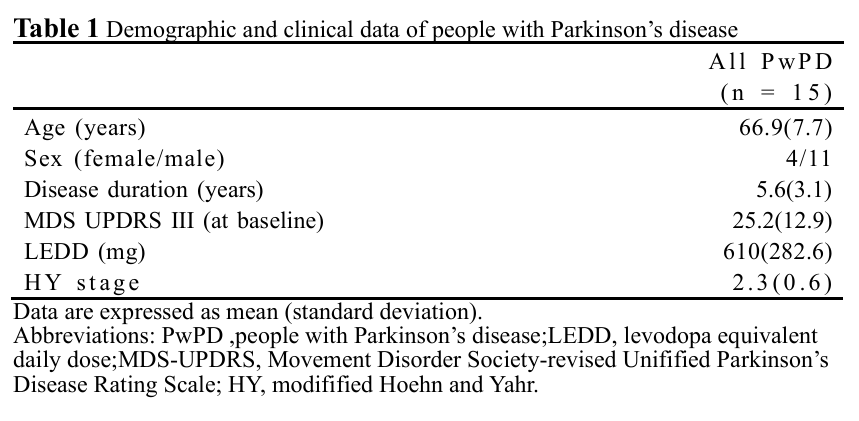
Table 1
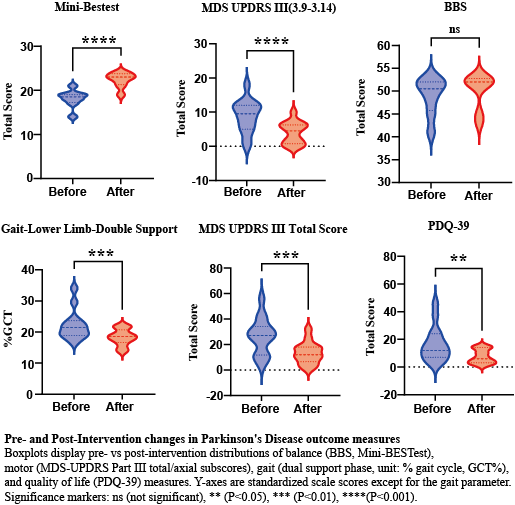
Fig 1
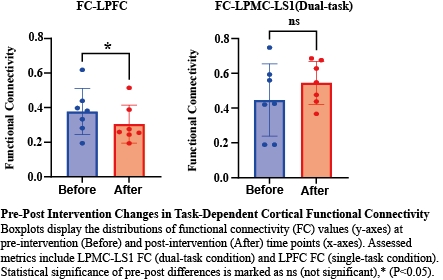
Fig 2
To cite this abstract in AMA style:
X. Zha, P. Liu, J. Wu. Effects of LSVT BIG on Balance Dysfunction in Parkinson’s Disease and Its Underlying Cortical Regulatory Mechanisms Using fNIRS [abstract]. Mov Disord. 2026; 41 (suppl 1). https://www.mdsabstracts.org/abstract/effects-of-lsvt-big-on-balance-dysfunction-in-parkinsons-disease-and-its-underlying-cortical-regulatory-mechanisms-using-fnirs/. Accessed October 1, 2026.« Back to 2026 International Congress
MDS Abstracts - https://www.mdsabstracts.org/abstract/effects-of-lsvt-big-on-balance-dysfunction-in-parkinsons-disease-and-its-underlying-cortical-regulatory-mechanisms-using-fnirs/