
Category: Parkinson's Disease: Genetics
Objective: To compare dyskinesia occurrence and associated factors in PRKN versus non-PRKN early-onset Parkinson’s Disease (EOPD).
Background: Biallelic pathogenic PRKN variants represent the commonest recessive cause of PD (PRKN-PD) and have traditionally been associated with early-onset levodopa-induced dyskinesia.1-5 Recent large cohort studies suggest that dyskinesia in PRKN-PD may occur later than in non-PRKN EOPD.6
Method: We analysed 90 indigenous Sabahan EOPD patients (60 PRKN, 30 non-PRKN), previously screened for PRKN variants.7 Age at onset (AAO), dyskinesia occurrence, timing, and associated levodopa-equivalent daily dose (LEDD) were compared. Subgroup analyses by PRKN mutation type were also performed.
Results: PRKN patients had younger AAO than non-PRKN patients [35(28–40) vs. 46(34–48) years, p<0.0001]. Dyskinesia occurred in 50% of PRKN vs 41.4% of non-PRKN patients (p=0.45). Mean age at dyskinesia onset was similar in PRKN vs non-PRKN groups (48.3±9.1 vs 50.3±6.4years, p=0.52), with comparable median intervals from motor onset [11.5(6–17) vs 9(4–13)years, p=0.30] and medication initiation [3(1–8) vs 4.5(3.5–6)years, p=0.37]. However, PRKN patients developed dyskinesia at significantly lower LEDD (329±206 vs. 664±240 mg/day, p=0.0005), even after adjusting for AAO and disease duration. Dyskinesia rates between homozygous exon 3 deletion (n=20/44, 47.6%) and compound heterozygous (n=9/16, 56.2%) PRKN patients were similar (p=0.56). Time from motor onset to dyskinesia was numerically longer in compound heterozygous PRKN patients (17.5 vs 9.5 years, p=0.14).
Conclusion: Time to dyskinesia was similar between PRKN and non-PRKN EOPD, contrasting with recent reports.6 However, dyskinesia occurred at substantially lower dopaminergic doses, in our indigenous PRKN-PD cohort, suggesting heightened dopaminergic sensitivity. Genetic and/or environmental modifiers may influence dyskinesia risk in PRKN-PD and warrant further investigation.
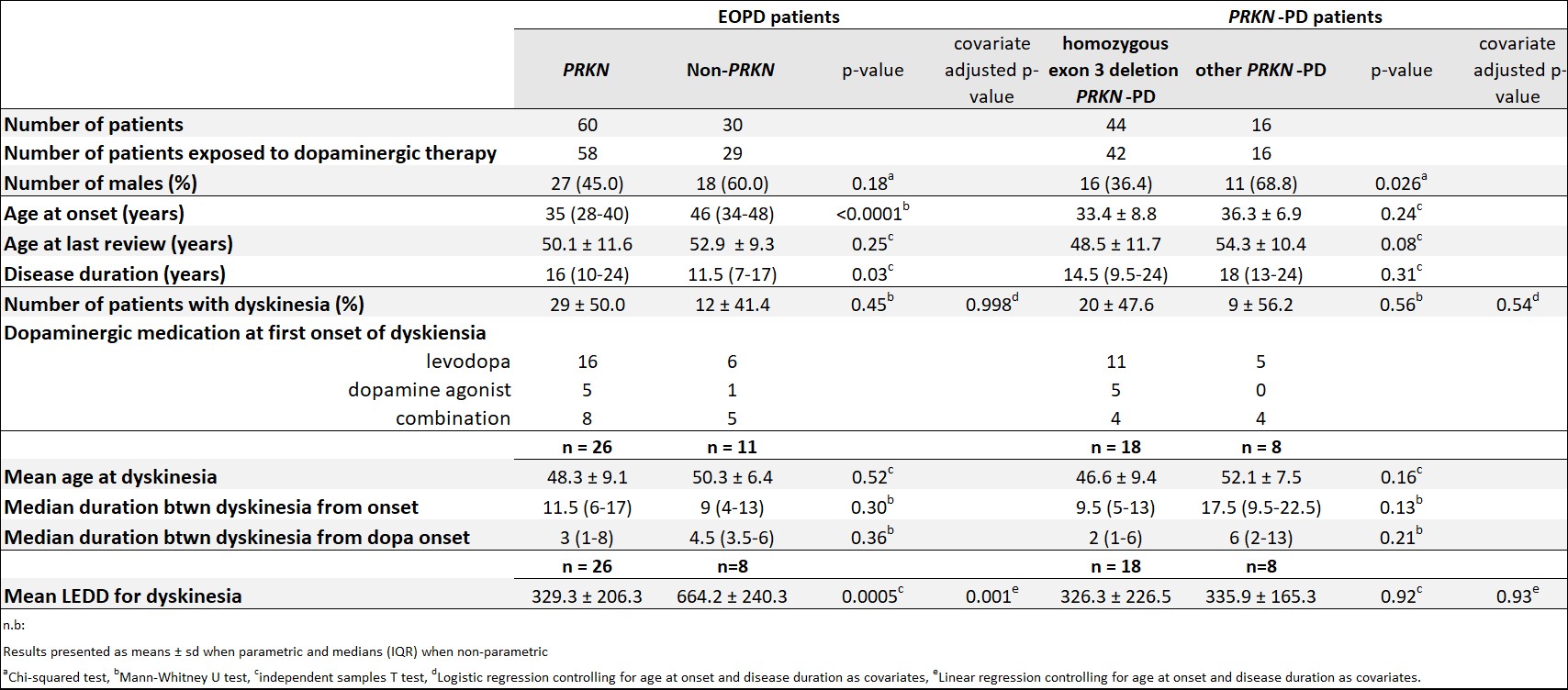
Table 1
References: 1. Kitada T, Asakawa S, Hattori N, et al. Mutations in the parkin gene cause autosomal recessive juvenile parkinsonism. Nature. 1998;392(6676):605-608. doi:10.1038/33416
2. Paviour DC, Surtees RA, Lees AJ. Diagnostic considerations in juvenile parkinsonism. Mov Disord. 2004;19(2):123-135. doi:10.1002/mds.10644
3. Wickremaratchi MM, Knipe MD, Sastry BS, et al. The motor phenotype of Parkinson’s disease in relation to age at onset. Mov Disord. 2011;26(3):457-463. doi:10.1002/mds.23469
4. Halkias IA, Haq I, Huang Z, Fernandez HH. When should levodopa therapy be initiated in patients with Parkinson’s disease?. Drugs Aging. 2007;24(4):261-273. doi:10.2165/00002512-200724040-00001
5. Fox SH, Katzenschlager R, Lim SY, et al. International Parkinson and movement disorder society evidence-based medicine review: Update on treatments for the motor symptoms of Parkinson’s disease. Mov Disord. 2018;33(8):1248-1266. doi:10.1002/mds.27372
6. Menon PJ, Sambin S, Criniere-Boizet B, et al. Genotype-phenotype correlation in PRKN-associated Parkinson’s disease. NPJ Parkinsons Dis. 2024;10(1):72. Published 2024 Mar 29. doi:10.1038/s41531-024-00677-3
7. Tay YW, Ooi JCE, Lim SY, et al. Very High Frequency of Early-Onset Parkinson’s Disease and PRKN Mutations among Indigenous Patients in Sabah, Malaysia. Mov Disord. 2025;40(11):2407-2418. doi:10.1002/mds.70015
To cite this abstract in AMA style:
JCE. Ooi, YK. Chia, YW. Tay, TZ. Toh, A. Ahmad-Annuar, S-Y. Lim, AH. Tan. Higher Dopaminergic Sensitivity Underlies Dyskinesia Occurrence in Indigenous Sabahan PRKN Parkinson’s Disease [abstract]. Mov Disord. 2026; 41 (suppl 1). https://www.mdsabstracts.org/abstract/higher-dopaminergic-sensitivity-underlies-dyskinesia-occurrence-in-indigenous-sabahan-prkn-parkinsons-disease/. Accessed October 1, 2026.« Back to 2026 International Congress
MDS Abstracts - https://www.mdsabstracts.org/abstract/higher-dopaminergic-sensitivity-underlies-dyskinesia-occurrence-in-indigenous-sabahan-prkn-parkinsons-disease/