
Objective: To determine whether speech impairment severity, as quantified by acoustic speech measures, is associated with motor symptom lateralisation in advanced Parkinson’s disease (PD).
Background: Asymmetric nigral dopaminergic loss is a hallmark of idiopathic PD, leading to asymmetric motor symptoms. Speech function primarily depends on left-lateralised brain circuitries, and de novo individuals with PD (IwPD) with left-hemisphere onset show greater speech impairments at the time of diagnosis than those with right-hemisphere onset [1]. However, it is unclear whether speech asymmetries persist in advanced PD, or level out like limb motor symptoms [2].
Method: Speech and Unified Parkinson’s Disease Rating Scale part III (UPDRS III) data of over 250 German IwPD is available for analysis and was collected after a 12 hour cessation of dopaminergic medication. As data processing is ongoing, we provide a preliminary analysis of 131 IwPD (84M, 47F; mean age = 63.6 years; mean disease duration = 8.4 years; mean UPDRS part III score of 36.8, range: 13-72).
Speech data was collected following recommended recording protocols, and tasks included sustained vowels, oral diadochokinesis (DDK), and passage reading [3]. Following [1], we performed automated acoustic analyses of imprecise consonants (voice onset time), monopitch (standard deviation of the fundamental frequency), and pausing (duration of pause intervals) using the Dysarthria Analyzer [4].
Motor symptom lateralisation was calculated from UPDRS III scores by subtracting left-hemibody from right-hemibody bradykinesia, rigidity, and tremor scores [5]. A positive score indicates more right-hemibody motor symptoms.
Results: The full dataset will be presented at the congress alongside additional acoustic measures and motor symptom analyses. A preliminary linear mixed-effects model showed that a higher overall UPDRS III score was associated with worse speech scores (p < .001), but there was no effect of motor symptom lateralisation (p = .80, see Fig 1), or disease duration (p = .09).
Conclusion: While overall motor symptom severity was associated with speech impairment severity in this cohort of advanced IwPD, this relationship did not depend on motor symptom lateralisation. Instead, speech symptoms appear to level out like limb motor symptoms.
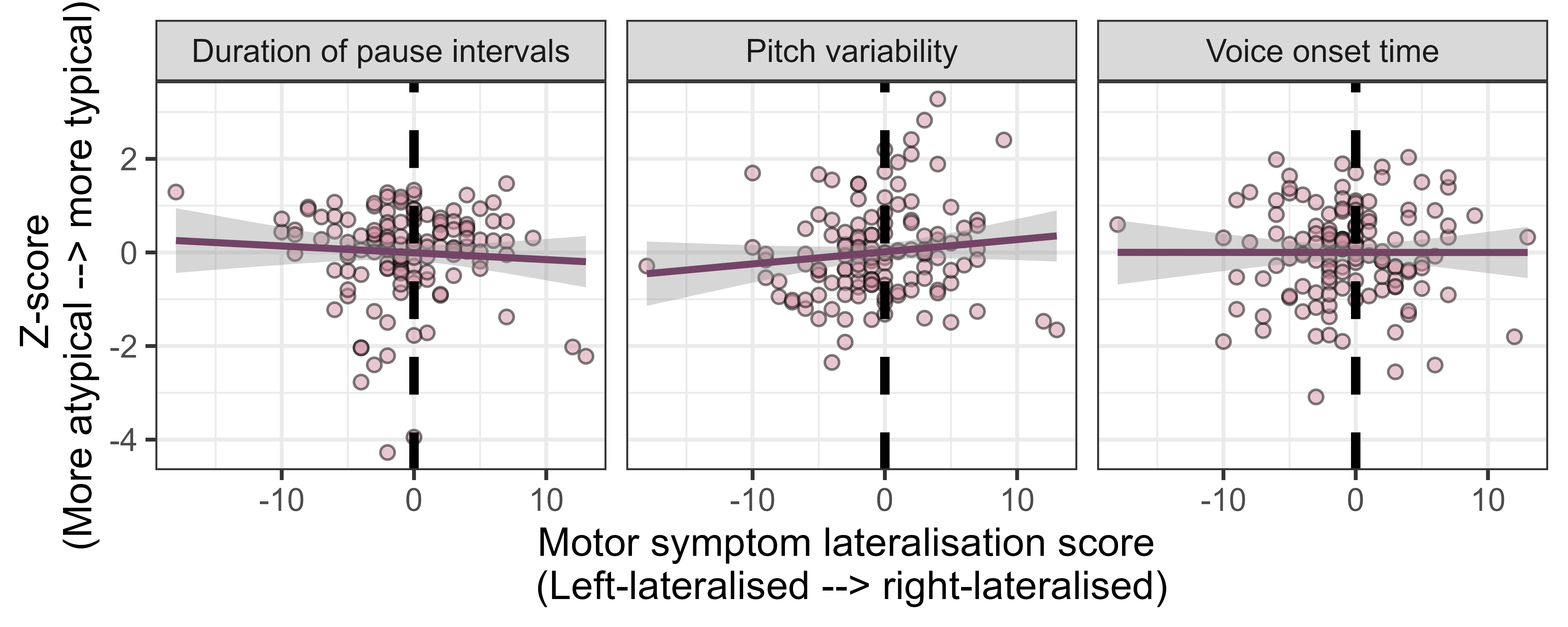
Z-scored measures and motor symptom lateralisation
References: [1] Rusz, J., Dusek, P., Tykalova, T., Novotny, M., Illner, V., Simek, M., … & Krack, P. (2025). Is speech function lateralised in the basal ganglia? Evidence from de novo Parkinson’s disease. Journal of Neurology, Neurosurgery & Psychiatry, 96(5), 462-465.
[2] Marinus, J., & van Hilten, J. J. (2015). The significance of motor (a) symmetry in Parkinson’s disease. Movement Disorders, 30(3), 379-385.
[3] Rusz, J., Tykalova, T., Ramig, L. O., & Tripoliti, E. (2021). Guidelines for speech recording and acoustic analyses in dysarthrias of movement disorders. Movement Disorders, 36(4), 803-814.
[4] Hlavnička, J. (2023). The Dysarthria Analyzer. from www.dysan.cz.
[5] Miller-Patterson, C., Buesa, R., McLaughlin, N., Jones, R., Akbar, U., & Friedman, J. H. (2018). Motor asymmetry over time in Parkinson’s disease. Journal of the neurological sciences, 393, 14-17.
To cite this abstract in AMA style:
T. Tienkamp, T. Thies, P. Schumacher, D. Mücke, M. Barbe. Speech Impairment Severity and Motor Symptom Lateralisation in Advanced Parkinson’s Disease [abstract]. Mov Disord. 2026; 41 (suppl 1). https://www.mdsabstracts.org/abstract/speech-impairment-severity-and-motor-symptom-lateralisation-in-advanced-parkinsons-disease/. Accessed October 1, 2026.« Back to 2026 International Congress
MDS Abstracts - https://www.mdsabstracts.org/abstract/speech-impairment-severity-and-motor-symptom-lateralisation-in-advanced-parkinsons-disease/