
Category: Parkinson's Disease (Other)
Objective: To evaluate the feasibility of developing a novel Multimodal Kinematic Artificial Intelligence (MKAI) system, uniquely guided by expert physician evaluation notes, to generate objective, clinically interpretable motor metrics in Parkinson’s Disease (PD), with a focus on decision support and patient-centric outcomes.
Background: Accurate assessment of motor function is essential for managing PD, yet standard evaluations are constrained by subjectivity and in-person care requirements. While human pose estimation captures objective motion data, raw kinematics often lack clinical relevance. We propose a feasibility study (SYNAPSE) to bridge this gap. By integrating specialist annotations directly into the model training, the proposed study aims to test the feasibility of a MKAI system that delivers interpretable and actionable metrics to support treatment decisions (ex: medication titration, programming adjustments) towards optimizing patient outcomes.)
Method: This prospective feasibility study will enroll up to 40 PD patients. Participants perform standard mobility tasks, including the (MDS-UPDRS) Part III, recorded via a secure application on off the shelf smart devices. Movement Disorders specialists will retrospectively review these videos and provide detailed evaluation notes and clinical scores. These rich, expert-derived clinical annotations are then utilized to train and guide the MKAI algorithms, teaching the system to identify and prioritize clinically meaningful kinematic deviations in 2D and 3D human pose estimations [figure1]. Primary endpoint is the correlation analysis between the clinically guided MKAI metrics and gold-standard specialist ratings. Secondary endpoints assess patient-reported usability and perceived barriers for conducting these tests at home.
Results: By anchoring the machine learning process in expert physician notes, we anticipate that the resulting algorithms will demonstrate robust reliability and a higher correlation with specialist clinical judgment
Conclusion: Integrating expert clinical reasoning in our MKAI system enables a path to practical and scalable approach for clinically relevant PD assessment. The long-term goal of this system is to supplement clinical judgement, enable longitudinal remote monitoring, and enhance access to personalized care.
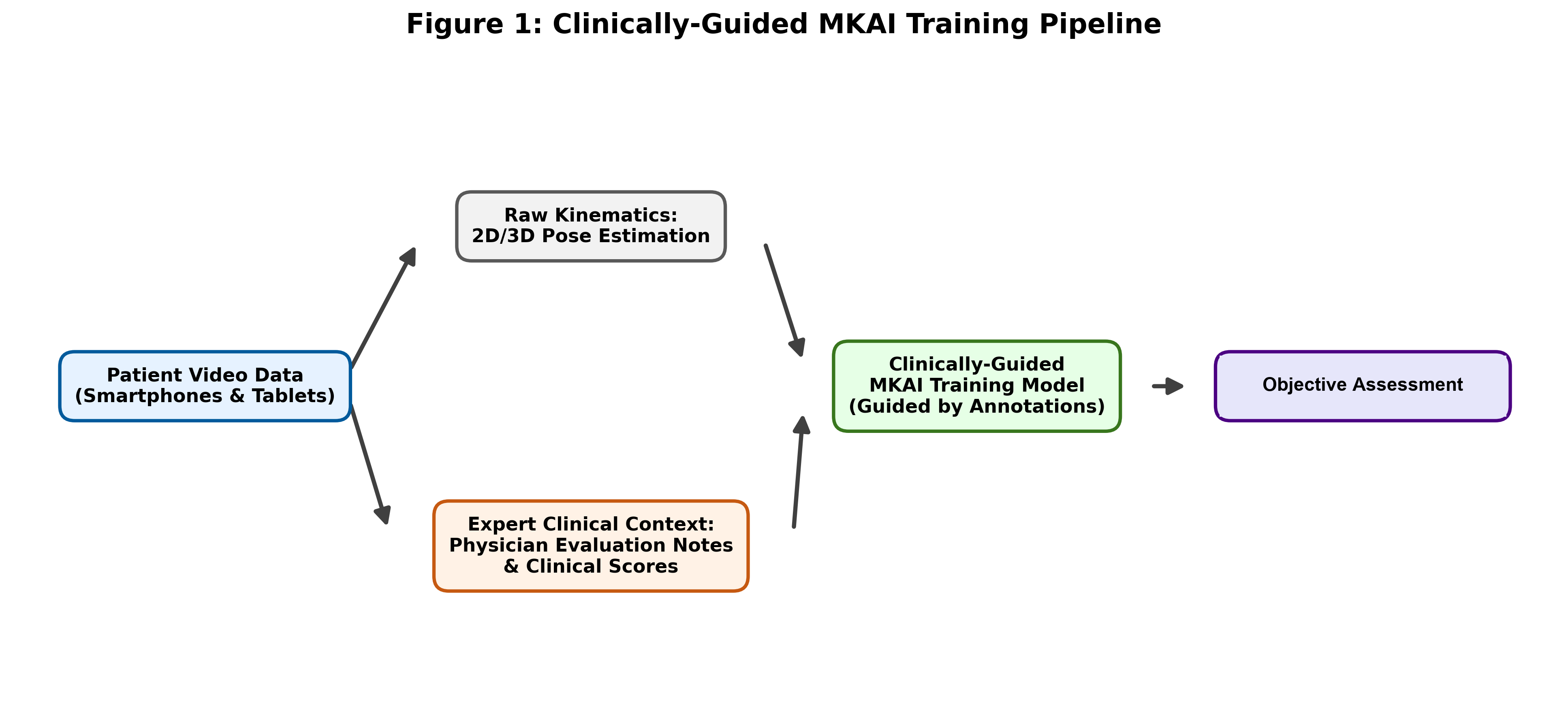
Figure 1
To cite this abstract in AMA style:
V. Tyagi, P. Silburn, Y. Pathak, D. Diaconescu. Clinician Guided Multimodal Kinematic AI System for Objective Assessment in Parkinson’s Disease [abstract]. Mov Disord. 2026; 41 (suppl 1). https://www.mdsabstracts.org/abstract/clinician-guided-multimodal-kinematic-ai-system-for-objective-assessment-in-parkinsons-disease/. Accessed October 1, 2026.« Back to 2026 International Congress
MDS Abstracts - https://www.mdsabstracts.org/abstract/clinician-guided-multimodal-kinematic-ai-system-for-objective-assessment-in-parkinsons-disease/