
Category: Parkinson's disease: Neuroimaging
Objective: To examine compartment-specific glymphatic alterations across prodromal and clinical stages of Parkinson’s disease (PD) and their associations with clinical features. We hypothesized that PA dysfunction reflects impaired arterial pulsatility potentially linked to autonomic dysfunction, whereas PV dysfunction reflects reduced clearance of interstitial waste.
Background: The glymphatic system is a brain waste clearance pathway that circulates cerebrospinal fluid through periarterial (PA) inflow and perivenous (PV) outflow. Dysfunction of this system is implicated in neurodegenerative diseases, including Parkinson’s disease (PD), but the relative contributions of the two compartments across PD progression remain unclear.
Method: A total of 1,774 participants from the PPMI cohort were included: 130 healthy controls, 1,079 prodromal individuals, and 565 patients with PD (demographics in Table 1). PA function was assessed using a perivascular space (PVS) composite derived from PVS counts and diameter. PV function was assessed using diffusion tensor imaging along the perivascular space (DTI-ALPS).
Group differences were evaluated using ANCOVA controlling for age and sex, followed by post-hoc comparisons with multiple-comparison correction. Associations between glymphatic markers and clinical measures (UPSIT, RBD-Q, UPDRS I–III, MoCA) were assessed using Pearson correlations.
Results: ANCOVA revealed a significant group difference for PVS burden (Fig. 1-A), with higher values in prodromal subjects compared with healthy and PD groups. In pooled healthy and prodromal participants, higher PVS burden was associated with worse olfactory function (UPSIT; Fig. 2).
DTI-ALPS also showed a significant group effect, with lower values in prodromal and PD participants compared with controls (Fig. 1-B). In pooled healthy and prodromal participants, lower DTI-ALPS was associated with greater motor impairment (UPDRS-III; Fig. 3). In PD only, lower DTI-ALPS was associated with worse nonmotor symptoms (UPDRS-I; Fig. 4). No associations were observed with RBD-Q in any group.
Conclusion: These findings support the hypothesis of compartment-specific glymphatic dysfunction across PD progression. Periarterial alterations are linked to prodromal olfactory impairment, whereas perivenous dysfunction relates to motor and nonmotor symptoms, suggesting impaired perivenous clearance.
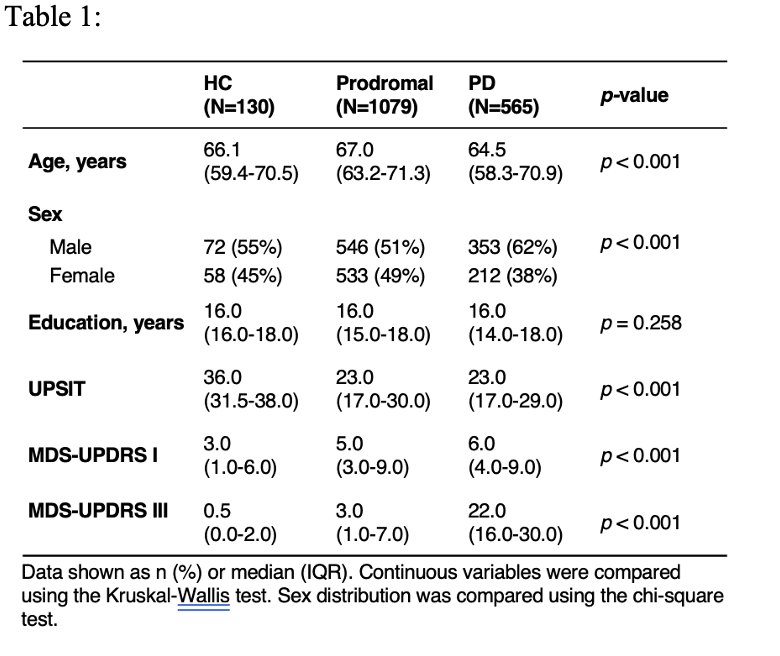
Table 1
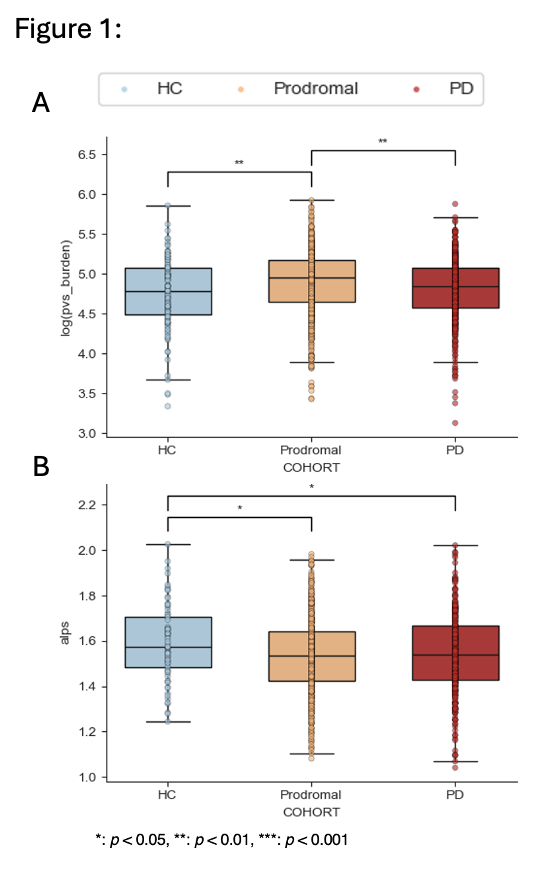
Figure 1
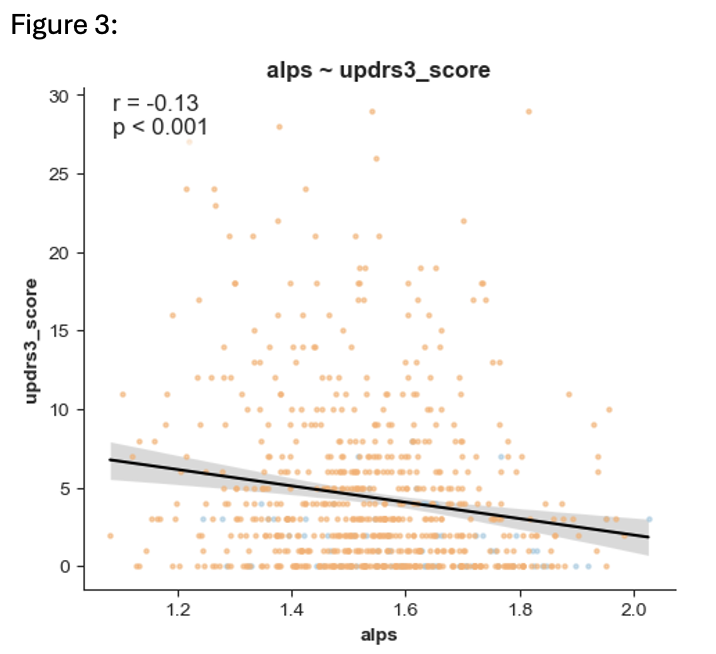
Figure 2
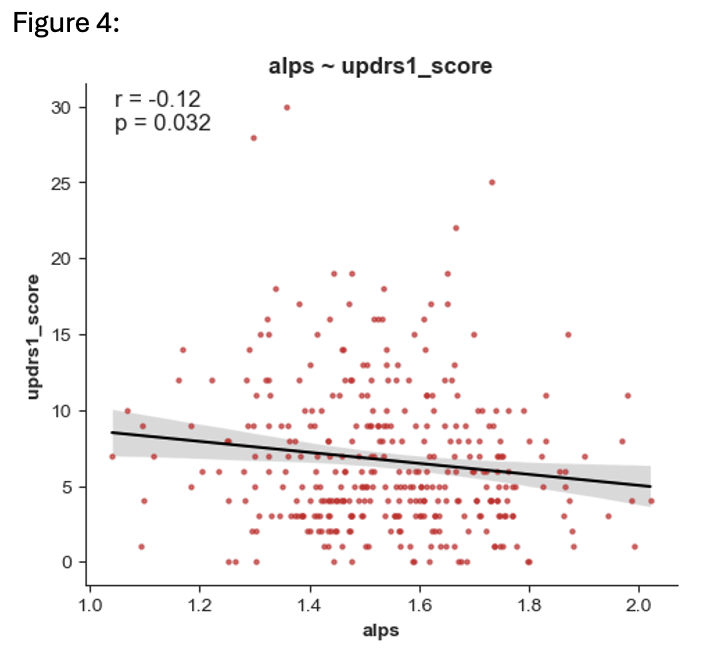
Figure 3
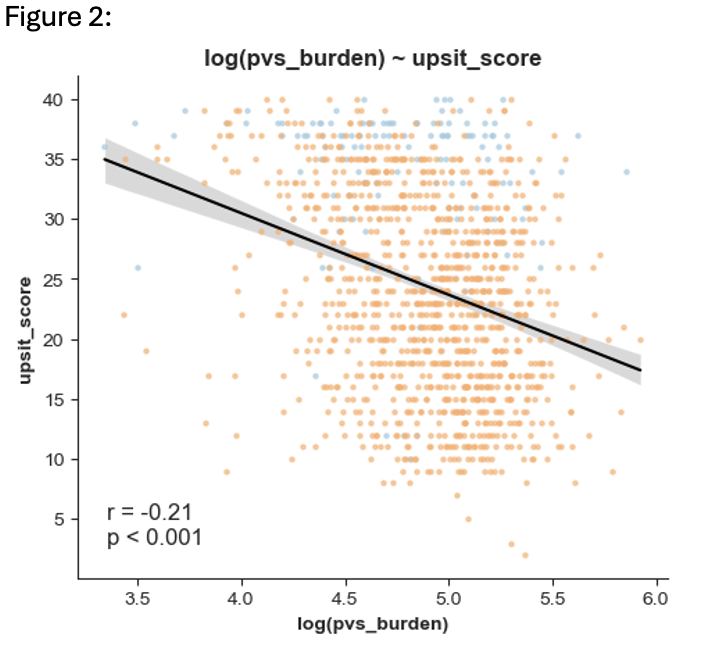
Figure 4
To cite this abstract in AMA style:
J. Choi, M. Kim, A. Kim. Distinct Glymphatic Pathways Underlie Prodromal and Clinical Features of Parkinson’s Disease [abstract]. Mov Disord. 2026; 41 (suppl 1). https://www.mdsabstracts.org/abstract/distinct-glymphatic-pathways-underlie-prodromal-and-clinical-features-of-parkinsons-disease/. Accessed October 1, 2026.« Back to 2026 International Congress
MDS Abstracts - https://www.mdsabstracts.org/abstract/distinct-glymphatic-pathways-underlie-prodromal-and-clinical-features-of-parkinsons-disease/